


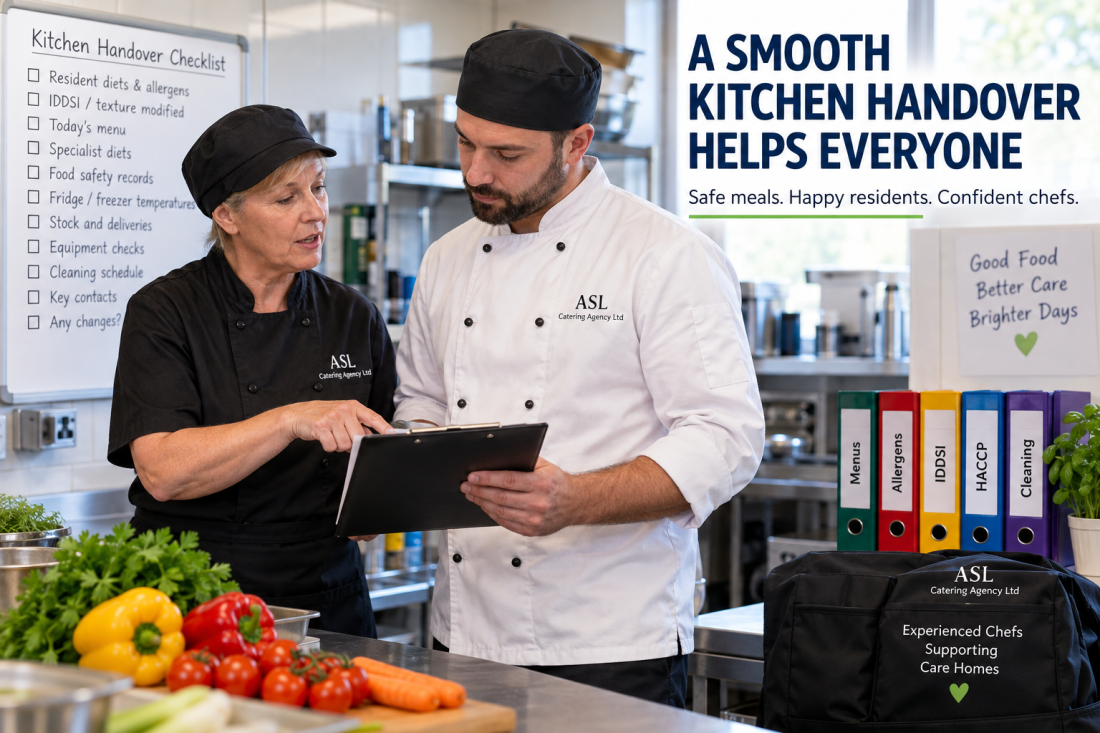
Walking into an unfamiliar care-home kitchen is very different from walking into an unfamiliar restaurant.
A relief chef may need to take responsibility for breakfast, lunch or dinner with relatively little time to become familiar with the kitchen.
But before cooking begins, there are important questions that need answering.
Which residents have food allergies?
Who requires a texture-modified diet?
Are any residents receiving fortified meals?
What is today’s menu?
Where are the food-safety records?
Have there been any changes to residents’ dietary requirements?
Are there deliveries expected?
Is any equipment out of service?
Who should the chef speak to if something is unclear?
A good care home chef handover helps answer these questions before service starts.
For experienced relief chefs, asking the right questions is part of the job. For care-home managers, providing accurate and accessible information helps a temporary chef work safely and effectively from the beginning of the shift.
Why Care Home Kitchen Handovers Matter
Care-home catering involves considerably more than preparing meals to a menu.
The kitchen may be catering simultaneously for residents with:
- Food allergies and intolerances
- Dysphagia
- Texture-modified diets
- Individual nutritional requirements
- Fortified diets
- Cultural or religious requirements
- Vegetarian or other ethical preferences
- Dementia-related eating difficulties
- Reduced appetites
- Individual likes and dislikes
CQC Regulation 14 requires providers to assess people’s nutritional and hydration needs and provide food that meets those needs. Specific diets must be provided in accordance with the person’s assessment, and staff should follow the most up-to-date nutritional and hydration information.
A relief chef therefore needs more than a menu and directions to the fridge.
They need the relevant information required to prepare each resident’s food safely and correctly.
A Handover Is a Two-Way Process
A good handover is not simply somebody giving the chef a folder.
The home needs to communicate relevant information, but an experienced relief chef should also ask questions where anything is unclear.
A sensible approach is:
Information → Confirmation → Questions → Preparation → Service → Feedback
If something does not make sense, it should be clarified before assumptions are made.
This is particularly important with allergies, specialist diets and texture-modified meals.
1. Start With Resident Dietary Requirements
One of the first things a relief chef needs to understand is who they are cooking for.
Relevant dietary information may include:
- Allergies
- Intolerances
- Religious or cultural requirements
- Vegetarian or other ethical diets
- Texture-modified requirements
- Fortification requirements
- Individual nutritional instructions
- Significant preferences or dislikes
- Suitable alternatives
This information needs to be current and communicated through the home’s approved system.
The Food Standards Agency specifically states that care homes should have a process ensuring dietary needs recorded in a resident’s care record are communicated to those serving the food.
That communication chain is critical.
2. Food Allergies Must Be Clear Before Cooking Starts
Allergy information should never depend on somebody remembering to mention it halfway through service.
The relief chef needs to know which residents have allergies and what procedures the home uses to manage them.
The FSA emphasises that institutions such as care homes are responsible for protecting the people in their care and should have processes enabling individuals with allergies or intolerances to receive safe food options. Staff handling food must understand allergen rules and the institution’s allergen-management policy.
A chef may therefore need to establish:
- Which residents have documented allergies?
- What allergens are involved?
- Where is the home’s current allergen information?
- How are allergen-safe meals identified?
- What controls are used to prevent cross-contact?
- Have any ingredients or recipes recently changed?
- How are meals matched to the correct resident?
If the information is unclear, stop and clarify it.
Guessing is not an allergen-control procedure.
3. Check Texture-Modified and IDDSI Requirements
Residents with professionally assessed swallowing difficulties may require food prepared to a specific texture.
A relief chef needs clear information about each relevant resident’s current requirements.
This might include an IDDSI level or another requirement specified within the resident’s care documentation.
The chef should not independently decide that somebody “looks like they need softer food” or alter a professionally assessed texture because another option seems easier.
CQC states that where a person has been assessed as needing a specific diet, it must be provided in accordance with that assessment.
Where IDDSI is used, the chef should understand how to prepare and check the required food texture correctly.
4. Understand Fortification and Nutritional Instructions
Some residents may have individual nutritional plans requiring fortified meals, smaller portions, snacks or other adaptations.
A relief chef should establish which requirements apply to which residents.
For example:
- Does somebody require fortified food?
- Is a particular recipe or fortification method used?
- Does somebody require a smaller portion?
- Are snacks required between meals?
- Are there prescribed nutritional supplements handled by appropriate staff?
The chef should follow the home’s current instructions rather than creating their own nutritional intervention.
CQC requires nutritional needs to be reviewed and changes responded to appropriately. It also states that prescribed nutritional supplements must be provided according to the relevant professional requirements.
5. Review Today’s Menu Before Starting Preparation
Once resident requirements are understood, the chef needs to establish what is actually being served.
Check:
- Breakfast requirements
- Lunch menu
- Evening meal
- Desserts
- Alternatives
- Snacks
- Specialist-diet adaptations
- Expected covers
- Portion requirements
- Any planned events or visitors
It is also useful to ask whether any menu substitutions have already been made.
A delivery shortage may have changed today’s meal before the relief chef arrived.
Any substitution must still work with the home’s allergen controls and residents’ dietary requirements.
6. Know the Alternative Meal Procedure
Even a popular menu will not suit every resident.
A relief chef should understand what alternatives the home normally provides and how they are requested.
That could be particularly important where somebody:
- Dislikes the main option
- Has an allergy
- Has a specialist dietary requirement
- Has a reduced appetite
- Has changed their preference
- Requires an adapted version of the meal
CQC requires people’s preferences and reasonable cultural or religious requirements to be considered, and people should be able to make choices about their diet.
The relief chef should therefore know what meaningful alternatives are available rather than improvising unnecessarily during service.
7. Check the Food-Safety Management System
Before taking responsibility for an unfamiliar kitchen, the chef should know which food-safety management system the home uses and where the relevant records are kept.
For appropriate residential care settings, the Food Standards Agency provides Safer Food, Better Business (SFBB) guidance and a specific residential-care-home supplement. The current residential supplement was published on 25 June 2026.
SFBB covers areas including:
- Cross-contamination
- Cleaning
- Chilling
- Cooking
- Management
- Daily records
The FSA explains that completed diary pages should be retained because a local-authority food-safety officer may want to inspect them.
A relief chef should therefore establish what records they are expected to complete during their shift.
8. Check Refrigeration and Freezer Temperatures
A sensible kitchen takeover includes checking that cold-storage equipment appears to be operating correctly and reviewing the home’s required temperature records.
The chef should know:
- Which fridges and freezers are in use
- Where temperatures are recorded
- Whether previous checks have been completed
- Whether any unit has a known problem
- What the home’s procedure is if a temperature is outside its acceptable range
If a fridge is already malfunctioning when the chef arrives, that is information they need before loading it with food.
9. Understand Cooking, Cooling and Reheating Procedures
Different kitchens may use different equipment and workflows.
A relief chef should familiarise themselves with the home’s procedures for:
- Cooking
- Hot holding
- Cooling
- Reheating
- Chilling
- Food storage
- Labelling
- Date control
- Leftovers
The FSA’s SFBB system is designed to help food businesses document how they prepare and store food safely and demonstrate the hygiene practices they have in place.
A chef should work within the home’s food-safety system rather than importing an entirely different procedure simply because that is what they used elsewhere.
10. Review Cleaning Arrangements
An unfamiliar chef needs to know what cleaning responsibilities apply during their shift.
That may include:
- Work surfaces
- Cooking equipment
- Floors
- Refrigeration
- Food-contact equipment
- Sinks
- Storage areas
- Waste areas
- Specialist equipment
They should also know where cleaning chemicals are stored and the home’s arrangements for safe use.
If there is a cleaning schedule, check what has already been completed and what remains outstanding.
11. Check Equipment Before Service
Nothing disrupts lunch quite like discovering the oven does not work when the roast is due to go in.
A practical handover should identify any:
- Faulty ovens
- Broken mixers
- Refrigeration problems
- Dishwasher issues
- Damaged utensils
- Equipment awaiting repair
- Items that must not be used
Where equipment presents a safety concern, the chef should follow the home’s reporting and escalation procedure.
Never assume that a handwritten “DO NOT USE” sign is optional.
12. Understand Stock and Deliveries
A relief chef should quickly establish:
- What stock is available
- What has already been ordered
- Whether a delivery is expected
- Whether anything is unavailable
- Where specialist-diet ingredients are stored
- How allergen-sensitive ingredients are managed
- Whether any supplier substitutions have occurred
This helps prevent unnecessary emergency purchasing and allows the chef to identify problems before preparation begins.
Stock knowledge is particularly important when today’s planned menu depends on ingredients that have not arrived.
13. Know Who to Speak To
Every relief chef should know their key contact within the home.
Depending on the organisation, this could be:
- Registered manager
- Deputy manager
- Nurse in charge
- Senior carer
- Catering manager
- Head chef
- Facilities manager
The chef should know who can answer questions about resident dietary requirements and who should be contacted if a food-safety or equipment problem arises.
A handover is far more effective when everybody knows who has responsibility for what.
14. Understand Meal Service Arrangements
Preparing the food correctly is only part of the process.
The chef should also understand how meals leave the kitchen and reach residents.
Questions may include:
- What time is service?
- Is food plated in the kitchen or elsewhere?
- How are specialist meals identified?
- How are allergen-safe meals identified?
- How are meals kept at an appropriate temperature?
- How does the kitchen know which resident receives which meal?
- Who communicates last-minute changes?
CQC requires food to be suitable, nutritious and appetising and served at an appropriate temperature.
The handover therefore needs to cover service, not just cooking.
15. Ask About Changes Since the Previous Shift
This is one of the simplest but most valuable questions:
“Has anything changed?”
A resident’s requirements may have changed.
A new resident may have arrived.
Someone may have returned from hospital.
A supplier may have substituted an ingredient.
A piece of equipment may have failed.
A menu may have changed.
A good handover should highlight anything new rather than assuming the relief chef can identify every change from paperwork alone.
Protect Confidential Resident Information
A relief chef may need access to relevant dietary information to do their job safely.
That does not mean they need unrestricted access to every aspect of a resident’s care record.
Information should be handled according to the home’s confidentiality and data-protection procedures.
The principle is straightforward:
Provide the chef with the relevant information they need to prepare food safely, and handle that information appropriately.
Care Home Relief Chef Handover Checklist
This is the section I would make particularly prominent in WordPress because managers could genuinely use it.
Resident Information
☐ Current dietary requirements available
☐ Allergies and intolerances clearly identified
☐ Texture-modified requirements confirmed
☐ IDDSI information available where applicable
☐ Fortification requirements identified
☐ Cultural/religious requirements known
☐ Important preferences and dislikes communicated
Menu & Service
☐ Today’s menu checked
☐ Expected number of meals confirmed
☐ Alternatives understood
☐ Specialist-diet adaptations planned
☐ Meal times confirmed
☐ Service procedure understood
☐ Method for identifying specialist meals confirmed
Food Safety
☐ Food-safety management system located
☐ Required daily records identified
☐ Fridge/freezer checks reviewed
☐ Cooking/hot-holding procedures understood
☐ Cooling/reheating procedures understood
☐ Allergen procedures understood
☐ Cleaning schedule reviewed
Kitchen
☐ Equipment checked
☐ Known faults identified
☐ Stock levels reviewed
☐ Deliveries confirmed
☐ Specialist ingredients located
☐ Waste arrangements understood
Communication
☐ Manager/person in charge identified
☐ Dietary-query contact identified
☐ Equipment/facilities contact identified
☐ Changes since previous shift discussed
☐ End-of-shift handover expectations understood
What Should a Relief Chef Do If the Handover Is Incomplete?
Occasionally a relief chef may arrive and find that information is missing or unclear.
The answer is not to guess.
If the uncertainty concerns something safety-critical—particularly an allergy, specialist diet or texture requirement—the chef should seek clarification from the appropriate person before preparing or serving the affected meal.
An experienced relief chef should be confident enough to say:
“I need this confirmed before I can safely prepare that resident’s meal.”
That is professional practice, not being difficult.
The End-of-Shift Handover Matters Too
Handover works both ways.
Before leaving, the relief chef may need to communicate relevant information to the manager, care team or incoming chef.
Examples could include:
- Low stock
- Missing ingredients
- Supplier issues
- Equipment faults
- Food-safety concerns
- Menu changes
- Relevant resident feedback
- Unusual levels of plate waste
- Records requiring follow-up
The next chef should not have to rediscover problems that were already identified during the previous shift.
Why Experienced Care Home Relief Chefs Matter
A strong relief chef does more than arrive, put on a jacket and start cooking.
They understand that an unfamiliar care-home kitchen requires careful orientation.
They know which questions to ask.
They understand the importance of allergens.
They recognise that IDDSI and texture requirements cannot be guessed.
They appreciate the importance of resident choice and nutritional needs.
And they understand that food-safety records, communication and handover are part of professional care-home catering.
That is why specialist sector experience can be so valuable.
At ASL Catering Agency Ltd, we specialise in supplying experienced chefs to care homes, residential homes and nursing homes requiring temporary, relief and emergency catering support.
This is where I’d place your internal links to Relief Chefs for Care Homes, Emergency Chef Cover and Request a Chef.
Relevant Training for Care Home Chefs
For this article I would keep the FlexiLearnHub training links very focused.
The most relevant subjects are:
- Dysphagia & IDDSI Awareness
- Food Safety & Hygiene Level 2
- HACCP Level 2
- Allergen Awareness
These are directly connected with the areas a relief chef may encounter when taking responsibility for an unfamiliar care-home kitchen.
I wouldn’t add unrelated care courses simply to increase the number of links.
Frequently Asked Questions
What should be included in a care home chef handover?
A practical handover should provide the chef with the information necessary for the shift, including current resident dietary requirements, allergies, texture requirements, menus, specialist meals, food-safety procedures, relevant records, equipment issues, stock and key contacts.
Is a written chef handover legally required?There is not one universal statutory document called a “care home chef handover form”. However, providers have legal and regulatory responsibilities around safe care, nutrition and hydration, and food safety. Systems therefore need to ensure the people preparing and serving food have the relevant current information required to do so safely. CQC requires specific assessed diets to be provided correctly, while FSA guidance specifically requires a process for communicating residents’ dietary needs to those serving their food.
What should a relief chef do if allergy information is unclear?
They should seek clarification through the home’s established procedure before preparing or serving food for the affected resident. Allergy information should never be guessed.
Can a relief chef change a resident’s IDDSI level?
A chef should not independently change a resident’s professionally assessed dietary requirement. The kitchen should follow the resident’s current documented requirements and seek clarification from the appropriate care or healthcare professional where information is unclear.
Should relief chefs complete the home’s food-safety records?
They should follow the food business’s food-safety management system and complete whichever checks and records fall within their responsibilities during the shift. SFBB, where applicable, includes daily records to demonstrate food-safety practices.
Should the outgoing relief chef leave a handover?
Where there is relevant information for the next shift, yes. The home’s own procedures should determine how this is recorded and communicated.
Further Reading – Trusted UK Resources
I would add these at the bottom and set the external links to Open in New Tab:
CQC – Regulation 14: Meeting Nutritional and Hydration Needs
Food Standards Agency – Allergen Guidance for Institutional Caterers
Food Standards Agency – Safer Food, Better Business for Residential Care Homes
The residential-care supplement is especially useful supporting material because the current GOV.UK publication is dated 25 June 2026.
A Good Handover Sets the Chef Up for a Safe Shift
Relief chefs are often brought into care homes because the kitchen needs immediate support.
That urgency should never mean bypassing a proper handover.
Taking a few minutes at the beginning of a shift to confirm residents’ dietary requirements, allergies, specialist diets, menus, food-safety arrangements, equipment and key contacts can prevent confusion later.
The best handovers are clear, current and practical.
And the best relief chefs understand that asking questions before cooking is part of delivering a professional service.
For care homes needing experienced temporary or emergency catering support, this is where I’d finish with your Request a Chef call to action.
For experienced care-home chefs looking for temporary and relief work, we can also link to Join Our Chef Network.
Visit FlexiLearnHub’s CPD & CQC Aligned certificated OnLine training courses
Our growing course library includes:
- Food Safety & Hygiene
- HACCP Level 2
- Allergen Awareness
- Nutrition & Hydration
- Dysphagia & IDDSI Awareness
- Advanced IDDSI Level 4 Professional Purée Presentation
- Infection Prevention & Control
- Dementia Awareness
- Mental Capacity Act & DoLS Awareness (CQC-Aligned)
- End of Life Care Awareness (CQC-Aligned)
- Modern Slavery Awareness (CQC-Aligned)
- Health & Safety Awareness in Care Settings (CQC-Aligned)
- Moving and Handling of People in Care
Thank you for visiting FlexiLearnHub