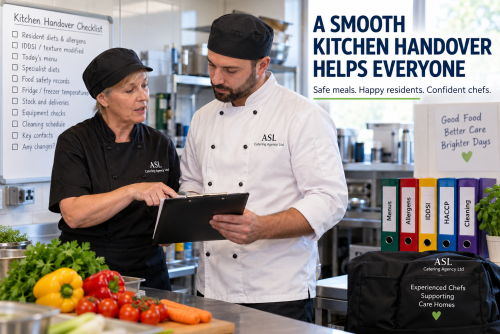
Two care home chefs completing a kitchen handover and reviewing resident diets, allergens, IDDSI requirements and food safety information.

Kitchen Handover in Care Homes: What Every Relief Chef Needs to Know

Walking into an unfamiliar care-home kitchen is very different from walking into an unfamiliar restaurant.

A relief chef may need to take responsibility for breakfast, lunch or dinner with relatively little time to become familiar with the kitchen.

But before cooking begins, there are important questions that need answering.

Which residents have food allergies?

Who requires a texture-modified diet?

Are any residents receiving fortified meals?

What is today’s menu?

Where are the food-safety records?

Have there been any changes to residents’ dietary requirements?

Are there deliveries expected?

Is any equipment out of service?

Who should the chef speak to if something is unclear?

A good care home chef handover helps answer these questions before service starts.

For experienced relief chefs, asking the right questions is part of the job. For care-home managers, providing accurate and accessible information helps a temporary chef work safely and effectively from the beginning of the shift.


Why Care Home Kitchen Handovers Matter

Care-home catering involves considerably more than preparing meals to a menu.

The kitchen may be catering simultaneously for residents with:

  • Food allergies and intolerances
  • Dysphagia
  • Texture-modified diets
  • Individual nutritional requirements
  • Fortified diets
  • Cultural or religious requirements
  • Vegetarian or other ethical preferences
  • Dementia-related eating difficulties
  • Reduced appetites
  • Individual likes and dislikes

CQC Regulation 14 requires providers to assess people’s nutritional and hydration needs and provide food that meets those needs. Specific diets must be provided in accordance with the person’s assessment, and staff should follow the most up-to-date nutritional and hydration information.

A relief chef therefore needs more than a menu and directions to the fridge.

They need the relevant information required to prepare each resident’s food safely and correctly.


A Handover Is a Two-Way Process

A good handover is not simply somebody giving the chef a folder.

The home needs to communicate relevant information, but an experienced relief chef should also ask questions where anything is unclear.

A sensible approach is:

Information → Confirmation → Questions → Preparation → Service → Feedback

If something does not make sense, it should be clarified before assumptions are made.

This is particularly important with allergies, specialist diets and texture-modified meals.


1. Start With Resident Dietary Requirements

One of the first things a relief chef needs to understand is who they are cooking for.

Relevant dietary information may include:

  • Allergies
  • Intolerances
  • Religious or cultural requirements
  • Vegetarian or other ethical diets
  • Texture-modified requirements
  • Fortification requirements
  • Individual nutritional instructions
  • Significant preferences or dislikes
  • Suitable alternatives

This information needs to be current and communicated through the home’s approved system.

The Food Standards Agency specifically states that care homes should have a process ensuring dietary needs recorded in a resident’s care record are communicated to those serving the food.

That communication chain is critical.


2. Food Allergies Must Be Clear Before Cooking Starts

Allergy information should never depend on somebody remembering to mention it halfway through service.

The relief chef needs to know which residents have allergies and what procedures the home uses to manage them.

The FSA emphasises that institutions such as care homes are responsible for protecting the people in their care and should have processes enabling individuals with allergies or intolerances to receive safe food options. Staff handling food must understand allergen rules and the institution’s allergen-management policy.

A chef may therefore need to establish:

  • Which residents have documented allergies?
  • What allergens are involved?
  • Where is the home’s current allergen information?
  • How are allergen-safe meals identified?
  • What controls are used to prevent cross-contact?
  • Have any ingredients or recipes recently changed?
  • How are meals matched to the correct resident?

If the information is unclear, stop and clarify it.

Guessing is not an allergen-control procedure.


3. Check Texture-Modified and IDDSI Requirements

Residents with professionally assessed swallowing difficulties may require food prepared to a specific texture.

A relief chef needs clear information about each relevant resident’s current requirements.

This might include an IDDSI level or another requirement specified within the resident’s care documentation.

The chef should not independently decide that somebody “looks like they need softer food” or alter a professionally assessed texture because another option seems easier.

CQC states that where a person has been assessed as needing a specific diet, it must be provided in accordance with that assessment.

Where IDDSI is used, the chef should understand how to prepare and check the required food texture correctly.


4. Understand Fortification and Nutritional Instructions

Some residents may have individual nutritional plans requiring fortified meals, smaller portions, snacks or other adaptations.

A relief chef should establish which requirements apply to which residents.

For example:

  • Does somebody require fortified food?
  • Is a particular recipe or fortification method used?
  • Does somebody require a smaller portion?
  • Are snacks required between meals?
  • Are there prescribed nutritional supplements handled by appropriate staff?

The chef should follow the home’s current instructions rather than creating their own nutritional intervention.

CQC requires nutritional needs to be reviewed and changes responded to appropriately. It also states that prescribed nutritional supplements must be provided according to the relevant professional requirements.


5. Review Today’s Menu Before Starting Preparation

Once resident requirements are understood, the chef needs to establish what is actually being served.

Check:

  • Breakfast requirements
  • Lunch menu
  • Evening meal
  • Desserts
  • Alternatives
  • Snacks
  • Specialist-diet adaptations
  • Expected covers
  • Portion requirements
  • Any planned events or visitors

It is also useful to ask whether any menu substitutions have already been made.

A delivery shortage may have changed today’s meal before the relief chef arrived.

Any substitution must still work with the home’s allergen controls and residents’ dietary requirements.


6. Know the Alternative Meal Procedure

Even a popular menu will not suit every resident.

A relief chef should understand what alternatives the home normally provides and how they are requested.

That could be particularly important where somebody:

  • Dislikes the main option
  • Has an allergy
  • Has a specialist dietary requirement
  • Has a reduced appetite
  • Has changed their preference
  • Requires an adapted version of the meal

CQC requires people’s preferences and reasonable cultural or religious requirements to be considered, and people should be able to make choices about their diet.

The relief chef should therefore know what meaningful alternatives are available rather than improvising unnecessarily during service.


7. Check the Food-Safety Management System

Before taking responsibility for an unfamiliar kitchen, the chef should know which food-safety management system the home uses and where the relevant records are kept.

For appropriate residential care settings, the Food Standards Agency provides Safer Food, Better Business (SFBB) guidance and a specific residential-care-home supplement. The current residential supplement was published on 25 June 2026.

SFBB covers areas including:

  • Cross-contamination
  • Cleaning
  • Chilling
  • Cooking
  • Management
  • Daily records

The FSA explains that completed diary pages should be retained because a local-authority food-safety officer may want to inspect them.

A relief chef should therefore establish what records they are expected to complete during their shift.


8. Check Refrigeration and Freezer Temperatures

A sensible kitchen takeover includes checking that cold-storage equipment appears to be operating correctly and reviewing the home’s required temperature records.

The chef should know:

  • Which fridges and freezers are in use
  • Where temperatures are recorded
  • Whether previous checks have been completed
  • Whether any unit has a known problem
  • What the home’s procedure is if a temperature is outside its acceptable range

If a fridge is already malfunctioning when the chef arrives, that is information they need before loading it with food.


9. Understand Cooking, Cooling and Reheating Procedures

Different kitchens may use different equipment and workflows.

A relief chef should familiarise themselves with the home’s procedures for:

  • Cooking
  • Hot holding
  • Cooling
  • Reheating
  • Chilling
  • Food storage
  • Labelling
  • Date control
  • Leftovers

The FSA’s SFBB system is designed to help food businesses document how they prepare and store food safely and demonstrate the hygiene practices they have in place.

A chef should work within the home’s food-safety system rather than importing an entirely different procedure simply because that is what they used elsewhere.


10. Review Cleaning Arrangements

An unfamiliar chef needs to know what cleaning responsibilities apply during their shift.

That may include:

  • Work surfaces
  • Cooking equipment
  • Floors
  • Refrigeration
  • Food-contact equipment
  • Sinks
  • Storage areas
  • Waste areas
  • Specialist equipment

They should also know where cleaning chemicals are stored and the home’s arrangements for safe use.

If there is a cleaning schedule, check what has already been completed and what remains outstanding.


11. Check Equipment Before Service

Nothing disrupts lunch quite like discovering the oven does not work when the roast is due to go in.

A practical handover should identify any:

  • Faulty ovens
  • Broken mixers
  • Refrigeration problems
  • Dishwasher issues
  • Damaged utensils
  • Equipment awaiting repair
  • Items that must not be used

Where equipment presents a safety concern, the chef should follow the home’s reporting and escalation procedure.

Never assume that a handwritten “DO NOT USE” sign is optional.


12. Understand Stock and Deliveries

A relief chef should quickly establish:

  • What stock is available
  • What has already been ordered
  • Whether a delivery is expected
  • Whether anything is unavailable
  • Where specialist-diet ingredients are stored
  • How allergen-sensitive ingredients are managed
  • Whether any supplier substitutions have occurred

This helps prevent unnecessary emergency purchasing and allows the chef to identify problems before preparation begins.

Stock knowledge is particularly important when today’s planned menu depends on ingredients that have not arrived.


13. Know Who to Speak To

Every relief chef should know their key contact within the home.

Depending on the organisation, this could be:

  • Registered manager
  • Deputy manager
  • Nurse in charge
  • Senior carer
  • Catering manager
  • Head chef
  • Facilities manager

The chef should know who can answer questions about resident dietary requirements and who should be contacted if a food-safety or equipment problem arises.

A handover is far more effective when everybody knows who has responsibility for what.


14. Understand Meal Service Arrangements

Preparing the food correctly is only part of the process.

The chef should also understand how meals leave the kitchen and reach residents.

Questions may include:

  • What time is service?
  • Is food plated in the kitchen or elsewhere?
  • How are specialist meals identified?
  • How are allergen-safe meals identified?
  • How are meals kept at an appropriate temperature?
  • How does the kitchen know which resident receives which meal?
  • Who communicates last-minute changes?

CQC requires food to be suitable, nutritious and appetising and served at an appropriate temperature.

The handover therefore needs to cover service, not just cooking.


15. Ask About Changes Since the Previous Shift

This is one of the simplest but most valuable questions:

“Has anything changed?”

A resident’s requirements may have changed.

A new resident may have arrived.

Someone may have returned from hospital.

A supplier may have substituted an ingredient.

A piece of equipment may have failed.

A menu may have changed.

A good handover should highlight anything new rather than assuming the relief chef can identify every change from paperwork alone.


Protect Confidential Resident Information

A relief chef may need access to relevant dietary information to do their job safely.

That does not mean they need unrestricted access to every aspect of a resident’s care record.

Information should be handled according to the home’s confidentiality and data-protection procedures.

The principle is straightforward:

Provide the chef with the relevant information they need to prepare food safely, and handle that information appropriately.


Care Home Relief Chef Handover Checklist

This is the section I would make particularly prominent in WordPress because managers could genuinely use it.

Resident Information

☐ Current dietary requirements available

☐ Allergies and intolerances clearly identified

☐ Texture-modified requirements confirmed

☐ IDDSI information available where applicable

☐ Fortification requirements identified

☐ Cultural/religious requirements known

☐ Important preferences and dislikes communicated

Menu & Service

☐ Today’s menu checked

☐ Expected number of meals confirmed

☐ Alternatives understood

☐ Specialist-diet adaptations planned

☐ Meal times confirmed

☐ Service procedure understood

☐ Method for identifying specialist meals confirmed

Food Safety

☐ Food-safety management system located

☐ Required daily records identified

☐ Fridge/freezer checks reviewed

☐ Cooking/hot-holding procedures understood

☐ Cooling/reheating procedures understood

☐ Allergen procedures understood

☐ Cleaning schedule reviewed

Kitchen

☐ Equipment checked

☐ Known faults identified

☐ Stock levels reviewed

☐ Deliveries confirmed

☐ Specialist ingredients located

☐ Waste arrangements understood

Communication

☐ Manager/person in charge identified

☐ Dietary-query contact identified

☐ Equipment/facilities contact identified

☐ Changes since previous shift discussed

☐ End-of-shift handover expectations understood


What Should a Relief Chef Do If the Handover Is Incomplete?

Occasionally a relief chef may arrive and find that information is missing or unclear.

The answer is not to guess.

If the uncertainty concerns something safety-critical—particularly an allergy, specialist diet or texture requirement—the chef should seek clarification from the appropriate person before preparing or serving the affected meal.

An experienced relief chef should be confident enough to say:

“I need this confirmed before I can safely prepare that resident’s meal.”

That is professional practice, not being difficult.


The End-of-Shift Handover Matters Too

Handover works both ways.

Before leaving, the relief chef may need to communicate relevant information to the manager, care team or incoming chef.

Examples could include:

  • Low stock
  • Missing ingredients
  • Supplier issues
  • Equipment faults
  • Food-safety concerns
  • Menu changes
  • Relevant resident feedback
  • Unusual levels of plate waste
  • Records requiring follow-up

The next chef should not have to rediscover problems that were already identified during the previous shift.


Why Experienced Care Home Relief Chefs Matter

A strong relief chef does more than arrive, put on a jacket and start cooking.

They understand that an unfamiliar care-home kitchen requires careful orientation.

They know which questions to ask.

They understand the importance of allergens.

They recognise that IDDSI and texture requirements cannot be guessed.

They appreciate the importance of resident choice and nutritional needs.

And they understand that food-safety records, communication and handover are part of professional care-home catering.

That is why specialist sector experience can be so valuable.

At ASL Catering Agency Ltd, we specialise in supplying experienced chefs to care homes, residential homes and nursing homes requiring temporary, relief and emergency catering support.

This is where I’d place your internal links to Relief Chefs for Care Homes, Emergency Chef Cover and Request a Chef.


Relevant Training for Care Home Chefs

For this article I would keep the FlexiLearnHub training links very focused.

The most relevant subjects are:

  • Dysphagia & IDDSI Awareness
  • Food Safety & Hygiene Level 2
  • HACCP Level 2
  • Allergen Awareness

These are directly connected with the areas a relief chef may encounter when taking responsibility for an unfamiliar care-home kitchen.

I wouldn’t add unrelated care courses simply to increase the number of links.


Frequently Asked Questions

What should be included in a care home chef handover?

A practical handover should provide the chef with the information necessary for the shift, including current resident dietary requirements, allergies, texture requirements, menus, specialist meals, food-safety procedures, relevant records, equipment issues, stock and key contacts.

Is a written chef handover legally required?There is not one universal statutory document called a “care home chef handover form”. However, providers have legal and regulatory responsibilities around safe care, nutrition and hydration, and food safety. Systems therefore need to ensure the people preparing and serving food have the relevant current information required to do so safely. CQC requires specific assessed diets to be provided correctly, while FSA guidance specifically requires a process for communicating residents’ dietary needs to those serving their food.

What should a relief chef do if allergy information is unclear?

They should seek clarification through the home’s established procedure before preparing or serving food for the affected resident. Allergy information should never be guessed.

Can a relief chef change a resident’s IDDSI level?

A chef should not independently change a resident’s professionally assessed dietary requirement. The kitchen should follow the resident’s current documented requirements and seek clarification from the appropriate care or healthcare professional where information is unclear.

Should relief chefs complete the home’s food-safety records?

They should follow the food business’s food-safety management system and complete whichever checks and records fall within their responsibilities during the shift. SFBB, where applicable, includes daily records to demonstrate food-safety practices.

Should the outgoing relief chef leave a handover?

Where there is relevant information for the next shift, yes. The home’s own procedures should determine how this is recorded and communicated.


Further Reading – Trusted UK Resources

I would add these at the bottom and set the external links to Open in New Tab:

CQC – Regulation 14: Meeting Nutritional and Hydration Needs

Food Standards Agency – Allergen Guidance for Institutional Caterers

Food Standards Agency – Safer Food, Better Business for Residential Care Homes

The residential-care supplement is especially useful supporting material because the current GOV.UK publication is dated 25 June 2026.


A Good Handover Sets the Chef Up for a Safe Shift

Relief chefs are often brought into care homes because the kitchen needs immediate support.

That urgency should never mean bypassing a proper handover.

Taking a few minutes at the beginning of a shift to confirm residents’ dietary requirements, allergies, specialist diets, menus, food-safety arrangements, equipment and key contacts can prevent confusion later.

The best handovers are clear, current and practical.

And the best relief chefs understand that asking questions before cooking is part of delivering a professional service.

For care homes needing experienced temporary or emergency catering support, this is where I’d finish with your Request a Chef call to action.

For experienced care-home chefs looking for temporary and relief work, we can also link to Join Our Chef Network.

Visit FlexiLearnHub’s CPD & CQC Aligned certificated OnLine training courses

Our growing course library includes:

Thank you for visiting FlexiLearnHub

Professional care home chef preparing a safe meal in a commercial kitchen with allergen information and a checklist for the 14 regulated food allergens.

Food Allergens in Care Homes: A Practical Guide for Kitchen Teams

Managing food allergens safely is an essential responsibility in every care home kitchen.

Residents may have diagnosed food allergies, intolerances or other dietary requirements that must be understood and communicated accurately between care staff, kitchen teams and management. For some people, exposure to an allergen can cause a serious or potentially life-threatening reaction.

For chefs working within residential and nursing care environments, allergen management therefore involves far more than simply checking a menu.

Ingredients can change. Products may be substituted. Deliveries can arrive from different suppliers. Temporary or relief chefs may join the kitchen. Residents’ dietary requirements may also change.

A robust allergen management system helps ensure everyone involved in preparing and serving food has accurate, current information and understands their responsibilities.

This practical guide examines some of the key areas care home managers, chefs and kitchen teams should consider when managing food allergens safely.


Key Takeaways

✔ Care home kitchens need accurate and up-to-date information about residents’ food allergies and dietary requirements.

✔ UK food law identifies 14 allergens that food businesses must declare when they are used as ingredients in applicable foods.

✔ Ingredient changes and substitutions should never be assumed to be allergen-equivalent.

✔ Effective communication between care teams and catering staff is essential.

✔ Procedures should address cross-contact during storage, preparation, cooking and service.

✔ New, temporary and relief chefs need an effective kitchen and dietary handover.

✔ Regular allergen training helps staff understand the risks and follow procedures consistently.


Why Allergen Management Is Particularly Important in Care Homes

Care home catering involves preparing food for people who may have complex and changing needs.

CQC guidance requires providers to assess people’s nutritional and hydration needs and specifically identifies dietary intolerances and allergies among the matters that should be considered. Where somebody has been assessed as needing a specific diet, it must be provided in accordance with that assessment.

This makes communication between the kitchen and wider care team particularly important.

A chef may prepare hundreds of meals safely, but one incorrect ingredient, uncommunicated menu change or misunderstanding about a resident’s dietary requirements can create significant risk.

Allergen safety therefore needs to form part of the everyday culture of the kitchen rather than being treated as a paperwork exercise.


What Are the 14 Regulated Food Allergens?

UK food businesses are required to provide information when food contains any of the 14 regulated allergens as ingredients.

These are:

  1. Celery
  2. Cereals containing gluten, including wheat, rye, barley and oats
  3. Crustaceans
  4. Eggs
  5. Fish
  6. Lupin
  7. Milk
  8. Molluscs
  9. Mustard
  10. Peanuts
  11. Sesame
  12. Soybeans
  13. Sulphur dioxide and sulphites above the specified concentration
  14. Tree nuts

The Food Standards Agency also makes an important distinction: people can be allergic or intolerant to ingredients outside these 14. The list defines the allergens subject to specific statutory declaration requirements; it does not mean other ingredients cannot cause reactions.

Food Standards Agency – Allergen Guidance for Food Businesses

External link setting: Open in a new tab.


Food Allergy and Food Intolerance Are Not the Same

Kitchen teams should understand that a food allergy and a food intolerance are different.

A food allergy involves the body’s immune system and reactions can sometimes be severe. Food intolerance does not involve the immune system in the same way, although it can still cause significant symptoms and discomfort.

From the kitchen’s perspective, the important point is straightforward:

Never make assumptions about a resident’s dietary requirements.

Follow the resident’s documented care and dietary information and the care home’s agreed procedures.


Maintaining Accurate Resident Allergen Information

Information is only useful when it is accurate and current.

Care homes should have clear procedures for communicating relevant dietary information to catering teams.

Depending on the home’s systems, this may include:

  • Resident dietary records
  • Allergen matrices
  • Kitchen dietary lists
  • Care plans
  • Meal-ordering systems
  • Dietary handover information
  • Updates following clinical assessment

Kitchen staff should know where the definitive information is held and what to do if information appears inconsistent.

If a chef is unsure whether a resident can safely receive a particular meal, the answer should never be guessed.

The issue should be checked with the appropriate member of the care team before the meal is served.


Ingredient Changes Can Create Hidden Risks

One of the easiest mistakes to make in a busy kitchen is assuming that a replacement product contains the same ingredients as the product normally used.

It may not.

A supplier might send a different:

  • Gravy
  • Stock
  • Sauce
  • Bread
  • Dessert
  • Sausage
  • Margarine
  • Seasoning
  • Ready-prepared component

Even products that appear almost identical can have different formulations.

Check Every Substitution

When products change, kitchen teams should check the current label and allergen information rather than relying on memory or previous packaging.

Recipes and allergen records should also be updated where necessary.

This becomes especially important when shortages result in last-minute substitutions.


Preventing Allergen Cross-Contact

Cross-contact occurs when an allergen is unintentionally transferred to food that was not intended to contain it.

This can happen through:

  • Hands
  • Knives
  • Chopping boards
  • Utensils
  • Work surfaces
  • Fryers
  • Grills
  • Containers
  • Cloths
  • Serving equipment
  • Storage practices

Good allergen management therefore requires more than simply removing an allergenic ingredient from a finished dish.

Preparation Procedures

Where required by the care home’s procedures and risk assessment, kitchen teams may need to consider:

  • Thoroughly cleaned preparation areas
  • Clean equipment and utensils
  • Appropriate hand washing
  • Safe ingredient storage
  • Clearly identified containers
  • Suitable preparation sequencing
  • Preventing accidental ingredient substitution
  • Appropriate service procedures

The objective is to minimise the risk of unintended allergen transfer throughout the food-production process.


Communication Between Care Staff and the Kitchen

Some of the strongest allergen controls happen before cooking begins.

Care staff often know residents closely and may become aware of changes to dietary requirements before kitchen teams do.

There should therefore be a reliable method for communicating relevant changes.

For example:

Resident dietary requirement changes → care team records information → kitchen is informed → catering records/menu information updated → staff preparing and serving food are made aware.

The precise system will differ between providers, but everyone should understand who is responsible for communicating changes and how those changes are recorded.

This is particularly important at weekends, during shift changes and when temporary staff are working.


Serving the Correct Meal to the Correct Resident

Preparing an allergen-safe meal correctly is only part of the process.

It must also reach the correct resident.

Care homes should have suitable procedures for identifying specialist meals during service.

Depending on the setting, this could involve:

  • Clearly identified plates or trays
  • Documented meal lists
  • Appropriate labelling
  • Communication with care staff
  • Final checking before service

Care and catering teams should avoid informal systems that depend entirely on somebody remembering who receives which meal.

A reliable process reduces the risk of human error.


What About Natasha’s Law?

You may hear the term Natasha’s Law when discussing food allergens.

The rules introduced in October 2021 concern prepacked for direct sale (PPDS) food. Where PPDS requirements apply, the food must carry the name of the food and a full ingredients list, with relevant allergens emphasised within that list.

Whether a particular item prepared within a care setting falls within PPDS requirements depends on how it is produced, packaged and supplied, so providers should use the Food Standards Agency’s current guidance rather than assuming the rules do or do not apply.

GOV.UK – Introduction to PPDS Allergen Labelling (Natasha’s Law)

External link setting: Open in a new tab.


Relief and Agency Chefs Need a Proper Handover

This is an area particularly relevant to ASL Catering Agency.

When a relief chef enters an unfamiliar care home kitchen, they may be professionally experienced but they cannot automatically know the individual dietary requirements of that home’s residents.

A proper catering handover should therefore include information such as:

  • Current menus
  • Residents’ dietary requirements
  • Known allergies and intolerances
  • Texture-modified diets
  • IDDSI requirements
  • Fortified diets
  • Kitchen procedures
  • Allergen records
  • Relevant food safety documentation
  • Who to speak to if clarification is required

This is one reason why previous care-sector experience is so valuable when recruiting relief chefs.

Experienced care home chefs understand that specialist diets and allergen controls are fundamental parts of the role.

For information about specialist chef support:

ASL Catering Agency – Care Home Chef Recruitment

ASL Catering Agency – Request a Chef


Staff Training and Allergen Awareness

Procedures work best when staff understand why they exist.

Allergen awareness training can help catering teams understand:

  • The 14 regulated allergens
  • Food labelling
  • Ingredient checking
  • Cross-contact
  • Safe food preparation
  • Communication
  • The importance of following established procedures

The Food Standards Agency states that food businesses must make sure staff receive training on allergens.

For care-home catering teams looking to strengthen their knowledge, FlexiLearnHub provides online training relevant to professional care catering.

Recommended Training

Allergen Awareness Training – FlexiLearnHub

Food Safety & Hygiene Level 2 – FlexiLearnHub

HACCP Level 2 – FlexiLearnHub

I’ve deliberately limited this to the three courses directly relevant to this article rather than inserting the entire FlexiLearnHub catalogue.


A Practical Allergen Checklist for Care Home Kitchens

Care home managers and catering teams can regularly ask:

Resident information

☐ Are residents’ allergy and intolerance records current?

☐ Are changes communicated promptly to the kitchen?

☐ Do kitchen staff know where authoritative dietary information is held?

Ingredients

☐ Are product labels checked?

☐ Are replacement products checked before use?

☐ Are recipe or allergen records updated following ingredient changes?

Kitchen controls

☐ Are appropriate procedures in place to minimise cross-contact?

☐ Are storage arrangements suitable?

☐ Are equipment and preparation areas managed appropriately?

☐ Do staff know what to do when they are uncertain?

Meal service

☐ Are specialist meals clearly identifiable?

☐ Is there a reliable system for getting the correct meal to the correct resident?

☐ Do care and catering teams communicate effectively?

Staff

☐ Have relevant staff received allergen awareness training?

☐ Are new and temporary staff given an appropriate dietary and kitchen handover?

☐ Is refresher training provided where appropriate?


Frequently Asked Questions

How many allergens must UK food businesses declare?

UK food law identifies 14 allergens that must be declared when they are used as ingredients in applicable foods. However, people can have allergies or intolerances to foods outside the statutory 14.

Should care home chefs check product labels every time?

Ingredient formulations and replacement products can change. Kitchen procedures should ensure current ingredient and allergen information is checked appropriately rather than relying solely on memory or assumptions.

Are food allergies and intolerances the same?

No. Food allergy involves an immune response, whereas food intolerance is different and generally does not involve the immune system in the same way. Both may nevertheless be important parts of an individual’s assessed dietary requirements.

Do relief chefs need allergen information?

Yes. Any chef preparing food needs access to the relevant dietary and allergen information required to prepare meals safely. Relief chefs should receive an appropriate handover before taking responsibility for the kitchen.

Does Natasha’s Law apply to care homes?

Natasha’s Law concerns food classed as prepacked for direct sale. Whether particular food prepared or supplied by a care home falls within those requirements depends on the circumstances. Providers should consult current FSA guidance for their specific operation.


Further Reading – Official Guidance

For further information, care providers and catering teams can consult:

Food Standards Agency – Allergen Guidance for Food Businesses

Care Quality Commission – Regulation 14: Meeting Nutritional and Hydration Needs

GOV.UK – Food Allergies and Allergen Information

NHS – Food Allergy Guidance

Set all external links above to open in a new tab.


Visit FlexiLearnHub’s CPD & CQC Aligned certificated OnLine training courses

Our growing course library includes:

Thank you for visiting FlexiLearnHub

Supporting High Standards in Care Home Catering

Safe allergen management depends on good systems, effective communication, knowledgeable staff and consistent kitchen practices.

Care home chefs play a significant role in that process.

From checking ingredients and preventing cross-contact to understanding individual dietary requirements and communicating with care teams, attention to detail can make a major difference to resident safety.

At ASL Catering Agency Ltd, we specialise in supporting care homes, nursing homes and residential care providers with experienced catering professionals who understand the specialist demands of care-sector kitchens.

Whether you require temporary cover, relief support or help recruiting an experienced care home chef:

Request a Chef – ASL Catering Agency

For experienced chefs interested in working with ASL:

Join Our Chef Network

Experienced care home chefs preparing nutritious meals in a professional care home kitchen, demonstrating the skills, teamwork and high standards needed to support resident wellbeing.

What Makes an Outstanding Care Home Chef? Skills, Qualities and Experience Explained

When people think about chefs, they often imagine busy restaurant kitchens, fine dining or hotel catering. However, working as a chef in a care home requires a very different combination of skills, knowledge and personal qualities.

An outstanding care home chef does far more than prepare breakfast, lunch and dinner. They play a vital role in supporting residents’ health, wellbeing and quality of life by providing safe, nutritious and enjoyable meals every day. Their work contributes directly to dignity, independence and person-centred care.

For care home managers, recruiting the right chef is one of the most important staffing decisions they can make. For chefs considering a career in the care sector, understanding what employers expect can help them develop the skills needed to succeed.

In this guide, we’ll explore the qualities, experience and professional standards that define an outstanding care home chef and explain why specialist recruitment makes all the difference.


Key Takeaways

✔ Outstanding care home chefs combine culinary expertise with compassion and professionalism.

✔ Food safety, nutrition and allergen management are essential everyday responsibilities.

✔ Strong communication and teamwork help ensure residents receive person-centred care.

✔ Continuous professional training supports compliance with CQC expectations and evolving best practice.

✔ Recruiting experienced chefs helps care homes maintain consistent catering standards and resident wellbeing.


Why Care Home Catering Is Different

Preparing meals in a care home is unlike working in most other catering environments. Every meal served has the potential to influence a resident’s health, comfort and overall wellbeing.

Residents may require:

  • Nutritionally balanced meals.
  • Texture-modified diets.
  • Fortified meals.
  • Food allergy management.
  • Diabetic or therapeutic diets.
  • Cultural and religious dietary preferences.
  • Individually tailored meal plans.

Care home chefs must also work closely with carers, nurses and managers to ensure meals meet each resident’s assessed needs while remaining enjoyable and appealing.

Unlike many commercial kitchens, success is measured not only by the quality of the food but also by the positive impact it has on residents’ daily lives.


The Essential Skills Every Outstanding Care Home Chef Needs

Technical cooking ability is only one part of the role. Exceptional care home chefs combine catering expertise with specialist knowledge developed through experience and ongoing training.


Food Safety and Hygiene

Food safety is the foundation of every professional kitchen.

Outstanding chefs understand:

  • Safe food storage.
  • Temperature control.
  • Cross-contamination prevention.
  • Personal hygiene.
  • Cleaning schedules.
  • Safe food handling procedures.

Maintaining these standards helps protect vulnerable residents and demonstrates compliance with food safety legislation and Care Quality Commission (CQC) expectations.


Nutrition and Hydration

Good nutrition plays an essential role in supporting older adults.

Experienced care home chefs understand how meals contribute to:

  • Maintaining healthy body weight.
  • Supporting recovery from illness.
  • Promoting hydration.
  • Improving energy levels.
  • Encouraging independence.
  • Enhancing quality of life.

They also recognise that mealtimes provide important social opportunities that contribute to residents’ emotional wellbeing.


Allergen Awareness

Food allergies and intolerances must always be taken seriously.

Outstanding chefs follow strict allergen procedures by:

  • Preventing cross-contamination.
  • Maintaining accurate allergen information.
  • Clearly identifying ingredients.
  • Communicating effectively with care staff.
  • Following documented kitchen procedures.

Attention to detail protects residents and helps maintain confidence in the catering service.


Dysphagia and IDDSI Knowledge

Many residents require texture-modified meals due to swallowing difficulties.

Experienced chefs understand:

  • The IDDSI Framework.
  • Safe texture preparation.
  • Food presentation.
  • Consistency testing.
  • Portion control.
  • Maintaining nutritional value while adapting meals.

Preparing modified texture meals correctly helps protect residents from avoidable risks while preserving dignity and enjoyment at mealtimes.

Visit FlexiLearnHub’s CPD & CQC Aligned certificated OnLine training courses

Our growing course library includes:

Thank you for visiting FlexiLearnHub

Professional care home chefs preparing nutritious meals in a clean commercial kitchen before a Care Quality Commission (CQC) inspection.

Preparing Your Care Home Kitchen for a CQC Inspection: A Practical Checklist

Every care home strives to provide residents with safe, nutritious and enjoyable meals, but maintaining high catering standards involves far more than simply serving good food. During a Care Quality Commission (CQC) inspection, the kitchen plays an important role in demonstrating that residents are receiving safe, effective and person-centred care.

Inspectors don’t just look at cleanliness. They assess how food is stored, prepared and served, whether staff understand food safety procedures, how allergens are managed, and whether the kitchen supports residents’ nutritional needs. They may also review documentation, training records and the overall organisation of the catering operation.

Whether your inspection is due next week or next year, being inspection-ready every day is the best approach. This practical checklist will help you prepare your care home kitchen while maintaining the high standards expected by residents, families and regulators.


Key Takeaways

✔ Maintain excellent kitchen hygiene every day—not just before inspections.

✔ Keep food safety, HACCP and temperature records accurate and up to date.

✔ Ensure all kitchen staff receive regular food safety and compliance training.

✔ Monitor nutrition, hydration and specialist dietary requirements carefully.

✔ Have experienced chefs available to maintain catering standards during sickness or staff shortages.

✔ Review your kitchen regularly using your own internal inspection checklist.


Why Kitchen Standards Matter During a CQC Inspection

A well-managed kitchen demonstrates much more than good catering. It reflects the overall quality, organisation and culture of a care home.

Inspectors recognise that nutrition, hydration and safe food preparation contribute directly to resident wellbeing. Poor kitchen management can increase risks relating to foodborne illness, malnutrition, dehydration and allergen exposure, all of which can affect the quality of care delivered.

Strong catering standards also demonstrate effective leadership, good governance and a commitment to continuous improvement.

If your care home requires experienced catering professionals to maintain these standards, ASL Catering Agency provides experienced relief and permanent chefs for care homes across the UK.

Internal Link

Care Home Chef Recruitment

https://www.aslcateringagency.co.uk/care-home-residential-nursing-home-chef-recruitment-agency-uk/


Kitchen Hygiene and Cleaning Standards

Kitchen cleanliness is one of the first things inspectors notice. A clean, organised kitchen immediately creates confidence that food safety procedures are being followed consistently.

Rather than carrying out a last-minute deep clean before an inspection, aim to maintain high standards every day. Daily routines are far easier to demonstrate than temporary improvements.


Daily Cleaning Schedules

Every care home kitchen should operate with documented cleaning schedules covering:

  • Food preparation surfaces
  • Cooking equipment
  • Refrigerators and freezers
  • Storage areas
  • Floors and walls
  • Hand washing facilities
  • Waste disposal areas

Cleaning records should be completed consistently and signed where appropriate.


Deep Cleaning Programme

Regular deep cleaning helps prevent the build-up of grease, bacteria and contamination in areas that are not cleaned during daily routines.

Your deep cleaning schedule should include:

  • Extraction canopies
  • Ventilation systems
  • Ovens
  • Refrigeration units
  • Shelving
  • Dry stores
  • Walk-in fridges
  • Freezers

Maintaining records of completed deep cleans provides useful evidence during inspections.


Equipment Maintenance

Kitchen equipment should always be clean, safe and fully operational.

Regularly inspect:

  • Temperature probes
  • Refrigerators
  • Freezers
  • Ovens
  • Dishwashers
  • Food processors
  • Slicers
  • Trolleys

Faulty equipment should be reported immediately and repaired without delay.


Food Safety Documentation

Good documentation demonstrates that your kitchen operates consistently rather than relying on memory.

Inspectors often ask to see written evidence that procedures are being followed correctly.

Important records include:

  • HACCP monitoring
  • Fridge and freezer temperatures
  • Hot holding temperatures
  • Cooling records
  • Cleaning schedules
  • Pest control reports
  • Delivery temperature checks
  • Food traceability information
  • Allergen information
  • Staff training records

Keeping documentation accurate and up to date helps demonstrate effective management and provides confidence that food safety systems are working as intended.

Professional food safety training helps kitchen teams understand not only what records need to be completed, but why they are essential for protecting residents.

Visit FlexiLearnHub’s CPD & CQC Aligned certificated OnLine training courses

Our growing course library includes:

Thank you for visiting FlexiLearnHub

Experienced relief care home chef helping maintain food safety and resident wellbeing during chef shortages.

The Hidden Cost of Being Short of a Care Home Chef

When a care home is unexpectedly left without a chef, the immediate concern is often simply finding someone to cover the shift. However, the true cost of being short of an experienced care home chef extends far beyond filling a rota.

From resident wellbeing and food quality to staff morale and CQC compliance, the impact of a kitchen vacancy can quickly affect the entire home.

At ASL Catering Agency, we understand how important it is to provide experienced relief chefs who can step into a busy kitchen with confidence and maintain the high standards your residents deserve.

Nutrition Isn’t Just About Food

For many elderly residents, mealtimes are the highlight of the day.

A well-prepared meal provides far more than nutrition. It supports dignity, independence, comfort and overall wellbeing.

When an experienced chef is unavailable, care homes may face challenges such as:

  • Reduced menu choices
  • Delays in meal service
  • Increased pressure on kitchen teams
  • Greater reliance on convenience foods
  • Difficulty meeting specialist dietary requirements

Maintaining consistency is essential, particularly for residents who depend on modified texture diets, fortified meals or carefully managed allergen controls.

Increased Pressure on Existing Staff

Chef shortages rarely affect only the kitchen.

Existing chefs often work additional hours, increasing fatigue and the risk of mistakes. Catering assistants may find themselves undertaking duties outside their normal responsibilities, while care staff can experience increased pressure if meal services are delayed.

Over time this can affect:

  • Staff wellbeing
  • Team morale
  • Productivity
  • Retention of experienced employees

Providing temporary professional cover helps reduce this pressure and allows permanent staff to continue working safely and effectively.

Protecting Food Safety Standards

Experienced care home chefs understand that every meal served must meet strict food safety requirements.

During periods of staff shortages there is an increased risk of:

  • HACCP procedures being overlooked
  • Allergen controls being compromised
  • Poor stock rotation
  • Inconsistent food temperatures
  • Incomplete kitchen records

Professional relief chefs are familiar with working in different environments and understand the importance of maintaining food safety systems from the moment they arrive.

Supporting CQC Expectations

The Care Quality Commission expects providers to ensure residents receive safe, nutritious and appropriate food.

Kitchen staffing shortages should never result in reduced standards of care.

Having access to experienced temporary chefs helps homes continue providing:

  • Safe meal preparation
  • Nutritionally balanced menus
  • Consistent meal service
  • Good kitchen hygiene
  • Professional catering standards

Why Experience Matters

Care home catering is very different from restaurant catering.

Experienced care home chefs understand:

  • Nutritional needs of older adults
  • Texture modified meals
  • Allergen management
  • Food fortification
  • Therapeutic diets
  • Working alongside care teams
  • Maintaining detailed kitchen documentation

This specialist knowledge allows them to become productive quickly with minimal disruption.

The Value of a Specialist Recruitment Agency

Recruiting temporary catering staff through a specialist agency provides confidence that candidates have experience working in professional catering environments.

At ASL Catering Agency, we understand the demands placed on care home kitchens and work hard to provide dependable chefs who can integrate quickly into your team and maintain the standards your residents expect.

Whether you require emergency same-day cover, planned holiday relief or longer-term temporary support, our aim is to help keep your kitchen operating smoothly.

Need an Experienced Relief Chef?

If your care home requires experienced temporary catering staff, ASL Catering Agency is here to help.

We supply professional relief chefs who understand the importance of food safety, nutrition and delivering high-quality meals within care environments.

Contact our team today to discuss your staffing requirements and let us help keep your kitchen running smoothly.

Need Training?

view our CPD and CQC Aligned certificated OnLine training courses at FlexiLearnHub

Care home chef preparing nutritious meals to support nutrition and hydration for older residents

Why Good Nutrition and Hydration Start in the Care Home Kitchen

Providing nutritious meals and encouraging good hydration are essential parts of delivering outstanding care. While carers play an important role in supporting residents during mealtimes, it all begins much earlier—in the care home kitchen.

Experienced care home chefs understand that every meal they prepare has the potential to support health, wellbeing and quality of life. From menu planning to food presentation, the kitchen team plays a vital role in creating positive dining experiences for residents.

The Care Home Kitchen Is About More Than Cooking

Today’s care home chefs do much more than prepare breakfast, lunch and dinner.

They are responsible for creating meals that are nutritious, enjoyable and appropriate for a wide range of dietary needs.

This may include:

  • Modified texture meals where required.
  • Special dietary requirements.
  • Food allergies and intolerances.
  • Cultural and religious preferences.
  • Hydration support through suitable drinks and desserts.

An experienced chef understands that every resident has individual needs and deserves meals that are both safe and enjoyable.

Nutrition Supports Wellbeing

Good nutrition contributes to many aspects of health and wellbeing.

Balanced meals can help support:

  • Energy levels.
  • Overall health.
  • Muscle strength.
  • Recovery following illness.
  • Enjoyment of food and mealtimes.

Working alongside care staff and managers, catering teams help ensure residents receive meals that meet both nutritional needs and personal preferences.

Hydration Is Everyone’s Responsibility

The kitchen also plays an important role in promoting hydration.

Providing a variety of appealing drinks, soups, fruit-based desserts and other suitable refreshments helps encourage regular fluid intake throughout the day.

Good communication between catering teams and care staff helps ensure residents receive the support they need in accordance with their individual care plans.

Recruiting the Right Care Home Chef Matters

Providing excellent catering within a care home requires more than strong cooking skills.

The best care home chefs understand:

  • Food safety.
  • Allergen awareness.
  • Nutrition and hydration.
  • Special diets.
  • Texture-modified meals where appropriate.
  • Working closely with care teams.
  • Delivering meals with dignity and respect.

These are specialist skills developed through experience and professional training.

Supporting Care Homes Across the UK

At ASL Catering Agency, we understand the importance of placing experienced chefs into care home environments.

Whether you require emergency chef cover, temporary support or permanent recruitment, we help care providers find catering professionals who understand the unique demands of residential and nursing care.

Reliable catering teams help create positive mealtime experiences that support both residents and the wider care team.

Investing in Training

Alongside recruiting experienced chefs, ongoing professional development is equally important.

Training in areas such as:

helps catering professionals maintain high standards and continue developing their knowledge.

You can also visit our:

Knowledge Hub – Free Professional Resources for Care, Catering & Hospitality

Conclusion

Great care starts with great teamwork.

Care staff, managers and catering professionals all contribute to creating safe, enjoyable and person-centred mealtime experiences.

By investing in experienced chefs and ongoing training, care homes can continue delivering the high standards that residents deserve.

Looking for experienced care home chefs?

ASL Catering Agency supplies professional chefs for residential care homes, nursing homes and specialist care settings throughout the UK.

We also support ongoing professional development through our sister company, FlexiLearnHub, offering CPD-accredited online training for the care, catering and hospitality sectors.