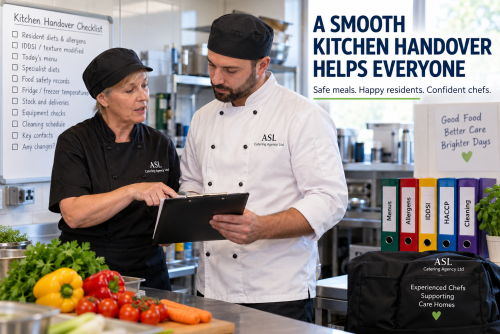
Two care home chefs completing a kitchen handover and reviewing resident diets, allergens, IDDSI requirements and food safety information.

Kitchen Handover in Care Homes: What Every Relief Chef Needs to Know

Walking into an unfamiliar care-home kitchen is very different from walking into an unfamiliar restaurant.

A relief chef may need to take responsibility for breakfast, lunch or dinner with relatively little time to become familiar with the kitchen.

But before cooking begins, there are important questions that need answering.

Which residents have food allergies?

Who requires a texture-modified diet?

Are any residents receiving fortified meals?

What is today’s menu?

Where are the food-safety records?

Have there been any changes to residents’ dietary requirements?

Are there deliveries expected?

Is any equipment out of service?

Who should the chef speak to if something is unclear?

A good care home chef handover helps answer these questions before service starts.

For experienced relief chefs, asking the right questions is part of the job. For care-home managers, providing accurate and accessible information helps a temporary chef work safely and effectively from the beginning of the shift.


Why Care Home Kitchen Handovers Matter

Care-home catering involves considerably more than preparing meals to a menu.

The kitchen may be catering simultaneously for residents with:

  • Food allergies and intolerances
  • Dysphagia
  • Texture-modified diets
  • Individual nutritional requirements
  • Fortified diets
  • Cultural or religious requirements
  • Vegetarian or other ethical preferences
  • Dementia-related eating difficulties
  • Reduced appetites
  • Individual likes and dislikes

CQC Regulation 14 requires providers to assess people’s nutritional and hydration needs and provide food that meets those needs. Specific diets must be provided in accordance with the person’s assessment, and staff should follow the most up-to-date nutritional and hydration information.

A relief chef therefore needs more than a menu and directions to the fridge.

They need the relevant information required to prepare each resident’s food safely and correctly.


A Handover Is a Two-Way Process

A good handover is not simply somebody giving the chef a folder.

The home needs to communicate relevant information, but an experienced relief chef should also ask questions where anything is unclear.

A sensible approach is:

Information → Confirmation → Questions → Preparation → Service → Feedback

If something does not make sense, it should be clarified before assumptions are made.

This is particularly important with allergies, specialist diets and texture-modified meals.


1. Start With Resident Dietary Requirements

One of the first things a relief chef needs to understand is who they are cooking for.

Relevant dietary information may include:

  • Allergies
  • Intolerances
  • Religious or cultural requirements
  • Vegetarian or other ethical diets
  • Texture-modified requirements
  • Fortification requirements
  • Individual nutritional instructions
  • Significant preferences or dislikes
  • Suitable alternatives

This information needs to be current and communicated through the home’s approved system.

The Food Standards Agency specifically states that care homes should have a process ensuring dietary needs recorded in a resident’s care record are communicated to those serving the food.

That communication chain is critical.


2. Food Allergies Must Be Clear Before Cooking Starts

Allergy information should never depend on somebody remembering to mention it halfway through service.

The relief chef needs to know which residents have allergies and what procedures the home uses to manage them.

The FSA emphasises that institutions such as care homes are responsible for protecting the people in their care and should have processes enabling individuals with allergies or intolerances to receive safe food options. Staff handling food must understand allergen rules and the institution’s allergen-management policy.

A chef may therefore need to establish:

  • Which residents have documented allergies?
  • What allergens are involved?
  • Where is the home’s current allergen information?
  • How are allergen-safe meals identified?
  • What controls are used to prevent cross-contact?
  • Have any ingredients or recipes recently changed?
  • How are meals matched to the correct resident?

If the information is unclear, stop and clarify it.

Guessing is not an allergen-control procedure.


3. Check Texture-Modified and IDDSI Requirements

Residents with professionally assessed swallowing difficulties may require food prepared to a specific texture.

A relief chef needs clear information about each relevant resident’s current requirements.

This might include an IDDSI level or another requirement specified within the resident’s care documentation.

The chef should not independently decide that somebody “looks like they need softer food” or alter a professionally assessed texture because another option seems easier.

CQC states that where a person has been assessed as needing a specific diet, it must be provided in accordance with that assessment.

Where IDDSI is used, the chef should understand how to prepare and check the required food texture correctly.


4. Understand Fortification and Nutritional Instructions

Some residents may have individual nutritional plans requiring fortified meals, smaller portions, snacks or other adaptations.

A relief chef should establish which requirements apply to which residents.

For example:

  • Does somebody require fortified food?
  • Is a particular recipe or fortification method used?
  • Does somebody require a smaller portion?
  • Are snacks required between meals?
  • Are there prescribed nutritional supplements handled by appropriate staff?

The chef should follow the home’s current instructions rather than creating their own nutritional intervention.

CQC requires nutritional needs to be reviewed and changes responded to appropriately. It also states that prescribed nutritional supplements must be provided according to the relevant professional requirements.


5. Review Today’s Menu Before Starting Preparation

Once resident requirements are understood, the chef needs to establish what is actually being served.

Check:

  • Breakfast requirements
  • Lunch menu
  • Evening meal
  • Desserts
  • Alternatives
  • Snacks
  • Specialist-diet adaptations
  • Expected covers
  • Portion requirements
  • Any planned events or visitors

It is also useful to ask whether any menu substitutions have already been made.

A delivery shortage may have changed today’s meal before the relief chef arrived.

Any substitution must still work with the home’s allergen controls and residents’ dietary requirements.


6. Know the Alternative Meal Procedure

Even a popular menu will not suit every resident.

A relief chef should understand what alternatives the home normally provides and how they are requested.

That could be particularly important where somebody:

  • Dislikes the main option
  • Has an allergy
  • Has a specialist dietary requirement
  • Has a reduced appetite
  • Has changed their preference
  • Requires an adapted version of the meal

CQC requires people’s preferences and reasonable cultural or religious requirements to be considered, and people should be able to make choices about their diet.

The relief chef should therefore know what meaningful alternatives are available rather than improvising unnecessarily during service.


7. Check the Food-Safety Management System

Before taking responsibility for an unfamiliar kitchen, the chef should know which food-safety management system the home uses and where the relevant records are kept.

For appropriate residential care settings, the Food Standards Agency provides Safer Food, Better Business (SFBB) guidance and a specific residential-care-home supplement. The current residential supplement was published on 25 June 2026.

SFBB covers areas including:

  • Cross-contamination
  • Cleaning
  • Chilling
  • Cooking
  • Management
  • Daily records

The FSA explains that completed diary pages should be retained because a local-authority food-safety officer may want to inspect them.

A relief chef should therefore establish what records they are expected to complete during their shift.


8. Check Refrigeration and Freezer Temperatures

A sensible kitchen takeover includes checking that cold-storage equipment appears to be operating correctly and reviewing the home’s required temperature records.

The chef should know:

  • Which fridges and freezers are in use
  • Where temperatures are recorded
  • Whether previous checks have been completed
  • Whether any unit has a known problem
  • What the home’s procedure is if a temperature is outside its acceptable range

If a fridge is already malfunctioning when the chef arrives, that is information they need before loading it with food.


9. Understand Cooking, Cooling and Reheating Procedures

Different kitchens may use different equipment and workflows.

A relief chef should familiarise themselves with the home’s procedures for:

  • Cooking
  • Hot holding
  • Cooling
  • Reheating
  • Chilling
  • Food storage
  • Labelling
  • Date control
  • Leftovers

The FSA’s SFBB system is designed to help food businesses document how they prepare and store food safely and demonstrate the hygiene practices they have in place.

A chef should work within the home’s food-safety system rather than importing an entirely different procedure simply because that is what they used elsewhere.


10. Review Cleaning Arrangements

An unfamiliar chef needs to know what cleaning responsibilities apply during their shift.

That may include:

  • Work surfaces
  • Cooking equipment
  • Floors
  • Refrigeration
  • Food-contact equipment
  • Sinks
  • Storage areas
  • Waste areas
  • Specialist equipment

They should also know where cleaning chemicals are stored and the home’s arrangements for safe use.

If there is a cleaning schedule, check what has already been completed and what remains outstanding.


11. Check Equipment Before Service

Nothing disrupts lunch quite like discovering the oven does not work when the roast is due to go in.

A practical handover should identify any:

  • Faulty ovens
  • Broken mixers
  • Refrigeration problems
  • Dishwasher issues
  • Damaged utensils
  • Equipment awaiting repair
  • Items that must not be used

Where equipment presents a safety concern, the chef should follow the home’s reporting and escalation procedure.

Never assume that a handwritten “DO NOT USE” sign is optional.


12. Understand Stock and Deliveries

A relief chef should quickly establish:

  • What stock is available
  • What has already been ordered
  • Whether a delivery is expected
  • Whether anything is unavailable
  • Where specialist-diet ingredients are stored
  • How allergen-sensitive ingredients are managed
  • Whether any supplier substitutions have occurred

This helps prevent unnecessary emergency purchasing and allows the chef to identify problems before preparation begins.

Stock knowledge is particularly important when today’s planned menu depends on ingredients that have not arrived.


13. Know Who to Speak To

Every relief chef should know their key contact within the home.

Depending on the organisation, this could be:

  • Registered manager
  • Deputy manager
  • Nurse in charge
  • Senior carer
  • Catering manager
  • Head chef
  • Facilities manager

The chef should know who can answer questions about resident dietary requirements and who should be contacted if a food-safety or equipment problem arises.

A handover is far more effective when everybody knows who has responsibility for what.


14. Understand Meal Service Arrangements

Preparing the food correctly is only part of the process.

The chef should also understand how meals leave the kitchen and reach residents.

Questions may include:

  • What time is service?
  • Is food plated in the kitchen or elsewhere?
  • How are specialist meals identified?
  • How are allergen-safe meals identified?
  • How are meals kept at an appropriate temperature?
  • How does the kitchen know which resident receives which meal?
  • Who communicates last-minute changes?

CQC requires food to be suitable, nutritious and appetising and served at an appropriate temperature.

The handover therefore needs to cover service, not just cooking.


15. Ask About Changes Since the Previous Shift

This is one of the simplest but most valuable questions:

“Has anything changed?”

A resident’s requirements may have changed.

A new resident may have arrived.

Someone may have returned from hospital.

A supplier may have substituted an ingredient.

A piece of equipment may have failed.

A menu may have changed.

A good handover should highlight anything new rather than assuming the relief chef can identify every change from paperwork alone.


Protect Confidential Resident Information

A relief chef may need access to relevant dietary information to do their job safely.

That does not mean they need unrestricted access to every aspect of a resident’s care record.

Information should be handled according to the home’s confidentiality and data-protection procedures.

The principle is straightforward:

Provide the chef with the relevant information they need to prepare food safely, and handle that information appropriately.


Care Home Relief Chef Handover Checklist

This is the section I would make particularly prominent in WordPress because managers could genuinely use it.

Resident Information

☐ Current dietary requirements available

☐ Allergies and intolerances clearly identified

☐ Texture-modified requirements confirmed

☐ IDDSI information available where applicable

☐ Fortification requirements identified

☐ Cultural/religious requirements known

☐ Important preferences and dislikes communicated

Menu & Service

☐ Today’s menu checked

☐ Expected number of meals confirmed

☐ Alternatives understood

☐ Specialist-diet adaptations planned

☐ Meal times confirmed

☐ Service procedure understood

☐ Method for identifying specialist meals confirmed

Food Safety

☐ Food-safety management system located

☐ Required daily records identified

☐ Fridge/freezer checks reviewed

☐ Cooking/hot-holding procedures understood

☐ Cooling/reheating procedures understood

☐ Allergen procedures understood

☐ Cleaning schedule reviewed

Kitchen

☐ Equipment checked

☐ Known faults identified

☐ Stock levels reviewed

☐ Deliveries confirmed

☐ Specialist ingredients located

☐ Waste arrangements understood

Communication

☐ Manager/person in charge identified

☐ Dietary-query contact identified

☐ Equipment/facilities contact identified

☐ Changes since previous shift discussed

☐ End-of-shift handover expectations understood


What Should a Relief Chef Do If the Handover Is Incomplete?

Occasionally a relief chef may arrive and find that information is missing or unclear.

The answer is not to guess.

If the uncertainty concerns something safety-critical—particularly an allergy, specialist diet or texture requirement—the chef should seek clarification from the appropriate person before preparing or serving the affected meal.

An experienced relief chef should be confident enough to say:

“I need this confirmed before I can safely prepare that resident’s meal.”

That is professional practice, not being difficult.


The End-of-Shift Handover Matters Too

Handover works both ways.

Before leaving, the relief chef may need to communicate relevant information to the manager, care team or incoming chef.

Examples could include:

  • Low stock
  • Missing ingredients
  • Supplier issues
  • Equipment faults
  • Food-safety concerns
  • Menu changes
  • Relevant resident feedback
  • Unusual levels of plate waste
  • Records requiring follow-up

The next chef should not have to rediscover problems that were already identified during the previous shift.


Why Experienced Care Home Relief Chefs Matter

A strong relief chef does more than arrive, put on a jacket and start cooking.

They understand that an unfamiliar care-home kitchen requires careful orientation.

They know which questions to ask.

They understand the importance of allergens.

They recognise that IDDSI and texture requirements cannot be guessed.

They appreciate the importance of resident choice and nutritional needs.

And they understand that food-safety records, communication and handover are part of professional care-home catering.

That is why specialist sector experience can be so valuable.

At ASL Catering Agency Ltd, we specialise in supplying experienced chefs to care homes, residential homes and nursing homes requiring temporary, relief and emergency catering support.

This is where I’d place your internal links to Relief Chefs for Care Homes, Emergency Chef Cover and Request a Chef.


Relevant Training for Care Home Chefs

For this article I would keep the FlexiLearnHub training links very focused.

The most relevant subjects are:

  • Dysphagia & IDDSI Awareness
  • Food Safety & Hygiene Level 2
  • HACCP Level 2
  • Allergen Awareness

These are directly connected with the areas a relief chef may encounter when taking responsibility for an unfamiliar care-home kitchen.

I wouldn’t add unrelated care courses simply to increase the number of links.


Frequently Asked Questions

What should be included in a care home chef handover?

A practical handover should provide the chef with the information necessary for the shift, including current resident dietary requirements, allergies, texture requirements, menus, specialist meals, food-safety procedures, relevant records, equipment issues, stock and key contacts.

Is a written chef handover legally required?There is not one universal statutory document called a “care home chef handover form”. However, providers have legal and regulatory responsibilities around safe care, nutrition and hydration, and food safety. Systems therefore need to ensure the people preparing and serving food have the relevant current information required to do so safely. CQC requires specific assessed diets to be provided correctly, while FSA guidance specifically requires a process for communicating residents’ dietary needs to those serving their food.

What should a relief chef do if allergy information is unclear?

They should seek clarification through the home’s established procedure before preparing or serving food for the affected resident. Allergy information should never be guessed.

Can a relief chef change a resident’s IDDSI level?

A chef should not independently change a resident’s professionally assessed dietary requirement. The kitchen should follow the resident’s current documented requirements and seek clarification from the appropriate care or healthcare professional where information is unclear.

Should relief chefs complete the home’s food-safety records?

They should follow the food business’s food-safety management system and complete whichever checks and records fall within their responsibilities during the shift. SFBB, where applicable, includes daily records to demonstrate food-safety practices.

Should the outgoing relief chef leave a handover?

Where there is relevant information for the next shift, yes. The home’s own procedures should determine how this is recorded and communicated.


Further Reading – Trusted UK Resources

I would add these at the bottom and set the external links to Open in New Tab:

CQC – Regulation 14: Meeting Nutritional and Hydration Needs

Food Standards Agency – Allergen Guidance for Institutional Caterers

Food Standards Agency – Safer Food, Better Business for Residential Care Homes

The residential-care supplement is especially useful supporting material because the current GOV.UK publication is dated 25 June 2026.


A Good Handover Sets the Chef Up for a Safe Shift

Relief chefs are often brought into care homes because the kitchen needs immediate support.

That urgency should never mean bypassing a proper handover.

Taking a few minutes at the beginning of a shift to confirm residents’ dietary requirements, allergies, specialist diets, menus, food-safety arrangements, equipment and key contacts can prevent confusion later.

The best handovers are clear, current and practical.

And the best relief chefs understand that asking questions before cooking is part of delivering a professional service.

For care homes needing experienced temporary or emergency catering support, this is where I’d finish with your Request a Chef call to action.

For experienced care-home chefs looking for temporary and relief work, we can also link to Join Our Chef Network.

Visit FlexiLearnHub’s CPD & CQC Aligned certificated OnLine training courses

Our growing course library includes:

Thank you for visiting FlexiLearnHub

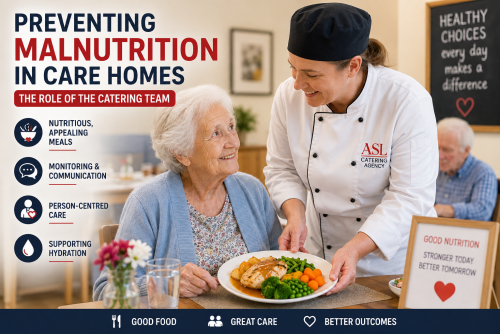
Care home chef serving a nutritious meal to an older resident, supporting good nutrition, hydration and person-centred care.

Preventing Malnutrition in Care Homes: The Role of the Catering Team

Food is one of life’s everyday pleasures, but within a care home it also plays a fundamental role in maintaining residents’ health, strength, independence and quality of life.

For some residents, eating enough can become difficult.

Illness, reduced appetite, dementia, swallowing difficulties, medication, changing tastes and other factors can all affect food intake. Malnutrition can develop gradually and may not always be immediately obvious.

The NHS defines malnutrition as a serious condition caused when a person’s diet does not contain the right amount of nutrients. Unintentional weight loss, reduced appetite, weakness and lack of interest in food and drink can be among its signs. Importantly, someone can be a normal weight—or even overweight—and still be malnourished.

Identifying and managing malnutrition is a multidisciplinary responsibility.

But the catering team has a particularly valuable perspective.

Chefs see which meals return to the kitchen untouched. They notice changing preferences. They know whether somebody who previously enjoyed Sunday lunch is suddenly eating very little.

Those observations can be important.

The role of the care-home chef is not to diagnose malnutrition. It is to provide safe, appealing food that meets assessed needs, communicate concerns and work alongside the wider care team to support residents at nutritional risk.


Key Takeaways

✔ Malnutrition is not simply about being underweight.

✔ Residents in care homes should be appropriately screened for malnutrition risk by trained professionals using a validated screening tool.

✔ Catering staff can provide valuable observations about changing appetite, preferences and uneaten meals.

✔ Residents’ individual nutritional assessments and care plans should guide catering provision.

✔ Smaller portions, snacks and a “little and often” approach may be appropriate for some residents.

✔ Fortification should follow the resident’s agreed nutritional plan rather than being introduced indiscriminately.

✔ Sudden or persistent changes in eating or swallowing should be communicated to the appropriate care or healthcare professional.

✔ Enjoyment, dignity, choice and presentation remain important when supporting nutritional intake.


What is Malnutrition ?

Malnutrition is sometimes misunderstood as simply meaning somebody is very thin.

The reality is more complex.

The NHS explains that malnutrition means poor nutrition and includes undernutrition—where someone is not receiving enough nutrients—as well as overnutrition.

For care-home catering teams, undernutrition is particularly relevant.

Possible indicators can include:

  • Unintentional weight loss
  • Reduced appetite
  • Lack of interest in eating and drinking
  • Weakness
  • Tiredness
  • Loose-fitting clothing
  • Poor wound healing
  • Difficulty swallowing

NICE specifically identifies issues including unintentional weight loss, poor appetite, impaired swallowing, poor wound healing and loose-fitting clothes as reasons for clinical concern in relation to malnutrition screening.

None of these observations should be used by a chef to diagnose a resident.

But they demonstrate why good communication matters.


Nutritional Screening Is a Professional Responsibility

Care-home kitchens should work within the home’s established nutritional assessment and care-planning system.

NICE states that people in care homes should be screened for malnutrition on admission and when there is clinical concern, using an appropriate validated approach. Its quality standard also says screening should be carried out by health and social care professionals who have undertaken training to use the validated tool.

One widely used system is the Malnutrition Universal Screening Tool (MUST) developed by BAPEN.

BAPEN describes MUST as the most commonly used nutritional screening tool across UK care settings.

The chef’s role is generally different.

Catering teams need to know what the resident’s assessed nutritional requirements mean for the food they prepare and serve.


CQC Requirements for Nutrition and Hydration

Nutrition and hydration are not optional extras in regulated care.

Under Regulation 14, providers must ensure people’s nutritional and hydration needs are met.

CQC guidance says nutritional needs should be assessed and regularly reviewed, and providers should respond to changes promptly. It also states that nutritious, appetising food should be available and that where somebody requires a specific diet, it should be provided in line with their assessment.

CQC also expects providers to consider:

  • Dietary intolerances and allergies
  • Support needed to eat and drink
  • Appropriate meal timing
  • Suitable quantities
  • Individual preferences
  • Religious and cultural requirements
  • Specialist nutritional advice where necessary

This demonstrates why the kitchen is such an important part of the wider care service.


The Catering Team Can Be an Important Early Warning System

A chef may not conduct the nutritional assessment, but catering staff are in an excellent position to notice changes around food.

Imagine a resident who normally eats most of their lunch.

Over several days, their plates begin returning almost untouched.

That information matters.

There could be many possible explanations, including:

  • Reduced appetite
  • Illness
  • Pain or discomfort
  • Dental problems
  • Changed preferences
  • Difficulty using cutlery
  • Difficulty recognising food
  • Swallowing difficulties
  • Medication-related effects
  • Portions appearing overwhelming

The kitchen should not try to determine the clinical cause.

Instead, the observation should be communicated through the home’s agreed process so the appropriate person can investigate.


10 Observations Catering Teams Should Feed Back

These are observations rather than diagnostic signs.

Kitchen or dining staff should consider reporting through the home’s established procedures when a resident:

  1. Repeatedly leaves most of their meals.
  2. Suddenly stops eating a previously favourite dish.
  3. Consistently requests much smaller amounts than usual.
  4. Regularly refuses meals.
  5. Appears to struggle with a particular food texture.
  6. Frequently leaves drinks untouched.
  7. Begins having difficulty using cutlery.
  8. Appears to take considerably longer to eat than previously.
  9. Repeatedly returns texture-modified meals uneaten.
  10. Shows a noticeable change in eating habits or preferences.

The important point is not that any one observation proves malnutrition.

It is that changes should not disappear unnoticed with the plate waste.


Resident Choice Is Part of Good Nutritional Care

A nutritionally perfect meal has limited value if the resident consistently refuses to eat it.

Understanding personal preferences therefore matters.

Care-home catering teams should consider residents’:

  • Favourite meals
  • Foods they dislike
  • Cultural background
  • Religious requirements
  • Ethical choices
  • Preferred meal times
  • Portion preferences
  • Familiar foods
  • Preferred drinks

CQC explicitly states that people’s reasonable food and hydration requirements arising from their preferences, religious or cultural background should be met.

Food is deeply personal.

For many older residents, familiar dishes may also carry decades of memories and associations.


Small Appetites May Need a Different Approach

Some residents simply cannot manage a large plate of food.

Putting more food on the plate does not necessarily result in somebody eating more.

For residents whose assessed plan supports it, a more effective approach might involve:

  • Smaller portions
  • Additional snacks
  • Nourishing drinks
  • Desserts
  • Favourite foods
  • Extra opportunities to eat throughout the day

CQC guidance specifically says snacks or other food should be available between meals for people who prefer to eat little and often.

The precise approach should always reflect the resident’s assessed needs.


Food Fortification Can Support Some Residents

Food fortification means increasing the energy or nutritional content of food without necessarily making the portion substantially larger.

Depending on an individual’s nutritional plan, this might involve enriching suitable dishes with ingredients such as:

  • Full-fat dairy products
  • Cheese
  • Cream
  • Butter
  • Milk powder
  • Oils
  • Other energy- or protein-rich ingredients

However, fortification should not become a blanket kitchen policy.

Residents may have allergies, medical conditions, therapeutic diets or other nutritional requirements.

Where fortification forms part of someone’s nutritional support, the catering team should follow the agreed care plan and any dietetic or healthcare advice.


Presentation Still Matters

When somebody has a reduced appetite, the appearance of the meal can become even more important.

An enormous plate of beige food is unlikely to encourage enthusiasm.

Chefs can consider:

  • Attractive colour combinations
  • Clear separation of foods
  • Appropriate portion sizes
  • Garnishing where suitable
  • Serving food at an appropriate temperature
  • Maintaining recognisable presentation

CQC specifically expects food to be nutritious and appetising.

The objective should be to encourage eating while preserving dignity and enjoyment.


Don’t Forget the Dining Experience

Nutrition does not begin and end with what is on the plate.

The environment in which somebody eats can influence their experience.

Depending on residents’ needs and preferences, useful considerations can include:

  • A calm atmosphere
  • Comfortable seating
  • Appropriate assistance
  • Enough time to eat
  • Social interaction where wanted
  • Independence wherever possible
  • Accessible drinks
  • Suitable crockery and cutlery

Some residents may enjoy a sociable dining room.

Others may prefer somewhere quieter.

Person-centred care means recognising the difference.


Dementia Can Affect Nutritional Intake

Dementia may affect food recognition, appetite, concentration, communication and the ability to use cutlery.

This can make nutrition more challenging for some residents.

Our recent guide to Dementia-Friendly Mealtimes in Care Homes explores this subject in more detail.

The important principle for chefs is not to assume that a resident is “being difficult” when they refuse food.

There may be a reason the person cannot easily communicate.

Working with the care team can help identify practical adaptations while preserving the resident’s choice and dignity.


Dysphagia Requires Particular Care

Difficulty swallowing can significantly affect a person’s ability to eat and drink safely and adequately.

If a catering team notices apparent changes in somebody’s ability to manage food, the concern should be passed to the appropriate care or healthcare professional.

Chefs should not independently decide to change a resident onto a texture-modified diet.

Where a resident has been professionally assessed as requiring texture-modified food or drink, the kitchen must receive clear instructions and follow the prescribed requirements.

For residents using the IDDSI Framework, chefs need sufficient knowledge to prepare the required texture safely and consistently.


Texture Modification Should Not Mean Losing Nutritional Quality

Preparing a texture-modified meal can present additional challenges.

The kitchen still needs to consider:

  • Nutritional content
  • Appropriate portion size
  • Flavour
  • Colour
  • Presentation
  • Resident preferences
  • Prescribed texture
  • Fortification where required

A safe texture is essential, but so is producing something the resident actually wants to eat.

Experienced care-home chefs understand how important it is to balance these requirements.


Hydration and Nutrition Go Together

A resident’s food intake should not be considered in isolation from hydration.

CQC requires providers to meet both nutritional and hydration needs and says water should be available and accessible, with other drinks offered throughout the day and night as appropriate.

Catering teams can support this by providing a suitable range of drinks and working with care staff to understand residents’ preferences.

A person who repeatedly refuses plain water may readily drink something else that is appropriate for their assessed needs.

Again, knowing the individual matters.


Communication Is the Link Between the Kitchen and Care Plan

A care home’s nutritional system is strongest when information moves effectively between teams.

A useful principle is:

Assessment → Care Plan → Care Team → Kitchen → Meal Service → Observation → Feedback → Review

The kitchen needs accurate information about what to provide.

The care team needs useful information about what residents are actually eating.

Neither side should work in isolation.


What Information Does the Chef Need?

Where relevant to the individual, catering teams may need clear, current information about:

  • Allergies and intolerances
  • Dietary requirements
  • Resident preferences
  • Texture requirements
  • IDDSI level
  • Fortification requirements
  • Portion requirements
  • Cultural and religious requirements
  • Suitable alternatives
  • Relevant changes to the nutritional plan

Temporary and relief chefs also need an appropriate handover before taking responsibility for meal preparation.


Why Experienced Care Home Chefs Matter

Care-home catering is considerably more specialised than simply producing three meals per day.

A chef may need to balance:

  • Food safety
  • Nutrition
  • Hydration
  • Allergens
  • Dementia-related needs
  • Dysphagia
  • IDDSI
  • Fortification
  • Resident preferences
  • Cultural requirements
  • Menu planning
  • Food presentation
  • Kitchen budgets
  • Stock management

That breadth of responsibility is one reason care-sector experience can be so valuable.

At ASL Catering Agency Ltd, our specialist focus is supplying catering professionals who understand the demands of care-home, residential and nursing-home kitchens.

Care Home Chef Recruitment – ASL Catering Agency

Request a Chef – ASL Catering Agency


Relevant Training for Care Home Catering Teams

For this article, I would again keep the training recommendations focused rather than listing the whole FlexiLearnHub catalogue.

The most relevant subjects are:

  • Nutrition & Hydration
  • Dysphagia & IDDSI Awareness
  • Dementia Awareness
  • Food Safety & Hygiene

FlexiLearnHub – Care, Catering & Compliance Training

These topics help catering professionals understand the wider care environment in which their food is being prepared and served.


Care Home Nutrition & Mealtime Checklist

Resident Needs

☐ Does the kitchen have current dietary information?

☐ Are resident preferences recorded and communicated?

☐ Are cultural and religious requirements understood?

☐ Are allergies and intolerances clearly identified?

Eating Patterns

☐ Are repeated uneaten meals reported?

☐ Are significant appetite changes communicated?

☐ Is persistent plate waste investigated?

☐ Are residents offered suitable alternatives where appropriate?

Meal Provision

☐ Are meals attractive and appetising?

☐ Are portions appropriate to assessed needs?

☐ Are suitable snacks available for residents who eat little and often?

☐ Are fortified meals prepared correctly where required?

Specialist Diets

☐ Are texture requirements clearly communicated?

☐ Do relevant chefs understand IDDSI?

☐ Are texture-modified meals nutritionally appropriate and attractively presented?

☐ Are changes in swallowing ability escalated rather than independently managed by kitchen staff?

Communication

☐ Do care and catering teams communicate effectively?

☐ Does the kitchen receive changes promptly?

☐ Can chefs report concerns easily?

☐ Do temporary or relief chefs receive an appropriate handover?


Frequently Asked Questions

What is malnutrition?

Malnutrition means poor nutrition caused by receiving an inappropriate amount or balance of nutrients. In the context of this article, we are primarily discussing undernutrition. A person does not necessarily need to appear underweight to be malnourished.

Who should screen care-home residents for malnutrition?

NICE says malnutrition screening should use a validated tool and be carried out by health and social care professionals who have undertaken appropriate training. People in care homes should be screened on admission and where there is clinical concern.

What is MUST?

MUST stands for Malnutrition Universal Screening Tool. It was developed by BAPEN and is widely used across UK health and care settings to identify adults at risk of malnutrition.

Can a care-home chef diagnose malnutrition?

No. Diagnosis and nutritional assessment belong with appropriately trained health and care professionals. However, chefs can play an important role by noticing changes in eating patterns and reporting them through the home’s agreed procedures.

Should every resident at risk of malnutrition receive fortified food?

Not automatically. Nutritional interventions should reflect the individual’s assessment and care plan. Catering teams should follow the instructions provided by the appropriate healthcare or care professionals.

What should a chef do if a resident suddenly stops eating?

The chef should communicate the change promptly through the home’s established procedure. There may be numerous possible causes, and persistent or significant changes require appropriate assessment rather than assumptions being made in the kitchen.


Further Reading – Trusted UK Resources

These are the external resources I’d place at the bottom and set to Open in New Tab in WordPress:

Care Quality Commission – Regulation 14: Meeting Nutritional and Hydration Needs

NICE – Screening for the Risk of Malnutrition

NHS – Malnutrition

BAPEN – Nutritional Screening and MUST


Good Nutrition Starts With Knowing the Resident

Preventing malnutrition in a care home cannot be achieved by the kitchen alone.

It requires assessment, care planning, communication, monitoring and cooperation between residents, care staff, healthcare professionals and catering teams.

But chefs have an important part to play.

They can prepare attractive food that reflects individual needs. They can understand residents’ preferences. They can adapt meals according to agreed nutritional plans. And importantly, they can notice when eating patterns change and make sure those observations reach the right people.

An excellent care-home chef therefore does much more than cook.

They contribute to a wider system designed to protect residents’ nutrition, dignity, independence, enjoyment and wellbeing.

For care providers requiring experienced catering support:

Request a Chef – ASL Catering Agency

For chefs interested in working within specialist care catering:

Join Our Chef Network – ASL Catering Agency

Visit FlexiLearnHub’s CPD & CQC Aligned certificated OnLine training courses

Our growing course library includes:

Thank you for visiting FlexiLearnHub

Professional care home chef preparing a nutritious meal in a commercial kitchen while managing fresh ingredients and food waste.

Reducing Food Waste in Care Homes: Practical Strategies for Better Catering

Food waste is an important issue for every professional kitchen, but in a care home it deserves particular attention.

Care-home catering teams must balance several priorities at once: providing nutritious meals, accommodating individual dietary requirements, offering residents meaningful choice, maintaining food-safety standards and controlling kitchen costs.

Reducing waste should therefore never mean simply providing less food.

Instead, it is about understanding why food is being wasted and making intelligent improvements to purchasing, menu planning, preparation, portioning and communication.

A well-managed care-home kitchen can reduce unnecessary waste while continuing to provide residents with safe, nutritious and enjoyable meals.

In this guide, we look at practical ways care-home managers, chefs and catering teams can reduce food waste without compromising resident choice, dignity or wellbeing.


Key Takeaways

✔ Measure food waste before deciding how to reduce it.

✔ Use resident feedback to identify unpopular meals and inappropriate portion sizes.

✔ Improve stock rotation and purchasing to prevent ingredients expiring unnecessarily.

✔ Communication between care and catering teams can prevent meals being prepared unnecessarily.

✔ Texture-modified, fortified and specialist diets require particularly careful planning.

✔ Food-safety requirements must never be compromised simply to reduce waste.

✔ Experienced care-home chefs can play an important role in controlling food costs while maintaining catering standards.


Why Reducing Food Waste Matters

Food that is purchased, stored, prepared and ultimately discarded represents more than the cost of the ingredients.

There may also be costs associated with:

  • Staff time
  • Preparation
  • Cooking
  • Energy
  • Refrigeration
  • Storage
  • Cleaning
  • Waste collection and disposal

There is also an environmental impact.

UK government guidance on food and drink waste places preventing surplus and waste as the first priority, ahead of redistribution, recycling, energy recovery and disposal.

For a care home, however, there is another important consideration.

Plate waste can tell us something.

If residents repeatedly leave particular dishes, vegetables, portion sizes or desserts, that information may help the catering team understand what residents actually enjoy eating.

Reducing food waste can therefore become part of improving the overall dining experience.


Start by Understanding Where Food Is Being Wasted

Before changing menus or reducing ordering, managers need to understand where waste is occurring.

Care-home food waste can broadly occur at several stages.

Storage Waste

Food may be discarded because it has:

  • Passed its use-by date
  • Deteriorated during storage
  • Been over-ordered
  • Been incorrectly stored
  • Been forgotten at the back of a refrigerator, freezer or storeroom

Good stock management can reduce much of this waste.

Preparation Waste

Some waste occurs during preparation.

This might include excessive trimming of vegetables, ingredients prepared but never required, or unnecessarily large batches.

Some preparation waste is unavoidable, but good kitchen practices can minimise unnecessary losses.

Overproduction

A kitchen may prepare significantly more portions than are actually required.

This can happen when the kitchen does not receive accurate information about:

  • Residents who are absent
  • Hospital appointments
  • Residents eating elsewhere
  • Changes in appetite
  • Dietary changes
  • Alternative meal requests

Better communication can make a significant difference.

Plate Waste

Plate waste is food that has been served but not eaten.

Rather than viewing this simply as rubbish, kitchens can use it as useful feedback.

Are portions consistently too large?

Is one menu choice repeatedly unpopular?

Is a particular vegetable always left?

Do some residents prefer smaller portions with the option of seconds?

Patterns can help catering teams make better decisions.


Measure Before You Manage

One of the most useful steps a care home can take is to begin measuring food waste.

Government guidance describes measuring and recording food and drink surplus and waste as good practice and points organisations towards resources for consistent measurement.

This does not necessarily require a complicated computer system.

A simple food-waste record could identify:

Date | Meal | Type of Waste | Approximate Quantity | Possible Reason

For example:

Monday | Lunch | Plate waste | High | Vegetable side largely uneaten

Over several weeks, patterns may become apparent.

This allows the chef or catering manager to make decisions based on evidence rather than guesswork.


Menu Planning Should Start With the Residents

A nutritionally balanced menu is important, but a meal provides little nutritional benefit if the resident does not want to eat it.

Good menu planning should consider both nutritional requirements and resident preferences.

Care-home catering teams can gather feedback through:

  • Resident meetings
  • Menu discussions
  • Informal conversations
  • Meal satisfaction surveys
  • Discussions with relatives where appropriate
  • Feedback from care staff
  • Monitoring plate waste

Seasonal menus can also help kitchens use ingredients effectively while providing variety throughout the year.

The objective is not simply to create a menu that looks good on paper.

It is to create food that residents want to eat.


Portion Control Does Not Mean Smaller Meals for Everyone

Reducing portion size across the board would be the wrong approach to tackling food waste.

Residents have individual nutritional requirements and appetites.

Some may require larger portions, while others may find a standard portion overwhelming.

An alternative approach can be offering an appropriate smaller portion where suitable, with additional food available if the resident wants more.

This can be particularly helpful for residents with smaller appetites.

However, nutritional requirements must always come first.

Where somebody is at risk of malnutrition or has an assessed nutritional requirement, their individual care and dietary plan should guide the approach.


Improve Communication Between the Care Team and Kitchen

This is one of the simplest areas in which waste can potentially be reduced.

Imagine that three residents are away from the home for lunch, another has gone to hospital and two have requested an alternative meal.

If the kitchen doesn’t receive that information, six unnecessary meals could potentially be prepared.

Multiply that across weeks and months and the waste becomes significant.

A simple communication process can help.

Care team → updated resident/meal information → kitchen → accurate production numbers

The system does not need to be complicated.

It needs to be reliable.

Kitchen teams should know how many residents they are catering for and whether there have been significant dietary or meal changes before production begins.


Better Stock Management Can Prevent Avoidable Waste

A well-organised storeroom, refrigerator and freezer can significantly reduce unnecessary waste.

Good practices include:

  • Regular stock checks
  • Sensible ordering levels
  • Clear date labelling
  • Appropriate rotation
  • Monitoring use-by dates
  • Reviewing slow-moving ingredients
  • Checking stock before placing new orders
  • Avoiding unnecessary duplication

FIFO – First In, First Out

Using older suitable stock before newer stock can help prevent ingredients becoming forgotten and eventually discarded.

However, date marking and food-safety requirements must always take priority.

Food must never be used simply because management wants to avoid waste if it is no longer safe.

Government guidance is explicit that food must not be used, sold or donated after its use-by date.


Be Careful With Bulk Purchasing

Buying larger quantities can sometimes reduce the unit cost of ingredients.

But cheaper does not always mean better value.

If a care home purchases ten cases because the price is attractive but eventually throws three away, the apparent saving may disappear.

Purchasing decisions should therefore consider:

  • Available storage
  • Shelf life
  • Menu cycle
  • Number of residents
  • Historical usage
  • Supplier delivery frequency

Good procurement is about purchasing the right quantity, not simply obtaining the lowest price per unit.


Texture-Modified Meals Require Particular Attention

Residents with dysphagia may require texture-modified meals prepared in accordance with their assessed needs.

These meals can require additional preparation, specialist knowledge and careful portioning.

Producing substantially more than required can therefore create both waste and unnecessary workload.

Kitchen teams should have accurate information about:

  • How many residents require texture modification
  • The appropriate IDDSI level for each resident
  • Portion requirements
  • Fortification requirements where applicable
  • Menu choices

Importantly, reducing waste must never result in unsafe improvisation or inappropriate reuse of food.

Resident safety always takes priority.

For catering professionals who prepare texture-modified meals, appropriate dysphagia and IDDSI knowledge is an important part of care catering.


Presentation Can Influence Waste Too

People eat with their eyes as well as their appetite.

An unappealing meal may be rejected before a resident has really started eating it.

Presentation is especially important when preparing texture-modified food.

Where safe and appropriate, chefs can consider:

  • Colour contrast
  • Separate presentation of meal components
  • Recognisable food appearance
  • Suitable portioning
  • Attractive plating
  • Variety across the menu

The objective should be to provide meals that are not only nutritionally appropriate but also enjoyable and dignified.


Fortified Meals Need Thoughtful Planning

Some residents may require additional calories or protein as part of an assessed nutritional plan.

Fortification can increase the nutritional density of meals without necessarily increasing their physical size significantly.

This can be valuable for people with smaller appetites.

However, kitchen teams need clear instructions and accurate resident information.

Reducing food waste must never become an excuse to alter a resident’s prescribed or assessed nutritional provision.


Food Safety Must Always Come First

There is an important boundary when discussing food waste:

Not everything should be saved or reused.

Reducing waste must operate within robust food-safety procedures.

Food businesses are responsible for ensuring food is safe, training staff, operating a food-safety management system and managing allergen and other food hazards.

Kitchen teams should follow their food-safety management procedures regarding:

  • Cooking
  • Cooling
  • Reheating
  • Storage
  • Temperature control
  • Cross-contamination
  • Allergens
  • Date marking

Trying to reduce waste must never encourage unsafe practices.


What Happens to Food That Cannot Be Prevented From Becoming Waste?

Prevention should be the priority, but some food waste is inevitable.

Government guidance establishes a hierarchy for dealing with surplus and waste food. After prevention, options can include redistribution where appropriate, followed by other routes including recycling. Sending food waste to sewer or landfill sits at the bottom of the hierarchy.

Care providers should ensure their waste arrangements comply with the rules applicable to their operation and location.

There are also specific restrictions around catering waste and animal products. For example, catering waste must not be supplied as farm-animal feed.


Experienced Care Home Chefs Can Make a Difference

Effective kitchen management requires more than cooking ability.

An experienced care-home chef may be responsible for balancing:

  • Resident preferences
  • Nutrition
  • Specialist diets
  • Allergens
  • Menu planning
  • Purchasing
  • Stock control
  • Food safety
  • Staffing
  • Budget management
  • Waste reduction

This is one reason specialist care-sector experience can be so valuable.

A chef who understands the environment can make informed decisions about production quantities and stock while keeping resident needs at the centre of the catering service.

For care providers requiring experienced catering professionals:

ASL Catering Agency – Care Home Chef Recruitment

Request a Chef – ASL Catering Agency


Training Supports Better Kitchen Management

Professional development can help catering staff understand the wider responsibilities involved in running a care-home kitchen.

For this article, I would link only to the training most directly relevant to the subject:

Nutrition & Hydration Training – FlexiLearnHub

Food Safety & Hygiene Level 2 – FlexiLearnHub

HACCP Level 2 – FlexiLearnHub

Dysphagia & IDDSI Awareness – FlexiLearnHub


Practical Care Home Food Waste Checklist

Use this simple checklist as a starting point for reviewing kitchen waste.

Menu & Residents

☐ Are residents regularly asked for menu feedback?

☐ Are unpopular dishes being identified?

☐ Are individual portion requirements considered?

☐ Are changes in resident numbers communicated to the kitchen?

Stock

☐ Are stock levels reviewed regularly?

☐ Is stock rotated effectively?

☐ Are use-by dates monitored?

☐ Is existing stock checked before new orders are placed?

☐ Are frequently wasted ingredients identified?

Production

☐ Does the kitchen know how many meals are actually required?

☐ Are batch quantities appropriate?

☐ Is overproduction being measured?

☐ Are specialist meals produced in appropriate quantities?

Plate Waste

☐ Is significant plate waste monitored?

☐ Are patterns discussed with care staff?

☐ Are portion sizes reviewed where appropriate?

☐ Are residents’ preferences being reflected in future menus?

Management

☐ Is food waste measured periodically?

☐ Are findings discussed with the catering team?

☐ Are realistic waste-reduction objectives set?

☐ Are food-safety standards maintained at all times?


Frequently Asked Questions

H3: How can care homes reduce food waste?

Start by measuring where waste occurs. Common opportunities include improving stock control, reviewing portion sizes, communicating resident numbers accurately, monitoring plate waste and involving residents in menu planning.

H3: Should portion sizes be reduced to prevent waste?

Not automatically. Residents have different nutritional requirements and appetites. Portion decisions should remain person-centred and consistent with assessed nutritional needs.

H3: Can leftover food simply be reused?

Not necessarily. Any reuse must comply with the home’s food-safety management procedures, including controls around temperature, cooling, storage, reheating, allergens and contamination. Food safety takes priority over waste reduction.

H3: Why should care homes measure plate waste?

Plate waste can reveal patterns. If particular dishes or portions are repeatedly left, the kitchen can investigate whether menu choice, portion size, presentation or another factor may be contributing.

H3: Can good menu planning reduce food waste?

Yes. Planning menus around resident preferences, seasonal ingredients, actual occupancy and realistic production quantities can help reduce avoidable waste while maintaining choice and nutritional standards.


Further Reading – Official Resources

For additional guidance:

GOV.UK – Food and Drink Waste Hierarchy

GOV.UK – Running a Food Business: Responsibilities

GOV.UK – How Food Businesses Must Dispose of Food and Former Foodstuffs

Set these external links to open in a new tab when you add them to WordPress.


Better Catering, Less Waste

Reducing food waste in a care home is not about cutting portions, limiting resident choice or finding ways to reuse food that should be discarded.

It is about running the kitchen intelligently.

Better communication can prevent unnecessary meals from being prepared. Better stock management can prevent ingredients expiring. Better menu planning can increase resident satisfaction. Measuring plate waste can reveal what residents actually enjoy.

When these practices work together, care homes can potentially reduce unnecessary costs and environmental impact while maintaining the nutrition, choice, dignity and enjoyment residents deserve.

At ASL Catering Agency Ltd, we understand that experienced care-home chefs contribute far more than cooking skills. Strong catering professionals can help maintain food safety, manage specialist diets, organise kitchens effectively and provide consistent meal services for residents.

Request a Chef – ASL Catering Agency

For chefs interested in care-home opportunities:

Join Our Chef Network – ASL Catering Agency

Visit FlexiLearnHub’s CPD & CQC Aligned certificated OnLine training courses

Our growing course library includes:

Thank you for visiting FlexiLearnHub

Professional care home chef preparing a safe meal in a commercial kitchen with allergen information and a checklist for the 14 regulated food allergens.

Food Allergens in Care Homes: A Practical Guide for Kitchen Teams

Managing food allergens safely is an essential responsibility in every care home kitchen.

Residents may have diagnosed food allergies, intolerances or other dietary requirements that must be understood and communicated accurately between care staff, kitchen teams and management. For some people, exposure to an allergen can cause a serious or potentially life-threatening reaction.

For chefs working within residential and nursing care environments, allergen management therefore involves far more than simply checking a menu.

Ingredients can change. Products may be substituted. Deliveries can arrive from different suppliers. Temporary or relief chefs may join the kitchen. Residents’ dietary requirements may also change.

A robust allergen management system helps ensure everyone involved in preparing and serving food has accurate, current information and understands their responsibilities.

This practical guide examines some of the key areas care home managers, chefs and kitchen teams should consider when managing food allergens safely.


Key Takeaways

✔ Care home kitchens need accurate and up-to-date information about residents’ food allergies and dietary requirements.

✔ UK food law identifies 14 allergens that food businesses must declare when they are used as ingredients in applicable foods.

✔ Ingredient changes and substitutions should never be assumed to be allergen-equivalent.

✔ Effective communication between care teams and catering staff is essential.

✔ Procedures should address cross-contact during storage, preparation, cooking and service.

✔ New, temporary and relief chefs need an effective kitchen and dietary handover.

✔ Regular allergen training helps staff understand the risks and follow procedures consistently.


Why Allergen Management Is Particularly Important in Care Homes

Care home catering involves preparing food for people who may have complex and changing needs.

CQC guidance requires providers to assess people’s nutritional and hydration needs and specifically identifies dietary intolerances and allergies among the matters that should be considered. Where somebody has been assessed as needing a specific diet, it must be provided in accordance with that assessment.

This makes communication between the kitchen and wider care team particularly important.

A chef may prepare hundreds of meals safely, but one incorrect ingredient, uncommunicated menu change or misunderstanding about a resident’s dietary requirements can create significant risk.

Allergen safety therefore needs to form part of the everyday culture of the kitchen rather than being treated as a paperwork exercise.


What Are the 14 Regulated Food Allergens?

UK food businesses are required to provide information when food contains any of the 14 regulated allergens as ingredients.

These are:

  1. Celery
  2. Cereals containing gluten, including wheat, rye, barley and oats
  3. Crustaceans
  4. Eggs
  5. Fish
  6. Lupin
  7. Milk
  8. Molluscs
  9. Mustard
  10. Peanuts
  11. Sesame
  12. Soybeans
  13. Sulphur dioxide and sulphites above the specified concentration
  14. Tree nuts

The Food Standards Agency also makes an important distinction: people can be allergic or intolerant to ingredients outside these 14. The list defines the allergens subject to specific statutory declaration requirements; it does not mean other ingredients cannot cause reactions.

Food Standards Agency – Allergen Guidance for Food Businesses

External link setting: Open in a new tab.


Food Allergy and Food Intolerance Are Not the Same

Kitchen teams should understand that a food allergy and a food intolerance are different.

A food allergy involves the body’s immune system and reactions can sometimes be severe. Food intolerance does not involve the immune system in the same way, although it can still cause significant symptoms and discomfort.

From the kitchen’s perspective, the important point is straightforward:

Never make assumptions about a resident’s dietary requirements.

Follow the resident’s documented care and dietary information and the care home’s agreed procedures.


Maintaining Accurate Resident Allergen Information

Information is only useful when it is accurate and current.

Care homes should have clear procedures for communicating relevant dietary information to catering teams.

Depending on the home’s systems, this may include:

  • Resident dietary records
  • Allergen matrices
  • Kitchen dietary lists
  • Care plans
  • Meal-ordering systems
  • Dietary handover information
  • Updates following clinical assessment

Kitchen staff should know where the definitive information is held and what to do if information appears inconsistent.

If a chef is unsure whether a resident can safely receive a particular meal, the answer should never be guessed.

The issue should be checked with the appropriate member of the care team before the meal is served.


Ingredient Changes Can Create Hidden Risks

One of the easiest mistakes to make in a busy kitchen is assuming that a replacement product contains the same ingredients as the product normally used.

It may not.

A supplier might send a different:

  • Gravy
  • Stock
  • Sauce
  • Bread
  • Dessert
  • Sausage
  • Margarine
  • Seasoning
  • Ready-prepared component

Even products that appear almost identical can have different formulations.

Check Every Substitution

When products change, kitchen teams should check the current label and allergen information rather than relying on memory or previous packaging.

Recipes and allergen records should also be updated where necessary.

This becomes especially important when shortages result in last-minute substitutions.


Preventing Allergen Cross-Contact

Cross-contact occurs when an allergen is unintentionally transferred to food that was not intended to contain it.

This can happen through:

  • Hands
  • Knives
  • Chopping boards
  • Utensils
  • Work surfaces
  • Fryers
  • Grills
  • Containers
  • Cloths
  • Serving equipment
  • Storage practices

Good allergen management therefore requires more than simply removing an allergenic ingredient from a finished dish.

Preparation Procedures

Where required by the care home’s procedures and risk assessment, kitchen teams may need to consider:

  • Thoroughly cleaned preparation areas
  • Clean equipment and utensils
  • Appropriate hand washing
  • Safe ingredient storage
  • Clearly identified containers
  • Suitable preparation sequencing
  • Preventing accidental ingredient substitution
  • Appropriate service procedures

The objective is to minimise the risk of unintended allergen transfer throughout the food-production process.


Communication Between Care Staff and the Kitchen

Some of the strongest allergen controls happen before cooking begins.

Care staff often know residents closely and may become aware of changes to dietary requirements before kitchen teams do.

There should therefore be a reliable method for communicating relevant changes.

For example:

Resident dietary requirement changes → care team records information → kitchen is informed → catering records/menu information updated → staff preparing and serving food are made aware.

The precise system will differ between providers, but everyone should understand who is responsible for communicating changes and how those changes are recorded.

This is particularly important at weekends, during shift changes and when temporary staff are working.


Serving the Correct Meal to the Correct Resident

Preparing an allergen-safe meal correctly is only part of the process.

It must also reach the correct resident.

Care homes should have suitable procedures for identifying specialist meals during service.

Depending on the setting, this could involve:

  • Clearly identified plates or trays
  • Documented meal lists
  • Appropriate labelling
  • Communication with care staff
  • Final checking before service

Care and catering teams should avoid informal systems that depend entirely on somebody remembering who receives which meal.

A reliable process reduces the risk of human error.


What About Natasha’s Law?

You may hear the term Natasha’s Law when discussing food allergens.

The rules introduced in October 2021 concern prepacked for direct sale (PPDS) food. Where PPDS requirements apply, the food must carry the name of the food and a full ingredients list, with relevant allergens emphasised within that list.

Whether a particular item prepared within a care setting falls within PPDS requirements depends on how it is produced, packaged and supplied, so providers should use the Food Standards Agency’s current guidance rather than assuming the rules do or do not apply.

GOV.UK – Introduction to PPDS Allergen Labelling (Natasha’s Law)

External link setting: Open in a new tab.


Relief and Agency Chefs Need a Proper Handover

This is an area particularly relevant to ASL Catering Agency.

When a relief chef enters an unfamiliar care home kitchen, they may be professionally experienced but they cannot automatically know the individual dietary requirements of that home’s residents.

A proper catering handover should therefore include information such as:

  • Current menus
  • Residents’ dietary requirements
  • Known allergies and intolerances
  • Texture-modified diets
  • IDDSI requirements
  • Fortified diets
  • Kitchen procedures
  • Allergen records
  • Relevant food safety documentation
  • Who to speak to if clarification is required

This is one reason why previous care-sector experience is so valuable when recruiting relief chefs.

Experienced care home chefs understand that specialist diets and allergen controls are fundamental parts of the role.

For information about specialist chef support:

ASL Catering Agency – Care Home Chef Recruitment

ASL Catering Agency – Request a Chef


Staff Training and Allergen Awareness

Procedures work best when staff understand why they exist.

Allergen awareness training can help catering teams understand:

  • The 14 regulated allergens
  • Food labelling
  • Ingredient checking
  • Cross-contact
  • Safe food preparation
  • Communication
  • The importance of following established procedures

The Food Standards Agency states that food businesses must make sure staff receive training on allergens.

For care-home catering teams looking to strengthen their knowledge, FlexiLearnHub provides online training relevant to professional care catering.

Recommended Training

Allergen Awareness Training – FlexiLearnHub

Food Safety & Hygiene Level 2 – FlexiLearnHub

HACCP Level 2 – FlexiLearnHub

I’ve deliberately limited this to the three courses directly relevant to this article rather than inserting the entire FlexiLearnHub catalogue.


A Practical Allergen Checklist for Care Home Kitchens

Care home managers and catering teams can regularly ask:

Resident information

☐ Are residents’ allergy and intolerance records current?

☐ Are changes communicated promptly to the kitchen?

☐ Do kitchen staff know where authoritative dietary information is held?

Ingredients

☐ Are product labels checked?

☐ Are replacement products checked before use?

☐ Are recipe or allergen records updated following ingredient changes?

Kitchen controls

☐ Are appropriate procedures in place to minimise cross-contact?

☐ Are storage arrangements suitable?

☐ Are equipment and preparation areas managed appropriately?

☐ Do staff know what to do when they are uncertain?

Meal service

☐ Are specialist meals clearly identifiable?

☐ Is there a reliable system for getting the correct meal to the correct resident?

☐ Do care and catering teams communicate effectively?

Staff

☐ Have relevant staff received allergen awareness training?

☐ Are new and temporary staff given an appropriate dietary and kitchen handover?

☐ Is refresher training provided where appropriate?


Frequently Asked Questions

How many allergens must UK food businesses declare?

UK food law identifies 14 allergens that must be declared when they are used as ingredients in applicable foods. However, people can have allergies or intolerances to foods outside the statutory 14.

Should care home chefs check product labels every time?

Ingredient formulations and replacement products can change. Kitchen procedures should ensure current ingredient and allergen information is checked appropriately rather than relying solely on memory or assumptions.

Are food allergies and intolerances the same?

No. Food allergy involves an immune response, whereas food intolerance is different and generally does not involve the immune system in the same way. Both may nevertheless be important parts of an individual’s assessed dietary requirements.

Do relief chefs need allergen information?

Yes. Any chef preparing food needs access to the relevant dietary and allergen information required to prepare meals safely. Relief chefs should receive an appropriate handover before taking responsibility for the kitchen.

Does Natasha’s Law apply to care homes?

Natasha’s Law concerns food classed as prepacked for direct sale. Whether particular food prepared or supplied by a care home falls within those requirements depends on the circumstances. Providers should consult current FSA guidance for their specific operation.


Further Reading – Official Guidance

For further information, care providers and catering teams can consult:

Food Standards Agency – Allergen Guidance for Food Businesses

Care Quality Commission – Regulation 14: Meeting Nutritional and Hydration Needs

GOV.UK – Food Allergies and Allergen Information

NHS – Food Allergy Guidance

Set all external links above to open in a new tab.


Visit FlexiLearnHub’s CPD & CQC Aligned certificated OnLine training courses

Our growing course library includes:

Thank you for visiting FlexiLearnHub

Supporting High Standards in Care Home Catering

Safe allergen management depends on good systems, effective communication, knowledgeable staff and consistent kitchen practices.

Care home chefs play a significant role in that process.

From checking ingredients and preventing cross-contact to understanding individual dietary requirements and communicating with care teams, attention to detail can make a major difference to resident safety.

At ASL Catering Agency Ltd, we specialise in supporting care homes, nursing homes and residential care providers with experienced catering professionals who understand the specialist demands of care-sector kitchens.

Whether you require temporary cover, relief support or help recruiting an experienced care home chef:

Request a Chef – ASL Catering Agency

For experienced chefs interested in working with ASL:

Join Our Chef Network

Care home chef preparing nutritious meals to support nutrition and hydration for older residents

Why Good Nutrition and Hydration Start in the Care Home Kitchen

Providing nutritious meals and encouraging good hydration are essential parts of delivering outstanding care. While carers play an important role in supporting residents during mealtimes, it all begins much earlier—in the care home kitchen.

Experienced care home chefs understand that every meal they prepare has the potential to support health, wellbeing and quality of life. From menu planning to food presentation, the kitchen team plays a vital role in creating positive dining experiences for residents.

The Care Home Kitchen Is About More Than Cooking

Today’s care home chefs do much more than prepare breakfast, lunch and dinner.

They are responsible for creating meals that are nutritious, enjoyable and appropriate for a wide range of dietary needs.

This may include:

  • Modified texture meals where required.
  • Special dietary requirements.
  • Food allergies and intolerances.
  • Cultural and religious preferences.
  • Hydration support through suitable drinks and desserts.

An experienced chef understands that every resident has individual needs and deserves meals that are both safe and enjoyable.

Nutrition Supports Wellbeing

Good nutrition contributes to many aspects of health and wellbeing.

Balanced meals can help support:

  • Energy levels.
  • Overall health.
  • Muscle strength.
  • Recovery following illness.
  • Enjoyment of food and mealtimes.

Working alongside care staff and managers, catering teams help ensure residents receive meals that meet both nutritional needs and personal preferences.

Hydration Is Everyone’s Responsibility

The kitchen also plays an important role in promoting hydration.

Providing a variety of appealing drinks, soups, fruit-based desserts and other suitable refreshments helps encourage regular fluid intake throughout the day.

Good communication between catering teams and care staff helps ensure residents receive the support they need in accordance with their individual care plans.

Recruiting the Right Care Home Chef Matters

Providing excellent catering within a care home requires more than strong cooking skills.

The best care home chefs understand:

  • Food safety.
  • Allergen awareness.
  • Nutrition and hydration.
  • Special diets.
  • Texture-modified meals where appropriate.
  • Working closely with care teams.
  • Delivering meals with dignity and respect.

These are specialist skills developed through experience and professional training.

Supporting Care Homes Across the UK

At ASL Catering Agency, we understand the importance of placing experienced chefs into care home environments.

Whether you require emergency chef cover, temporary support or permanent recruitment, we help care providers find catering professionals who understand the unique demands of residential and nursing care.

Reliable catering teams help create positive mealtime experiences that support both residents and the wider care team.

Investing in Training

Alongside recruiting experienced chefs, ongoing professional development is equally important.

Training in areas such as:

helps catering professionals maintain high standards and continue developing their knowledge.

You can also visit our:

Knowledge Hub – Free Professional Resources for Care, Catering & Hospitality

Conclusion

Great care starts with great teamwork.

Care staff, managers and catering professionals all contribute to creating safe, enjoyable and person-centred mealtime experiences.

By investing in experienced chefs and ongoing training, care homes can continue delivering the high standards that residents deserve.

Looking for experienced care home chefs?

ASL Catering Agency supplies professional chefs for residential care homes, nursing homes and specialist care settings throughout the UK.

We also support ongoing professional development through our sister company, FlexiLearnHub, offering CPD-accredited online training for the care, catering and hospitality sectors.

Experienced care home chef preparing nutritious meals in a Birmingham care home kitchen supplied by ASL Catering Agency.

Care Home Chef Recruitment Birmingham

Introduction

Finding experienced chefs for care homes can be challenging, particularly when maintaining high standards of nutrition, food safety and resident satisfaction is essential. At ASL Catering Agency, we specialise in supplying experienced care home chefs to residential homes, nursing homes and supported living services throughout Birmingham and the surrounding West Midlands.

Whether you require emergency chef cover, temporary support during staff shortages or a permanent chef to strengthen your kitchen team, we provide reliable catering professionals with experience working in care environments.

Why Choose ASL Catering Agency?

Our chefs understand the unique demands of catering within care settings, including preparing nutritious meals for elderly residents while working within strict food safety and dietary requirements.

We provide:

  • Emergency chef cover
  • Temporary relief chefs
  • Permanent chef recruitment
  • Holiday and sickness cover
  • Experienced care home chefs
  • Support for residential and nursing homes
  • Flexible recruitment solutions

Supporting Quality Care Through Catering

Food plays an important role in the wellbeing of residents. We recruit chefs who understand the importance of providing balanced, nutritious meals while maintaining consistency, hygiene and excellent kitchen management.

Many of our chefs have experience preparing meals for residents with specialist dietary requirements and work confidently within professional care home kitchens.

Recruitment Across Birmingham & The West Midlands

We recruit and supply chefs throughout the west midlands:

  • Birmingham City Centre
  • Sutton Coldfield
  • Edgbaston
  • Harborne
  • Solihull
  • West Bromwich
  • Smethwick
  • Walsall
  • Dudley
  • Wolverhampton
  • Coventry
  • surrounding West Midlands locations

More Than Just Chef Recruitment

ASL Catering Agency also supports the care sector through FlexiLearnHub, providing online CPD Accredited and CQC-aligned training for care and catering professionals.

Training includes:

Training helps kitchen teams remain compliant while continually developing their professional knowledge.

Visit: FlexiLearnHub

This allows employers to access both experienced chefs and professional online training from organisations working closely with the care sector.

Why Birmingham Care Homes Choose ASL

We understand that staffing shortages can affect meal quality, resident satisfaction and operational efficiency. Our responsive recruitment service helps care providers maintain continuity by supplying experienced chefs who can integrate quickly into existing kitchen teams.

Whether you require immediate emergency cover or wish to recruit a permanent care home chef, our experienced team is here to help.

Call To Action

Need a Care Home Chef in Birmingham?

If your care home requires an experienced relief, temporary or permanent chef in Birmingham or the West Midlands, contact ASL Catering Agency today to discuss your requirements.

We provide dependable chef recruitment solutions that help care homes continue delivering high-quality catering services to their residents.

Internal Links


ASL Catering Agency Our Blog


Care Home Chef Recruitment Wolverhampton 

Care Home Chef Recruitment Coventry 

Care Home Chef Recruitment Birmingham

Care Home Chef Recruitment London | Relief & Emergency Chef Cover

Care home chef recruitment London relief and emergency chefs UK

ASL Catering Agency provides specialist care home chef recruitment services across London and Greater London. We supply experienced chefs to care homes, residential homes and nursing homes, supporting safe, compliant and high-quality catering services.

Whether you require emergency chef cover, relief chefs or long-term recruitment support, our team can respond quickly to your needs.

Care Home Chef Recruitment in London

We understand the demands of recruiting reliable chefs within care environments. Our chefs are experienced, fully vetted and able to integrate seamlessly into your kitchen.

👉 Learn more about our care home chef recruitment services

Relief Chefs for Care Homes in London

We provide relief chefs for:

  • Staff sickness and absence

  • Holiday cover

  • Short-term staffing gaps

  • High-demand periods

Our chefs ensure continuity of service while maintaining food safety and nutritional standards.

👉 View our relief chefs for care homes

Emergency Chef Cover London (24–48 Hours)

We offer rapid response emergency chef cover across London, ensuring your kitchen continues to operate safely and efficiently.

👉 Explore our emergency chef cover services

Experienced Care Home Chefs

Our chefs understand the specific requirements of care home catering, including:

  • Nutritional requirements for residents

  • Allergen management

  • Food safety and hygiene standards

  • IDDSI framework and dysphagia diets

Supporting CQC Catering Standards

We support care homes in maintaining compliance with CQC standards by supplying chefs who understand safe and compliant catering practices.

👉 Read our guide on CQC catering compliance in care homes

Training & Professional Development

Our chefs are supported with ongoing training, including:

  • Food Safety & Hygiene

  • Allergen Awareness

  • IDDSI Framework

  • Nutrition & Hydration

👉 View our online care home training courses

Areas We Cover in London

We supply chefs across:

  • Central London

  • North London

  • South London

  • East London

  • West London

  • Greater London boroughs

Why Choose ASL Catering Agency in London?

  • Experienced care sector chefs

  • Fast response times

  • Fully vetted professionals

  • Flexible staffing solutions

  • Nationwide coverage

Request a Care Home Chef in London

If you require a chef for your care home in London, contact our team today.

📞 Call: 07525 933 980
👉 Request a Chef Today

To ensure your team meets required standards, training is essential.
👉 Explore our online training courses at FlexiLearnHub

Become a care home chef at ASL Catering Agency Ltd

“Join Our Chef Network”

Care Home Chef Recruitment Liverpool | Relief & Emergency Chef Cover

Care home chef recruitment Liverpool relief and emergency chefs UK

ASL Catering Agency provides specialist care home chef recruitment services across Liverpool and surrounding areas. We supply experienced chefs to care homes, residential homes and nursing homes, helping maintain safe, compliant and high-quality catering services.

Whether you require emergency chef cover, relief chefs or long-term recruitment support, our team can respond quickly to your needs.

Care Home Chef Recruitment in Liverpool

We understand the importance of reliable staffing in care environments. Our chefs are experienced, fully vetted and able to integrate seamlessly into your kitchen team.

👉 Learn more about our care home chef recruitment services

Relief Chefs for Care Homes in Liverpool

We provide relief chefs for:

  • Staff sickness and absence

  • Annual leave cover

  • Short-term staffing gaps

  • Busy service periods

Our chefs ensure continuity of service while maintaining food safety and nutritional standards.

👉 View our relief chefs for care homes

Emergency Chef Cover Liverpool (24–48 Hours)

We offer fast response emergency chef cover across Liverpool, helping care homes maintain operations without disruption.

👉 Explore our emergency chef cover services

Experienced Care Home Chefs

Our chefs understand the unique requirements of care home catering, including:

  • Nutritional needs of residents

  • Allergen management

  • Food safety and hygiene

  • IDDSI framework and dysphagia diets

Supporting CQC Catering Standards

We help care homes maintain compliance with CQC standards by supplying chefs who understand safe, compliant catering practices.

👉 Read our guide on CQC catering compliance in care homes

Training & Professional Development

Our chefs are supported with ongoing training, including:

  • Food Safety & Hygiene

  • Allergen Awareness

  • IDDSI Framework

  • Nutrition & Hydration

👉 View our online care home training courses

Areas We Cover in Liverpool & Merseyside

We supply chefs across:

  • Liverpool

  • Wirral

  • St Helens

  • Southport

  • Bootle

  • Huyton

  • Prescot

Why Choose ASL Catering Agency in Liverpool?

  • Experienced care sector chefs

  • Rapid response times

  • Fully vetted professionals

  • Flexible staffing solutions

  • Nationwide support

Request a Care Home Chef in Liverpool

If you require a chef for your care home in Liverpool, contact our team today.

📞 Call: 07525 933 980
👉 Request a Chef Today

To ensure your team meets required standards, training is essential.
👉 Explore our online training courses at FlexiLearnHub

Become a care home chef at ASL Catering Agency Ltd

“Join Our Chef Network”

Care Home Chef Recruitment Manchester | Relief & Emergency Chef Cover

Care home chef recruitment Manchester relief and emergency chefs UK

ASL Catering Agency provides specialist care home chef recruitment services across Manchester and surrounding areas. We supply experienced chefs to care homes, residential homes and nursing homes, supporting safe, compliant and high-quality catering services.

Whether you require emergency chef cover, relief chefs or long-term recruitment support, our team is ready to respond quickly.

Care Home Chef Recruitment in Manchester

We understand the challenges care homes face when recruiting experienced chefs. Our service ensures you have access to reliable, fully vetted chefs who can integrate seamlessly into your kitchen.

👉 Learn more about our care home chef recruitment services

Relief Chefs for Care Homes in Manchester

We provide relief chefs to cover:

  • Staff sickness

  • Annual leave

  • Short-term absences

  • Increased demand

Our chefs maintain food quality, hygiene standards and nutritional care for residents.

👉 View our relief chefs for care homes

Emergency Chef Cover Manchester (24–48 Hours)

We offer rapid response emergency chef cover across Manchester, ensuring your kitchen continues to operate safely and efficiently.

👉 Explore our emergency chef cover services

Experienced Care Home Chefs

Our chefs are experienced in care environments and understand:

  • Nutritional requirements for residents

  • Allergen management

  • Food safety and hygiene standards

  • IDDSI framework and dysphagia diets

Supporting CQC Care Catering Standards

We support care homes in maintaining compliance with CQC requirements by providing chefs who understand safe food preparation, hygiene and nutritional care.

👉 Read our guide on CQC catering compliance in care homes

Ongoing Training & Professional Development

Through our training platform, our chefs are supported with ongoing development in:

  • Food Safety & Hygiene

  • Allergen Awareness

  • IDDSI Framework

  • Nutrition & Hydration

👉 View our online care home training courses

Areas We Cover in Greater Manchester

We supply chefs across:

  • Manchester

  • Salford

  • Stockport

  • Bolton

  • Oldham

  • Rochdale

  • Wigan

  • Bury

Why Choose ASL Catering Agency in Manchester?

  • Experienced care sector chefs

  • Fast response times

  • Fully vetted professionals

  • Flexible staffing solutions

  • Nationwide support

Request a Care Home Chef in Manchester

If you require a chef for your care home in Manchester, our team is ready to assist.

📞 Call: 07525 933 980
👉 Request a Chef Today

To ensure your team meets required standards, training is essential.
👉 Explore our online training courses at FlexiLearnHub

Become a care home chef at ASL Catering Agency Ltd

“Join Our Chef Network”

Emergency Chef Cover for Care Homes: Fast & Reliable Support When You Need It Most

Emergency chef cover for care homes UK providing urgent temporary chef support

Staff shortages in care homes can happen without warning. Whether due to illness, last-minute absence or unexpected demand, having access to emergency chef cover is essential to maintaining safe and compliant catering services.

In this guide, we explain how emergency chef cover works and why it is critical for care home operations.

What is Emergency Chef Cover?

Emergency chef cover provides immediate access to experienced chefs who can step into your kitchen at short notice. These chefs are trained to adapt quickly, ensuring your service continues without disruption.

When Do Care Homes Need Emergency Chef Cover?

Emergency chef support is often required when:

  • A chef calls in sick at short notice

  • There is a sudden staffing shortage

  • Inspection or compliance pressures increase

  • Unexpected demand arises

👉 Explore our emergency chef cover services

Why Fast Response Matters

In care environments, delays in staffing can impact:

  • Resident nutrition and wellbeing

  • Food safety compliance

  • Kitchen efficiency

  • Staff stress levels

Having a reliable agency ensures rapid response — often within 24–48 hours.

Key Skills of Emergency Care Home Chefs

Emergency chefs must be able to:

  • Work independently with minimal supervision

  • Understand care home catering requirements

  • Manage allergens and dietary needs

  • Deliver safe and compliant meals

👉 Learn more about our care home chef recruitment services

Nationwide Emergency Chef Coverage

ASL Catering Agency provides emergency chef cover across the UK, including Manchester, Liverpool, Birmingham and London.

We ensure fast response times and reliable staffing solutions wherever you are based.

How ASL Catering Agency Can Help

We supply experienced, fully vetted chefs who are ready to step in at short notice and maintain your kitchen operations to the highest standards.

Need Emergency Chef Cover Now?

If your care home requires urgent chef support, contact our team today.

📞 Call: 07525 933 980
👉 Request a Chef Today

To ensure your team meets required standards, training is essential.
👉 Explore our online training courses at FlexiLearnHub

Become a care home chef at ASL Catering Agency Ltd

“Join Our Chef Network”