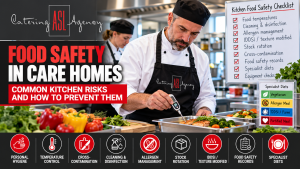
Food Safety in Care Homes: Common Kitchen Risks and How to Prevent Them

Care home chefs following food safety procedures including temperature control, allergen management, cleaning and cross-contamination prevention.

Common Kitchen Risks and How to Prevent Them. Food safety matters in every commercial kitchen, but within a care home it carries particular importance. Residents may include older people and people with complex health or dietary needs. Care-home catering teams therefore need reliable food-safety systems, good communication and consistent kitchen procedures every day. The Food Standards Agency’s food hygiene guidance for businesses identifies key areas including cleaning, cooking, chilling, personal hygiene and preventing cross-contamination. Within a care-home kitchen, these basic principles operate alongside additional responsibilities such as managing food allergies, specialist diets, texture-modified meals, resident preferences and the safe delivery of meals around the home. Good food safety is therefore about much more than keeping a kitchen visibly clean. It means creating a system in which safe practices are understood and followed on every shift.

Why Food Safety Is Particularly Important in Care Homes

A busy care-home kitchen may prepare breakfast, lunch, evening meals, desserts, snacks and drinks alongside individual alternatives and specialist meals. At a single service, the kitchen may be producing standard meals, allergen-managed meals, fortified dishes and texture-modified foods for different residents. Every additional requirement makes accurate systems and communication increasingly important. Care-home catering also contributes directly to resident wellbeing. Meals need to be nutritious and enjoyable, but they must also be stored, prepared and served safely. The Food Standards Agency’s food hygiene guidance provides practical information for food businesses on managing these responsibilities.

The Four Fundamental Areas of Food Hygiene

Four particularly important principles underpin safe food preparation.

Cleaning

Hands, equipment, utensils and food-contact surfaces need to be kept appropriately clean to reduce the risk of harmful microorganisms and other contamination spreading around the kitchen.

Cooking

Foods that require cooking need to be cooked sufficiently to make them safe. Kitchen staff should follow the cooking procedures and checks contained within the care home’s food-safety management system.

Chilling

Foods requiring refrigeration need appropriate temperature control throughout storage and handling. Kitchen teams should know what checks are required, how they are recorded and what action should be taken if temperatures fall outside the home’s accepted limits.

Preventing Cross-Contamination

Raw foods, ready-to-eat foods, equipment, surfaces, cloths and hands can all provide routes for contamination. Good kitchen organisation and safe working practices are therefore essential.

12 Common Food-Safety Risks in Care Home Kitchens

Understanding where problems can occur helps kitchen teams prevent them.

1. Poor Hand Hygiene

Hands can transfer contamination between food, equipment and surfaces. Effective handwashing is therefore one of the simplest but most important food-safety controls. Staff should understand when handwashing is required, including after handling raw food, visiting the toilet, handling waste or undertaking another activity that could contaminate their hands. Disposable gloves do not replace good hand hygiene. Used incorrectly, gloves can simply transfer contamination from one surface or food to another.

2. Cross-Contamination Between Raw and Ready-to-Eat Foods

Cross-contamination can occur through chopping boards, knives, work surfaces, cloths, containers, equipment and hands. Raw and ready-to-eat foods therefore need to be managed in accordance with the home’s food-safety procedures. The FSA includes avoiding cross-contamination as one of its central food-hygiene principles. Further information is available from the Food Standards Agency’s official food hygiene resource.

3. Incorrect Chilled Storage

Refrigeration is an important control because low temperatures slow the growth of many harmful bacteria. But temperature monitoring is only useful when action follows an unacceptable reading. Care-home kitchens should have clear procedures covering temperature checks, recording, reporting faulty equipment and protecting food when refrigeration equipment is not operating correctly. Repeatedly recording an abnormal temperature without investigating or taking appropriate action defeats the purpose of monitoring.

4. Inadequate Cooking

Food that requires cooking must be cooked safely. Care-home chefs should follow the cooking methods and monitoring procedures established within the home’s food-safety management system. Where temperature probes are used, staff should also know how to use and clean them correctly so the probe itself does not become a route for cross-contamination.

5. Unsafe Reheating

Reheating needs the same disciplined approach as initial cooking. Food should be reheated according to the home’s documented safe methods, and kitchen staff should understand which foods can be reheated and how they should be handled. The important principle is consistency: staff should not improvise different food-safety procedures from one shift to another.

6. Poor Cleaning and Disinfection

A surface can look clean without necessarily being hygienically safe. An effective cleaning system should cover relevant areas and equipment throughout the kitchen, including food-contact surfaces, chopping boards, refrigerators, handles, sinks, equipment, floors and storage areas. Staff also need to understand which cleaning products are used, where they should be used and the correct method of application. The official Safer Food, Better Business guidance includes cleaning as one of the principal areas of its food-safety management system.

7. Poor Date Control and Stock Rotation

Busy kitchens can accumulate significant quantities of food. Without effective organisation, older products can disappear behind newer deliveries. Good stock management should therefore include checking deliveries, following date information, correct storage, appropriate labelling and effective stock rotation. FIFO — First In, First Out — can be a useful stock-management principle, but it does not replace checking use-by dates and individual storage instructions. Effective stock management can also help reduce unnecessary food waste.

8. Out-of-Date Allergen Information

Allergen management requires particular attention because ingredients can change. Suppliers change. Brands change. Recipes change. Products may be substituted. The kitchen should therefore never assume that allergen information remains unchanged indefinitely. Where residents have identified food allergies, catering staff need access to accurate information about both the resident’s requirements and the ingredients being used. Communication between care staff and catering staff is particularly important when a resident’s dietary requirements change.

9. Confusing Specialist Meals

A single lunch service might involve standard meals, vegetarian meals, fortified meals, allergen-managed dishes, texture-modified meals and individual alternatives. The kitchen’s responsibility does not end when the correct meal has been prepared. The correct meal must reach the correct resident. Clear identification, communication and service procedures are therefore important throughout the complete journey from preparation to the resident.

10. Staff Working While Unwell

Food handlers can present a food-safety risk if they work while suffering from certain illnesses. Kitchen employees should understand the organisation’s sickness-reporting procedures and know when symptoms must be reported. This also needs to be communicated to temporary and relief chefs. A chef entering an unfamiliar care home should know who to contact if an illness or other issue may affect their fitness to handle food safely.

11. Incomplete Food-Safety Records

Paperwork alone does not make food safe. However, appropriate records can help demonstrate that important controls are being monitored and that problems are acted upon. Depending on the home’s food-safety management system, records may cover areas including refrigeration, cooking, cleaning, deliveries and corrective actions. The official Safer Food, Better Business guidance advises businesses using the system to retain completed diary pages because local-authority food-safety officers may wish to examine them. Records should reflect what actually happened in the kitchen. Completing checks retrospectively simply to make paperwork appear complete undermines the purpose of the system.

12. Poor Handover to Relief or Temporary Chefs

An experienced relief chef can walk into a kitchen with excellent professional knowledge, but they cannot automatically know how that particular care home operates. They may need information about resident allergies, specialist diets, IDDSI requirements, food-safety records, equipment, menus, cleaning procedures and changes affecting the current shift. A proper kitchen handover therefore matters. For care homes requiring experienced temporary support, ASL Catering Agency’s Care Home Chef Recruitment service provides specialist chef recruitment for care homes, residential homes and nursing homes. Experienced care-home chefs interested in working with ASL can also visit Join Our Chef Network.

Safer Food, Better Business for Residential Care Homes

An important current resource for the sector is the Food Standards Agency’s Safer Food, Better Business supplement for residential care homes. Published on 25 June 2026, it is a food-safety management resource for small residential care homes that prepare and cook food for residents. Care-home managers and catering teams can access it free through the official government website: Safer Food, Better Business Supplement for Residential Care Homes – GOV.UK This is a particularly useful external resource to retain alongside the home’s own food-safety arrangements.

Food Safety Starts When a Delivery Arrives

Safe catering begins before ingredients reach the kitchen shelves. When deliveries arrive, relevant checks may include the condition of packaging, date information, chilled or frozen condition where appropriate and whether the correct products have been supplied. Substituted products deserve particular attention. A supplier substitution may not simply affect the recipe or cost. Different ingredients may contain different allergens, so the replacement product needs to be checked before it is used.

Safe Storage Requires Organisation

Good storage supports several food-safety controls simultaneously. Food should be stored according to its requirements, protected from contamination, appropriately labelled and easy for kitchen staff to identify. Raw and ready-to-eat foods should be separated as required by the home’s food-safety system. An overcrowded and disorganised refrigerator also makes effective cleaning, stock rotation and identification of food considerably harder. Kitchen organisation is therefore part of food safety, not merely tidiness.

Cleaning Schedules Must Work in Practice

A professionally presented cleaning schedule achieves very little if nobody follows it. Responsibilities need to be clear. Kitchen staff should understand what needs cleaning, how often it needs cleaning, which method and products should be used and how required checks are recorded. Cleaning systems should also evolve with the kitchen. If equipment is replaced or new equipment is introduced, managers should consider whether cleaning arrangements need updating.

Pest Awareness

Food premises can attract pests when food, waste and access points are not effectively controlled. Kitchen staff should remain alert for potential signs of pest activity, including damaged packaging, droppings, insect activity or unusual evidence around storage and waste areas. Suspected pest activity should be reported through the home’s established procedure rather than ignored.

Training Must Match the Job

Food handlers need appropriate supervision, instruction and/or training for the work they carry out. A particular training certificate should not be confused with the underlying legal requirement for food handlers to have appropriate food-hygiene knowledge for their responsibilities. Training can nevertheless provide a structured way for chefs and catering staff to develop and refresh that knowledge. For teams wishing to develop their care and catering knowledge, FlexiLearnHub provides online training covering areas including Food Safety & Hygiene, HACCP, Allergen Awareness, Nutrition & Hydration and Dysphagia & IDDSI Awareness.

Care Home Kitchen Food-Safety Checklist

Personal Hygiene

☐ Staff understand handwashing requirements ☐ Appropriate protective clothing is used ☐ Sickness-reporting procedures are understood ☐ Temporary and relief staff receive appropriate information

Storage

☐ Required refrigeration checks are completed ☐ Frozen storage is appropriately managed ☐ Food is protected from contamination ☐ Date controls are followed ☐ Stock is rotated effectively ☐ Raw and ready-to-eat foods are appropriately separated

Preparation

☐ Cross-contamination controls are followed ☐ Equipment and surfaces are appropriately cleaned ☐ Allergen information is current ☐ Specialist meals are clearly identified

Cooking and Service

☐ Cooking procedures are followed ☐ Reheating procedures are followed ☐ Hot and cold holding controls are understood ☐ Specialist meals reach the correct resident ☐ Food is protected during transfer and service

Cleaning

☐ The cleaning schedule is current ☐ Appropriate cleaning products are available ☐ Staff understand the required cleaning methods ☐ Food-contact equipment receives appropriate attention

Management

☐ Food-safety records are completed accurately ☐ Corrective actions are recorded where required ☐ Equipment faults are reported ☐ Pest concerns are reported ☐ Relief chefs receive an appropriate kitchen handover

Why Experienced Care Home Chefs Matter

Care-home catering requires considerably more than culinary ability. A chef may simultaneously be responsible for food hygiene, allergens, specialist diets, IDDSI requirements, resident preferences, stock control, cleaning, documentation, temperature controls and meal service. Experienced care-home chefs understand that producing attractive food is only one part of the job. Meals also need to be safe, appropriate and suitable for the resident receiving them. ASL Catering Agency Ltd specialises in supplying experienced chefs to care homes, residential homes and nursing homes. Care providers looking for specialist recruitment support can find further information through our Care Home, Residential & Nursing Home Chef Recruitment service. Our growing Care Home Catering Blog also contains practical guidance covering catering, recruitment, training and professional standards within care environments.

Frequently Asked Questions

What are the main food-safety risks in a care-home kitchen?

Common risks include cross-contamination, inadequate cooking or chilling, poor cleaning, incorrect storage, ineffective allergen controls, poor personal hygiene and failures in communication surrounding specialist meals. The Food Standards Agency’s Food Hygiene for Businesses guidance provides further official information on cleaning, cooking, chilling, personal hygiene and cross-contamination.

What is Safer Food, Better Business?

Safer Food, Better Business — often abbreviated to SFBB — is a Food Standards Agency food-safety management system designed to help relevant food businesses manage food safely and demonstrate their procedures. There is now a specific SFBB supplement for residential care homes.

Are food-safety records important?

Yes. Appropriate records can help demonstrate that food-safety controls are being monitored and that action is taken when problems occur. Businesses using SFBB are advised to retain completed diary pages because local-authority food-safety officers may wish to review them. Further information is available in the official SFBB guidance.

Should a relief chef use their own food-safety procedures?

A relief chef should work within the food business’s established food-safety management system and procedures. An experienced chef should raise concerns if something appears unsafe, but temporary responsibility for the kitchen does not mean replacing the home’s established system with a chef’s preferred paperwork or methods.

Why is a kitchen handover important for a relief chef?

Every care home operates slightly differently. A handover can provide important information about resident diets, allergens, texture-modified meals, menus, food-safety records, equipment, cleaning arrangements and changes affecting the shift. This allows an experienced relief chef to understand the kitchen much more quickly while maintaining continuity.

Official Food-Safety Resources

Care-home managers and catering professionals may also find the following official resources useful: Food Standards Agency – Food Hygiene for Businesses GOV.UK – Safer Food, Better Business for Residential Care Homes GOV.UK – Safer Food, Better Business Full Guidance External authority resources should be set to open in a new tab when adding the article to WordPress.

Food Safety Depends on Consistency

A care-home kitchen can have excellent policies, modern equipment and comprehensive paperwork. None of those replaces consistent everyday practice. Food safety depends on chefs and catering staff applying appropriate controls during every delivery, preparation task and meal service. That means washing hands when required. Separating foods appropriately. Monitoring temperatures. Managing allergens carefully. Cleaning effectively. Completing records accurately. Reporting problems. And making sure everyone working in the kitchen — including temporary and relief chefs — understands how the kitchen operates. When those practices become part of the everyday culture of a care-home kitchen, food safety stops being something staff think about only when an inspection is approaching. It becomes simply how the kitchen works. For specialist care-home chef recruitment and catering support, visit ASL Catering Agency Ltd or learn more about our Care Home Chef Recruitment service.

Visit FlexiLearnHub’s CPD & CQC Aligned certificated OnLine training courses

Our growing course library includes:

Thank you for visiting ASL Catering Agency
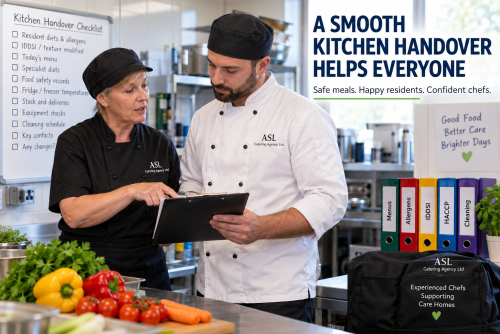
Two care home chefs completing a kitchen handover and reviewing resident diets, allergens, IDDSI requirements and food safety information.

Kitchen Handover in Care Homes: What Every Relief Chef Needs to Know

Walking into an unfamiliar care-home kitchen is very different from walking into an unfamiliar restaurant.

A relief chef may need to take responsibility for breakfast, lunch or dinner with relatively little time to become familiar with the kitchen.

But before cooking begins, there are important questions that need answering.

Which residents have food allergies?

Who requires a texture-modified diet?

Are any residents receiving fortified meals?

What is today’s menu?

Where are the food-safety records?

Have there been any changes to residents’ dietary requirements?

Are there deliveries expected?

Is any equipment out of service?

Who should the chef speak to if something is unclear?

A good care home chef handover helps answer these questions before service starts.

For experienced relief chefs, asking the right questions is part of the job. For care-home managers, providing accurate and accessible information helps a temporary chef work safely and effectively from the beginning of the shift.


Why Care Home Kitchen Handovers Matter

Care-home catering involves considerably more than preparing meals to a menu.

The kitchen may be catering simultaneously for residents with:

  • Food allergies and intolerances
  • Dysphagia
  • Texture-modified diets
  • Individual nutritional requirements
  • Fortified diets
  • Cultural or religious requirements
  • Vegetarian or other ethical preferences
  • Dementia-related eating difficulties
  • Reduced appetites
  • Individual likes and dislikes

CQC Regulation 14 requires providers to assess people’s nutritional and hydration needs and provide food that meets those needs. Specific diets must be provided in accordance with the person’s assessment, and staff should follow the most up-to-date nutritional and hydration information.

A relief chef therefore needs more than a menu and directions to the fridge.

They need the relevant information required to prepare each resident’s food safely and correctly.


A Handover Is a Two-Way Process

A good handover is not simply somebody giving the chef a folder.

The home needs to communicate relevant information, but an experienced relief chef should also ask questions where anything is unclear.

A sensible approach is:

Information → Confirmation → Questions → Preparation → Service → Feedback

If something does not make sense, it should be clarified before assumptions are made.

This is particularly important with allergies, specialist diets and texture-modified meals.


1. Start With Resident Dietary Requirements

One of the first things a relief chef needs to understand is who they are cooking for.

Relevant dietary information may include:

  • Allergies
  • Intolerances
  • Religious or cultural requirements
  • Vegetarian or other ethical diets
  • Texture-modified requirements
  • Fortification requirements
  • Individual nutritional instructions
  • Significant preferences or dislikes
  • Suitable alternatives

This information needs to be current and communicated through the home’s approved system.

The Food Standards Agency specifically states that care homes should have a process ensuring dietary needs recorded in a resident’s care record are communicated to those serving the food.

That communication chain is critical.


2. Food Allergies Must Be Clear Before Cooking Starts

Allergy information should never depend on somebody remembering to mention it halfway through service.

The relief chef needs to know which residents have allergies and what procedures the home uses to manage them.

The FSA emphasises that institutions such as care homes are responsible for protecting the people in their care and should have processes enabling individuals with allergies or intolerances to receive safe food options. Staff handling food must understand allergen rules and the institution’s allergen-management policy.

A chef may therefore need to establish:

  • Which residents have documented allergies?
  • What allergens are involved?
  • Where is the home’s current allergen information?
  • How are allergen-safe meals identified?
  • What controls are used to prevent cross-contact?
  • Have any ingredients or recipes recently changed?
  • How are meals matched to the correct resident?

If the information is unclear, stop and clarify it.

Guessing is not an allergen-control procedure.


3. Check Texture-Modified and IDDSI Requirements

Residents with professionally assessed swallowing difficulties may require food prepared to a specific texture.

A relief chef needs clear information about each relevant resident’s current requirements.

This might include an IDDSI level or another requirement specified within the resident’s care documentation.

The chef should not independently decide that somebody “looks like they need softer food” or alter a professionally assessed texture because another option seems easier.

CQC states that where a person has been assessed as needing a specific diet, it must be provided in accordance with that assessment.

Where IDDSI is used, the chef should understand how to prepare and check the required food texture correctly.


4. Understand Fortification and Nutritional Instructions

Some residents may have individual nutritional plans requiring fortified meals, smaller portions, snacks or other adaptations.

A relief chef should establish which requirements apply to which residents.

For example:

  • Does somebody require fortified food?
  • Is a particular recipe or fortification method used?
  • Does somebody require a smaller portion?
  • Are snacks required between meals?
  • Are there prescribed nutritional supplements handled by appropriate staff?

The chef should follow the home’s current instructions rather than creating their own nutritional intervention.

CQC requires nutritional needs to be reviewed and changes responded to appropriately. It also states that prescribed nutritional supplements must be provided according to the relevant professional requirements.


5. Review Today’s Menu Before Starting Preparation

Once resident requirements are understood, the chef needs to establish what is actually being served.

Check:

  • Breakfast requirements
  • Lunch menu
  • Evening meal
  • Desserts
  • Alternatives
  • Snacks
  • Specialist-diet adaptations
  • Expected covers
  • Portion requirements
  • Any planned events or visitors

It is also useful to ask whether any menu substitutions have already been made.

A delivery shortage may have changed today’s meal before the relief chef arrived.

Any substitution must still work with the home’s allergen controls and residents’ dietary requirements.


6. Know the Alternative Meal Procedure

Even a popular menu will not suit every resident.

A relief chef should understand what alternatives the home normally provides and how they are requested.

That could be particularly important where somebody:

  • Dislikes the main option
  • Has an allergy
  • Has a specialist dietary requirement
  • Has a reduced appetite
  • Has changed their preference
  • Requires an adapted version of the meal

CQC requires people’s preferences and reasonable cultural or religious requirements to be considered, and people should be able to make choices about their diet.

The relief chef should therefore know what meaningful alternatives are available rather than improvising unnecessarily during service.


7. Check the Food-Safety Management System

Before taking responsibility for an unfamiliar kitchen, the chef should know which food-safety management system the home uses and where the relevant records are kept.

For appropriate residential care settings, the Food Standards Agency provides Safer Food, Better Business (SFBB) guidance and a specific residential-care-home supplement. The current residential supplement was published on 25 June 2026.

SFBB covers areas including:

  • Cross-contamination
  • Cleaning
  • Chilling
  • Cooking
  • Management
  • Daily records

The FSA explains that completed diary pages should be retained because a local-authority food-safety officer may want to inspect them.

A relief chef should therefore establish what records they are expected to complete during their shift.


8. Check Refrigeration and Freezer Temperatures

A sensible kitchen takeover includes checking that cold-storage equipment appears to be operating correctly and reviewing the home’s required temperature records.

The chef should know:

  • Which fridges and freezers are in use
  • Where temperatures are recorded
  • Whether previous checks have been completed
  • Whether any unit has a known problem
  • What the home’s procedure is if a temperature is outside its acceptable range

If a fridge is already malfunctioning when the chef arrives, that is information they need before loading it with food.


9. Understand Cooking, Cooling and Reheating Procedures

Different kitchens may use different equipment and workflows.

A relief chef should familiarise themselves with the home’s procedures for:

  • Cooking
  • Hot holding
  • Cooling
  • Reheating
  • Chilling
  • Food storage
  • Labelling
  • Date control
  • Leftovers

The FSA’s SFBB system is designed to help food businesses document how they prepare and store food safely and demonstrate the hygiene practices they have in place.

A chef should work within the home’s food-safety system rather than importing an entirely different procedure simply because that is what they used elsewhere.


10. Review Cleaning Arrangements

An unfamiliar chef needs to know what cleaning responsibilities apply during their shift.

That may include:

  • Work surfaces
  • Cooking equipment
  • Floors
  • Refrigeration
  • Food-contact equipment
  • Sinks
  • Storage areas
  • Waste areas
  • Specialist equipment

They should also know where cleaning chemicals are stored and the home’s arrangements for safe use.

If there is a cleaning schedule, check what has already been completed and what remains outstanding.


11. Check Equipment Before Service

Nothing disrupts lunch quite like discovering the oven does not work when the roast is due to go in.

A practical handover should identify any:

  • Faulty ovens
  • Broken mixers
  • Refrigeration problems
  • Dishwasher issues
  • Damaged utensils
  • Equipment awaiting repair
  • Items that must not be used

Where equipment presents a safety concern, the chef should follow the home’s reporting and escalation procedure.

Never assume that a handwritten “DO NOT USE” sign is optional.


12. Understand Stock and Deliveries

A relief chef should quickly establish:

  • What stock is available
  • What has already been ordered
  • Whether a delivery is expected
  • Whether anything is unavailable
  • Where specialist-diet ingredients are stored
  • How allergen-sensitive ingredients are managed
  • Whether any supplier substitutions have occurred

This helps prevent unnecessary emergency purchasing and allows the chef to identify problems before preparation begins.

Stock knowledge is particularly important when today’s planned menu depends on ingredients that have not arrived.


13. Know Who to Speak To

Every relief chef should know their key contact within the home.

Depending on the organisation, this could be:

  • Registered manager
  • Deputy manager
  • Nurse in charge
  • Senior carer
  • Catering manager
  • Head chef
  • Facilities manager

The chef should know who can answer questions about resident dietary requirements and who should be contacted if a food-safety or equipment problem arises.

A handover is far more effective when everybody knows who has responsibility for what.


14. Understand Meal Service Arrangements

Preparing the food correctly is only part of the process.

The chef should also understand how meals leave the kitchen and reach residents.

Questions may include:

  • What time is service?
  • Is food plated in the kitchen or elsewhere?
  • How are specialist meals identified?
  • How are allergen-safe meals identified?
  • How are meals kept at an appropriate temperature?
  • How does the kitchen know which resident receives which meal?
  • Who communicates last-minute changes?

CQC requires food to be suitable, nutritious and appetising and served at an appropriate temperature.

The handover therefore needs to cover service, not just cooking.


15. Ask About Changes Since the Previous Shift

This is one of the simplest but most valuable questions:

“Has anything changed?”

A resident’s requirements may have changed.

A new resident may have arrived.

Someone may have returned from hospital.

A supplier may have substituted an ingredient.

A piece of equipment may have failed.

A menu may have changed.

A good handover should highlight anything new rather than assuming the relief chef can identify every change from paperwork alone.


Protect Confidential Resident Information

A relief chef may need access to relevant dietary information to do their job safely.

That does not mean they need unrestricted access to every aspect of a resident’s care record.

Information should be handled according to the home’s confidentiality and data-protection procedures.

The principle is straightforward:

Provide the chef with the relevant information they need to prepare food safely, and handle that information appropriately.


Care Home Relief Chef Handover Checklist

This is the section I would make particularly prominent in WordPress because managers could genuinely use it.

Resident Information

☐ Current dietary requirements available

☐ Allergies and intolerances clearly identified

☐ Texture-modified requirements confirmed

☐ IDDSI information available where applicable

☐ Fortification requirements identified

☐ Cultural/religious requirements known

☐ Important preferences and dislikes communicated

Menu & Service

☐ Today’s menu checked

☐ Expected number of meals confirmed

☐ Alternatives understood

☐ Specialist-diet adaptations planned

☐ Meal times confirmed

☐ Service procedure understood

☐ Method for identifying specialist meals confirmed

Food Safety

☐ Food-safety management system located

☐ Required daily records identified

☐ Fridge/freezer checks reviewed

☐ Cooking/hot-holding procedures understood

☐ Cooling/reheating procedures understood

☐ Allergen procedures understood

☐ Cleaning schedule reviewed

Kitchen

☐ Equipment checked

☐ Known faults identified

☐ Stock levels reviewed

☐ Deliveries confirmed

☐ Specialist ingredients located

☐ Waste arrangements understood

Communication

☐ Manager/person in charge identified

☐ Dietary-query contact identified

☐ Equipment/facilities contact identified

☐ Changes since previous shift discussed

☐ End-of-shift handover expectations understood


What Should a Relief Chef Do If the Handover Is Incomplete?

Occasionally a relief chef may arrive and find that information is missing or unclear.

The answer is not to guess.

If the uncertainty concerns something safety-critical—particularly an allergy, specialist diet or texture requirement—the chef should seek clarification from the appropriate person before preparing or serving the affected meal.

An experienced relief chef should be confident enough to say:

“I need this confirmed before I can safely prepare that resident’s meal.”

That is professional practice, not being difficult.


The End-of-Shift Handover Matters Too

Handover works both ways.

Before leaving, the relief chef may need to communicate relevant information to the manager, care team or incoming chef.

Examples could include:

  • Low stock
  • Missing ingredients
  • Supplier issues
  • Equipment faults
  • Food-safety concerns
  • Menu changes
  • Relevant resident feedback
  • Unusual levels of plate waste
  • Records requiring follow-up

The next chef should not have to rediscover problems that were already identified during the previous shift.


Why Experienced Care Home Relief Chefs Matter

A strong relief chef does more than arrive, put on a jacket and start cooking.

They understand that an unfamiliar care-home kitchen requires careful orientation.

They know which questions to ask.

They understand the importance of allergens.

They recognise that IDDSI and texture requirements cannot be guessed.

They appreciate the importance of resident choice and nutritional needs.

And they understand that food-safety records, communication and handover are part of professional care-home catering.

That is why specialist sector experience can be so valuable.

At ASL Catering Agency Ltd, we specialise in supplying experienced chefs to care homes, residential homes and nursing homes requiring temporary, relief and emergency catering support.

This is where I’d place your internal links to Relief Chefs for Care Homes, Emergency Chef Cover and Request a Chef.


Relevant Training for Care Home Chefs

For this article I would keep the FlexiLearnHub training links very focused.

The most relevant subjects are:

  • Dysphagia & IDDSI Awareness
  • Food Safety & Hygiene Level 2
  • HACCP Level 2
  • Allergen Awareness

These are directly connected with the areas a relief chef may encounter when taking responsibility for an unfamiliar care-home kitchen.

I wouldn’t add unrelated care courses simply to increase the number of links.


Frequently Asked Questions

What should be included in a care home chef handover?

A practical handover should provide the chef with the information necessary for the shift, including current resident dietary requirements, allergies, texture requirements, menus, specialist meals, food-safety procedures, relevant records, equipment issues, stock and key contacts.

Is a written chef handover legally required?There is not one universal statutory document called a “care home chef handover form”. However, providers have legal and regulatory responsibilities around safe care, nutrition and hydration, and food safety. Systems therefore need to ensure the people preparing and serving food have the relevant current information required to do so safely. CQC requires specific assessed diets to be provided correctly, while FSA guidance specifically requires a process for communicating residents’ dietary needs to those serving their food.

What should a relief chef do if allergy information is unclear?

They should seek clarification through the home’s established procedure before preparing or serving food for the affected resident. Allergy information should never be guessed.

Can a relief chef change a resident’s IDDSI level?

A chef should not independently change a resident’s professionally assessed dietary requirement. The kitchen should follow the resident’s current documented requirements and seek clarification from the appropriate care or healthcare professional where information is unclear.

Should relief chefs complete the home’s food-safety records?

They should follow the food business’s food-safety management system and complete whichever checks and records fall within their responsibilities during the shift. SFBB, where applicable, includes daily records to demonstrate food-safety practices.

Should the outgoing relief chef leave a handover?

Where there is relevant information for the next shift, yes. The home’s own procedures should determine how this is recorded and communicated.


Further Reading – Trusted UK Resources

I would add these at the bottom and set the external links to Open in New Tab:

CQC – Regulation 14: Meeting Nutritional and Hydration Needs

Food Standards Agency – Allergen Guidance for Institutional Caterers

Food Standards Agency – Safer Food, Better Business for Residential Care Homes

The residential-care supplement is especially useful supporting material because the current GOV.UK publication is dated 25 June 2026.


A Good Handover Sets the Chef Up for a Safe Shift

Relief chefs are often brought into care homes because the kitchen needs immediate support.

That urgency should never mean bypassing a proper handover.

Taking a few minutes at the beginning of a shift to confirm residents’ dietary requirements, allergies, specialist diets, menus, food-safety arrangements, equipment and key contacts can prevent confusion later.

The best handovers are clear, current and practical.

And the best relief chefs understand that asking questions before cooking is part of delivering a professional service.

For care homes needing experienced temporary or emergency catering support, this is where I’d finish with your Request a Chef call to action.

For experienced care-home chefs looking for temporary and relief work, we can also link to Join Our Chef Network.

Visit FlexiLearnHub’s CPD & CQC Aligned certificated OnLine training courses

Our growing course library includes:

Thank you for visiting FlexiLearnHub

Stay Compliant and Safe: Enrol in Allergens UK Course on FlexiLearnHub

📢 New Course Alert: Master Food Allergen Safety with Our Allergens UK Course

At ASL Catering Agency, we understand how critical allergen awareness is across every sector of the food industry. That’s why we’ve launched our Allergens UK course on our dedicated training platform, FlexiLearnHub.

Food allergens are a serious matter — not just for compliance, but for safety, trust, and reputation. Whether you’re a catering assistant, chef, kitchen manager, or working in the care or hospitality sector, this course is essential.


🧠 What’s Covered in the Allergens UK Course?

This easy-to-follow online course is packed with up-to-date information aligned with UK food safety regulations — including Natasha’s Law.

Topics include:

✅ Understanding the 14 major allergens
✅ Legal obligations under UK legislation
✅ Practical allergen management in kitchens
✅ Cross-contamination risks & how to prevent them
✅ Allergen labelling & customer communication
✅ Compliance with Natasha’s Law (2021)
✅ Interactive case studies & final quiz

🕒 Duration: 45–60 minutes
💻 Format: 100% online, self-paced
📜 Certificate: Instant download on completion

➡️ Start Learning Now: Enrol in the Allergens UK Course


⚠️ Why Allergen Training Is Critical

Allergic reactions can be life-threatening — and the food industry has a legal and ethical responsibility to protect customers and service users.

Whether you’re prepping school meals, running a care home kitchen, or managing a food truck, allergen safety isn’t optional — it’s vital.

This course will empower your team to:

  • Stay compliant with UK food regulations
  • Avoid costly legal and reputational risks
  • Protect vulnerable individuals in your care
  • Gain confidence in managing food safely

👥 Who Is This Course For?

Perfect for:

  • Contract and agency catering staff
  • Chefs and kitchen operatives
  • Front-of-house teams
  • Food handlers in care, education, and healthcare
  • Hospitality and events teams
  • Anyone working with food!

🔐 About Natasha’s Law

Introduced in 2021, Natasha’s Law requires all food businesses to provide full ingredient labelling on pre-packed for direct sale (PPDS) foods. This course explains what it means for your role and how to stay compliant.


🎯 Why Choose FlexiLearnHub?

As a training partner developed by ASL Catering Agency, FlexiLearnHub offers:

✔️ Easy-to-access online learning
✔️ Industry-specific content
✔️ Mobile-friendly platform
✔️ Certificates for compliance and CPD portfolios
✔️ Trusted by care providers, schools, and catering agencies

➡️ Visit www.flexilearnhub.com to explore all available courses.


🗓️ Enrol Today and Stay Compliant

Food allergen awareness is not just a box to tick — it’s a core part of delivering safe, inclusive, and compliant catering services.

📚 Enrol now and protect the people you serve:
👉 Allergens UK Course on FlexiLearnHub


📣 Stay In Touch

To keep up with new course releases, catering insights, and exclusive offers:

🌐 Main Website: www.aslcateringagency.co.uk
🎓 Training Platform: www.flexilearnhub.com
📧 Email: info@aslcateringagency.co.uk
📱 Follow Us on Social Media – links in footer!