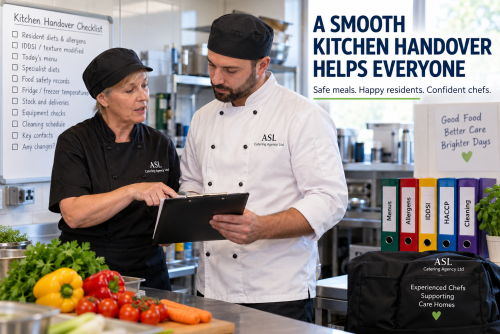
Two care home chefs completing a kitchen handover and reviewing resident diets, allergens, IDDSI requirements and food safety information.

Kitchen Handover in Care Homes: What Every Relief Chef Needs to Know

Walking into an unfamiliar care-home kitchen is very different from walking into an unfamiliar restaurant.

A relief chef may need to take responsibility for breakfast, lunch or dinner with relatively little time to become familiar with the kitchen.

But before cooking begins, there are important questions that need answering.

Which residents have food allergies?

Who requires a texture-modified diet?

Are any residents receiving fortified meals?

What is today’s menu?

Where are the food-safety records?

Have there been any changes to residents’ dietary requirements?

Are there deliveries expected?

Is any equipment out of service?

Who should the chef speak to if something is unclear?

A good care home chef handover helps answer these questions before service starts.

For experienced relief chefs, asking the right questions is part of the job. For care-home managers, providing accurate and accessible information helps a temporary chef work safely and effectively from the beginning of the shift.


Why Care Home Kitchen Handovers Matter

Care-home catering involves considerably more than preparing meals to a menu.

The kitchen may be catering simultaneously for residents with:

  • Food allergies and intolerances
  • Dysphagia
  • Texture-modified diets
  • Individual nutritional requirements
  • Fortified diets
  • Cultural or religious requirements
  • Vegetarian or other ethical preferences
  • Dementia-related eating difficulties
  • Reduced appetites
  • Individual likes and dislikes

CQC Regulation 14 requires providers to assess people’s nutritional and hydration needs and provide food that meets those needs. Specific diets must be provided in accordance with the person’s assessment, and staff should follow the most up-to-date nutritional and hydration information.

A relief chef therefore needs more than a menu and directions to the fridge.

They need the relevant information required to prepare each resident’s food safely and correctly.


A Handover Is a Two-Way Process

A good handover is not simply somebody giving the chef a folder.

The home needs to communicate relevant information, but an experienced relief chef should also ask questions where anything is unclear.

A sensible approach is:

Information → Confirmation → Questions → Preparation → Service → Feedback

If something does not make sense, it should be clarified before assumptions are made.

This is particularly important with allergies, specialist diets and texture-modified meals.


1. Start With Resident Dietary Requirements

One of the first things a relief chef needs to understand is who they are cooking for.

Relevant dietary information may include:

  • Allergies
  • Intolerances
  • Religious or cultural requirements
  • Vegetarian or other ethical diets
  • Texture-modified requirements
  • Fortification requirements
  • Individual nutritional instructions
  • Significant preferences or dislikes
  • Suitable alternatives

This information needs to be current and communicated through the home’s approved system.

The Food Standards Agency specifically states that care homes should have a process ensuring dietary needs recorded in a resident’s care record are communicated to those serving the food.

That communication chain is critical.


2. Food Allergies Must Be Clear Before Cooking Starts

Allergy information should never depend on somebody remembering to mention it halfway through service.

The relief chef needs to know which residents have allergies and what procedures the home uses to manage them.

The FSA emphasises that institutions such as care homes are responsible for protecting the people in their care and should have processes enabling individuals with allergies or intolerances to receive safe food options. Staff handling food must understand allergen rules and the institution’s allergen-management policy.

A chef may therefore need to establish:

  • Which residents have documented allergies?
  • What allergens are involved?
  • Where is the home’s current allergen information?
  • How are allergen-safe meals identified?
  • What controls are used to prevent cross-contact?
  • Have any ingredients or recipes recently changed?
  • How are meals matched to the correct resident?

If the information is unclear, stop and clarify it.

Guessing is not an allergen-control procedure.


3. Check Texture-Modified and IDDSI Requirements

Residents with professionally assessed swallowing difficulties may require food prepared to a specific texture.

A relief chef needs clear information about each relevant resident’s current requirements.

This might include an IDDSI level or another requirement specified within the resident’s care documentation.

The chef should not independently decide that somebody “looks like they need softer food” or alter a professionally assessed texture because another option seems easier.

CQC states that where a person has been assessed as needing a specific diet, it must be provided in accordance with that assessment.

Where IDDSI is used, the chef should understand how to prepare and check the required food texture correctly.


4. Understand Fortification and Nutritional Instructions

Some residents may have individual nutritional plans requiring fortified meals, smaller portions, snacks or other adaptations.

A relief chef should establish which requirements apply to which residents.

For example:

  • Does somebody require fortified food?
  • Is a particular recipe or fortification method used?
  • Does somebody require a smaller portion?
  • Are snacks required between meals?
  • Are there prescribed nutritional supplements handled by appropriate staff?

The chef should follow the home’s current instructions rather than creating their own nutritional intervention.

CQC requires nutritional needs to be reviewed and changes responded to appropriately. It also states that prescribed nutritional supplements must be provided according to the relevant professional requirements.


5. Review Today’s Menu Before Starting Preparation

Once resident requirements are understood, the chef needs to establish what is actually being served.

Check:

  • Breakfast requirements
  • Lunch menu
  • Evening meal
  • Desserts
  • Alternatives
  • Snacks
  • Specialist-diet adaptations
  • Expected covers
  • Portion requirements
  • Any planned events or visitors

It is also useful to ask whether any menu substitutions have already been made.

A delivery shortage may have changed today’s meal before the relief chef arrived.

Any substitution must still work with the home’s allergen controls and residents’ dietary requirements.


6. Know the Alternative Meal Procedure

Even a popular menu will not suit every resident.

A relief chef should understand what alternatives the home normally provides and how they are requested.

That could be particularly important where somebody:

  • Dislikes the main option
  • Has an allergy
  • Has a specialist dietary requirement
  • Has a reduced appetite
  • Has changed their preference
  • Requires an adapted version of the meal

CQC requires people’s preferences and reasonable cultural or religious requirements to be considered, and people should be able to make choices about their diet.

The relief chef should therefore know what meaningful alternatives are available rather than improvising unnecessarily during service.


7. Check the Food-Safety Management System

Before taking responsibility for an unfamiliar kitchen, the chef should know which food-safety management system the home uses and where the relevant records are kept.

For appropriate residential care settings, the Food Standards Agency provides Safer Food, Better Business (SFBB) guidance and a specific residential-care-home supplement. The current residential supplement was published on 25 June 2026.

SFBB covers areas including:

  • Cross-contamination
  • Cleaning
  • Chilling
  • Cooking
  • Management
  • Daily records

The FSA explains that completed diary pages should be retained because a local-authority food-safety officer may want to inspect them.

A relief chef should therefore establish what records they are expected to complete during their shift.


8. Check Refrigeration and Freezer Temperatures

A sensible kitchen takeover includes checking that cold-storage equipment appears to be operating correctly and reviewing the home’s required temperature records.

The chef should know:

  • Which fridges and freezers are in use
  • Where temperatures are recorded
  • Whether previous checks have been completed
  • Whether any unit has a known problem
  • What the home’s procedure is if a temperature is outside its acceptable range

If a fridge is already malfunctioning when the chef arrives, that is information they need before loading it with food.


9. Understand Cooking, Cooling and Reheating Procedures

Different kitchens may use different equipment and workflows.

A relief chef should familiarise themselves with the home’s procedures for:

  • Cooking
  • Hot holding
  • Cooling
  • Reheating
  • Chilling
  • Food storage
  • Labelling
  • Date control
  • Leftovers

The FSA’s SFBB system is designed to help food businesses document how they prepare and store food safely and demonstrate the hygiene practices they have in place.

A chef should work within the home’s food-safety system rather than importing an entirely different procedure simply because that is what they used elsewhere.


10. Review Cleaning Arrangements

An unfamiliar chef needs to know what cleaning responsibilities apply during their shift.

That may include:

  • Work surfaces
  • Cooking equipment
  • Floors
  • Refrigeration
  • Food-contact equipment
  • Sinks
  • Storage areas
  • Waste areas
  • Specialist equipment

They should also know where cleaning chemicals are stored and the home’s arrangements for safe use.

If there is a cleaning schedule, check what has already been completed and what remains outstanding.


11. Check Equipment Before Service

Nothing disrupts lunch quite like discovering the oven does not work when the roast is due to go in.

A practical handover should identify any:

  • Faulty ovens
  • Broken mixers
  • Refrigeration problems
  • Dishwasher issues
  • Damaged utensils
  • Equipment awaiting repair
  • Items that must not be used

Where equipment presents a safety concern, the chef should follow the home’s reporting and escalation procedure.

Never assume that a handwritten “DO NOT USE” sign is optional.


12. Understand Stock and Deliveries

A relief chef should quickly establish:

  • What stock is available
  • What has already been ordered
  • Whether a delivery is expected
  • Whether anything is unavailable
  • Where specialist-diet ingredients are stored
  • How allergen-sensitive ingredients are managed
  • Whether any supplier substitutions have occurred

This helps prevent unnecessary emergency purchasing and allows the chef to identify problems before preparation begins.

Stock knowledge is particularly important when today’s planned menu depends on ingredients that have not arrived.


13. Know Who to Speak To

Every relief chef should know their key contact within the home.

Depending on the organisation, this could be:

  • Registered manager
  • Deputy manager
  • Nurse in charge
  • Senior carer
  • Catering manager
  • Head chef
  • Facilities manager

The chef should know who can answer questions about resident dietary requirements and who should be contacted if a food-safety or equipment problem arises.

A handover is far more effective when everybody knows who has responsibility for what.


14. Understand Meal Service Arrangements

Preparing the food correctly is only part of the process.

The chef should also understand how meals leave the kitchen and reach residents.

Questions may include:

  • What time is service?
  • Is food plated in the kitchen or elsewhere?
  • How are specialist meals identified?
  • How are allergen-safe meals identified?
  • How are meals kept at an appropriate temperature?
  • How does the kitchen know which resident receives which meal?
  • Who communicates last-minute changes?

CQC requires food to be suitable, nutritious and appetising and served at an appropriate temperature.

The handover therefore needs to cover service, not just cooking.


15. Ask About Changes Since the Previous Shift

This is one of the simplest but most valuable questions:

“Has anything changed?”

A resident’s requirements may have changed.

A new resident may have arrived.

Someone may have returned from hospital.

A supplier may have substituted an ingredient.

A piece of equipment may have failed.

A menu may have changed.

A good handover should highlight anything new rather than assuming the relief chef can identify every change from paperwork alone.


Protect Confidential Resident Information

A relief chef may need access to relevant dietary information to do their job safely.

That does not mean they need unrestricted access to every aspect of a resident’s care record.

Information should be handled according to the home’s confidentiality and data-protection procedures.

The principle is straightforward:

Provide the chef with the relevant information they need to prepare food safely, and handle that information appropriately.


Care Home Relief Chef Handover Checklist

This is the section I would make particularly prominent in WordPress because managers could genuinely use it.

Resident Information

☐ Current dietary requirements available

☐ Allergies and intolerances clearly identified

☐ Texture-modified requirements confirmed

☐ IDDSI information available where applicable

☐ Fortification requirements identified

☐ Cultural/religious requirements known

☐ Important preferences and dislikes communicated

Menu & Service

☐ Today’s menu checked

☐ Expected number of meals confirmed

☐ Alternatives understood

☐ Specialist-diet adaptations planned

☐ Meal times confirmed

☐ Service procedure understood

☐ Method for identifying specialist meals confirmed

Food Safety

☐ Food-safety management system located

☐ Required daily records identified

☐ Fridge/freezer checks reviewed

☐ Cooking/hot-holding procedures understood

☐ Cooling/reheating procedures understood

☐ Allergen procedures understood

☐ Cleaning schedule reviewed

Kitchen

☐ Equipment checked

☐ Known faults identified

☐ Stock levels reviewed

☐ Deliveries confirmed

☐ Specialist ingredients located

☐ Waste arrangements understood

Communication

☐ Manager/person in charge identified

☐ Dietary-query contact identified

☐ Equipment/facilities contact identified

☐ Changes since previous shift discussed

☐ End-of-shift handover expectations understood


What Should a Relief Chef Do If the Handover Is Incomplete?

Occasionally a relief chef may arrive and find that information is missing or unclear.

The answer is not to guess.

If the uncertainty concerns something safety-critical—particularly an allergy, specialist diet or texture requirement—the chef should seek clarification from the appropriate person before preparing or serving the affected meal.

An experienced relief chef should be confident enough to say:

“I need this confirmed before I can safely prepare that resident’s meal.”

That is professional practice, not being difficult.


The End-of-Shift Handover Matters Too

Handover works both ways.

Before leaving, the relief chef may need to communicate relevant information to the manager, care team or incoming chef.

Examples could include:

  • Low stock
  • Missing ingredients
  • Supplier issues
  • Equipment faults
  • Food-safety concerns
  • Menu changes
  • Relevant resident feedback
  • Unusual levels of plate waste
  • Records requiring follow-up

The next chef should not have to rediscover problems that were already identified during the previous shift.


Why Experienced Care Home Relief Chefs Matter

A strong relief chef does more than arrive, put on a jacket and start cooking.

They understand that an unfamiliar care-home kitchen requires careful orientation.

They know which questions to ask.

They understand the importance of allergens.

They recognise that IDDSI and texture requirements cannot be guessed.

They appreciate the importance of resident choice and nutritional needs.

And they understand that food-safety records, communication and handover are part of professional care-home catering.

That is why specialist sector experience can be so valuable.

At ASL Catering Agency Ltd, we specialise in supplying experienced chefs to care homes, residential homes and nursing homes requiring temporary, relief and emergency catering support.

This is where I’d place your internal links to Relief Chefs for Care Homes, Emergency Chef Cover and Request a Chef.


Relevant Training for Care Home Chefs

For this article I would keep the FlexiLearnHub training links very focused.

The most relevant subjects are:

  • Dysphagia & IDDSI Awareness
  • Food Safety & Hygiene Level 2
  • HACCP Level 2
  • Allergen Awareness

These are directly connected with the areas a relief chef may encounter when taking responsibility for an unfamiliar care-home kitchen.

I wouldn’t add unrelated care courses simply to increase the number of links.


Frequently Asked Questions

What should be included in a care home chef handover?

A practical handover should provide the chef with the information necessary for the shift, including current resident dietary requirements, allergies, texture requirements, menus, specialist meals, food-safety procedures, relevant records, equipment issues, stock and key contacts.

Is a written chef handover legally required?There is not one universal statutory document called a “care home chef handover form”. However, providers have legal and regulatory responsibilities around safe care, nutrition and hydration, and food safety. Systems therefore need to ensure the people preparing and serving food have the relevant current information required to do so safely. CQC requires specific assessed diets to be provided correctly, while FSA guidance specifically requires a process for communicating residents’ dietary needs to those serving their food.

What should a relief chef do if allergy information is unclear?

They should seek clarification through the home’s established procedure before preparing or serving food for the affected resident. Allergy information should never be guessed.

Can a relief chef change a resident’s IDDSI level?

A chef should not independently change a resident’s professionally assessed dietary requirement. The kitchen should follow the resident’s current documented requirements and seek clarification from the appropriate care or healthcare professional where information is unclear.

Should relief chefs complete the home’s food-safety records?

They should follow the food business’s food-safety management system and complete whichever checks and records fall within their responsibilities during the shift. SFBB, where applicable, includes daily records to demonstrate food-safety practices.

Should the outgoing relief chef leave a handover?

Where there is relevant information for the next shift, yes. The home’s own procedures should determine how this is recorded and communicated.


Further Reading – Trusted UK Resources

I would add these at the bottom and set the external links to Open in New Tab:

CQC – Regulation 14: Meeting Nutritional and Hydration Needs

Food Standards Agency – Allergen Guidance for Institutional Caterers

Food Standards Agency – Safer Food, Better Business for Residential Care Homes

The residential-care supplement is especially useful supporting material because the current GOV.UK publication is dated 25 June 2026.


A Good Handover Sets the Chef Up for a Safe Shift

Relief chefs are often brought into care homes because the kitchen needs immediate support.

That urgency should never mean bypassing a proper handover.

Taking a few minutes at the beginning of a shift to confirm residents’ dietary requirements, allergies, specialist diets, menus, food-safety arrangements, equipment and key contacts can prevent confusion later.

The best handovers are clear, current and practical.

And the best relief chefs understand that asking questions before cooking is part of delivering a professional service.

For care homes needing experienced temporary or emergency catering support, this is where I’d finish with your Request a Chef call to action.

For experienced care-home chefs looking for temporary and relief work, we can also link to Join Our Chef Network.

Visit FlexiLearnHub’s CPD & CQC Aligned certificated OnLine training courses

Our growing course library includes:

Thank you for visiting FlexiLearnHub

Care home chef planning nutritious menus with fresh ingredients, considering resident choice, specialist diets, allergens, food costs and food waste.

Menu Planning in Care Homes: How to Balance Nutrition, Choice and Cost

Planning a menu for a care home is very different from planning one for a restaurant.

A restaurant customer normally chooses to visit, selects something from a menu and may not return for weeks or months.

A care-home resident could be eating food prepared by the same kitchen three times a day, seven days a week.

That changes everything.

Care-home menus need to provide variety and enjoyment while accommodating individual nutritional needs, allergies, cultural and religious requirements, personal preferences and specialist diets.

At the same time, the chef has a kitchen to operate.

Food budgets matter. Staffing matters. Storage space matters. Supplier availability matters. Food waste matters.

Successful care-home menu planning therefore involves finding the right balance between:

Nutrition + Choice + Safety + Individual Needs + Practicality + Cost

Achieving that balance is one of the most important skills of an experienced care-home chef.


A Care Home Menu Is More Than a List of Meals

It can be tempting to think of menu planning simply as deciding what will be served on Monday, Tuesday and Wednesday.

In reality, an effective menu should form part of the home’s wider approach to nutrition and hydration.

CQC Regulation 14 requires providers to assess people’s nutritional and hydration needs and provide food and drink that meets those needs. CQC also expects a variety of nutritious and appetising food, suitable quantities, appropriate meal timing and provision for individual dietary requirements.

CQC’s person-centred care guidance also states that people should have food and drink choices that meet their needs and preferences as far as reasonably practicable.

The menu therefore needs to work for the people living in that particular home.

Not an imaginary “average resident”.


Start With the Residents

Before designing a new menu cycle, ask a simple question:

Who are we actually cooking for?

A chef needs sufficient information about residents’ dietary and food preferences to translate their needs into practical meals.

Depending on the home, this could include:

  • Favourite foods
  • Foods residents dislike
  • Cultural backgrounds
  • Religious requirements
  • Vegetarian or other ethical preferences
  • Food allergies and intolerances
  • Texture-modified diets
  • Individual nutritional requirements
  • Fortified diets where specified
  • Portion preferences
  • Preferred meal times
  • Familiar regional dishes
  • Snacks and drinks residents enjoy

CQC specifically requires reasonable food and hydration requirements arising from people’s preferences and religious or cultural backgrounds to be met.

That makes resident knowledge the logical starting point for menu planning.


Residents Should Have Genuine Choice

Choice means more than printing two meals on a menu.

Residents need to be able to make meaningful choices about what they eat.

CQC describes good nutrition and hydration practice as giving people genuine choice and involving them in decisions about food and drink.

Homes can gather feedback through:

  • Resident meetings
  • Menu discussions
  • Food surveys
  • Informal conversations
  • Plate-waste observations
  • Feedback from relatives where appropriate
  • Discussions between care and catering staff
  • Tasting sessions

One of the best menu-planning resources in a care home is often simply talking to the people eating the food.


Build Variety Into the Menu Cycle

Repeating the same meals too frequently can quickly become monotonous.

A structured menu cycle can help provide variety while making purchasing, stock management and kitchen planning more manageable.

Depending on the home, menus may rotate over several weeks and may also change seasonally.

A balanced cycle could consider variation between:

  • Meat
  • Poultry
  • Fish
  • Vegetarian dishes
  • Pasta
  • Rice
  • Potato-based dishes
  • Soups
  • Salads where appropriate
  • Hot and cold desserts
  • Fresh fruit
  • Snacks

The aim is not simply to make every day different.

It is to provide recognisable variety without losing the familiar foods residents enjoy.


Familiar Food Still Matters

Care-home chefs can be creative, but menu innovation should never become more important than the residents.

For many older people, familiar dishes can be particularly enjoyable.

Depending on the individual, favourites might include:

  • Roast dinners
  • Cottage or shepherd’s pie
  • Fish and chips
  • Stews and casseroles
  • Sausage and mash
  • Soups
  • Sandwiches
  • Traditional puddings
  • Fruit pies and crumbles

But there is no universal “care-home menu”.

A person’s culture, upbringing, religion and individual history may mean their familiar foods are entirely different.

A good menu reflects the residents actually living in the home today, not assumptions about what older people should enjoy.


Nutrition Must Remain at the Centre

Choice and enjoyment are essential, but care-home menus also need to support assessed nutritional requirements.

NHS England describes good nutrition and hydration as fundamental to the health and wellbeing of people living in care homes and recommends that individual dietary requirements, allergies, food and fluid preferences and relevant specialist recommendations are reflected in personalised care planning.

Menu planning should therefore consider the overall provision of:

  • Energy
  • Protein
  • Fruit and vegetables
  • Fibre
  • Suitable carbohydrates
  • Fats
  • Vitamins and minerals
  • Fluids

However, individual nutritional requirements can differ considerably.

Someone with a good appetite and stable nutritional status may have very different needs from a resident at risk of malnutrition.

That is why the kitchen needs accurate information from the wider care team.


Plan for Small Appetites

A standard portion is not suitable for everybody.

Some residents may prefer smaller meals or be unable to manage large portions.

CQC guidance specifically states that snacks or other food should be available between meals for people who prefer to eat little and often.

A menu therefore needs enough flexibility to accommodate:

  • Smaller portions
  • Second helpings
  • Snacks
  • Desserts
  • Nourishing drinks where appropriate
  • Alternative meals
  • Different meal times where required

This links directly with our recent ASL guide on Preventing Malnutrition in Care Homes.

The important principle is that portion size and meal provision should respond to the resident rather than forcing every resident into an identical system.


Specialist Diets Must Be Planned From the Beginning

One common mistake is designing the standard menu first and only afterwards asking:

“What are we going to give the residents on specialist diets?”

A better approach is to consider specialist requirements during menu development.

Depending on assessed resident needs, this may include:

  • Texture-modified meals
  • Allergen-safe alternatives
  • Vegetarian meals
  • Religious diets
  • Fortified meals
  • Therapeutic diets prescribed or advised by healthcare professionals
  • Other individually assessed dietary requirements

CQC requires a specific diet to be provided where somebody has been assessed as needing one.

Specialist provision should therefore be part of the menu system—not an afterthought.


Texture-Modified Menus Need Equal Consideration

Where residents have professionally assessed swallowing difficulties, they may require food prepared to a particular texture.

That does not mean they should receive a completely unrelated meal every day.

Where safe and practicable, kitchens can consider how the main menu can be adapted while maintaining:

  • Required texture
  • Nutrition
  • Flavour
  • Colour
  • Recognisable components
  • Attractive presentation
  • Resident choice

NHS England’s care-home framework specifically refers to recording recommended food/fluid consistencies and swallow information where appropriate and highlights staff understanding of the International Dysphagia Diet Standardisation Initiative (IDDSI).

A resident requiring texture modification should still be part of the home’s food culture.


Allergen Management Must Be Built Into Menu Planning

Allergens cannot safely be managed as an afterthought either.

The Food Standards Agency’s guidance for institutional caterers states that care homes should have processes ensuring residents’ dietary requirements recorded in care records are communicated to the people serving their food.

When planning menus, chefs need to understand:

  • Ingredients
  • Recipes
  • Supplier information
  • Allergens present
  • Suitable substitutions
  • Cross-contact risks
  • How recipe changes affect allergen information

If a supplier substitutes an ingredient, the kitchen cannot simply assume the allergen profile remains unchanged.

This is why recipe control and communication are so important.


Seasonal Menus Can Improve Variety and Control Costs

Seasonality can be useful when designing menu cycles.

A winter menu might naturally contain more:

  • Soups
  • Stews
  • Casseroles
  • Pies
  • Roast dishes
  • Hot puddings

A summer menu might include more:

  • Lighter dishes
  • Salads where appropriate
  • Cold desserts
  • Seasonal fruit
  • Lighter sandwiches and lunches

Seasonal purchasing may also provide opportunities to manage costs and introduce variety.

But seasonal changes should be gradual and resident-led.

There is little benefit in replacing a popular meal simply because a chef wants to create something more fashionable.


Food Cost Matters — But Cheapest Is Not Always Best

Every care-home kitchen has financial constraints.

Controlling food cost is therefore part of professional catering management.

But reducing cost should not simply mean buying the cheapest ingredients or reducing portions.

Better cost control often comes from:

  • Accurate ordering
  • Good stock rotation
  • Menu engineering
  • Reducing unnecessary waste
  • Using ingredients across several dishes
  • Appropriate portion control
  • Monitoring unpopular meals
  • Reviewing supplier pricing
  • Using seasonal ingredients
  • Managing leftovers safely and appropriately within established food-safety procedures

A well-designed menu can be financially efficient without feeling cheap.


Cross-Utilise Ingredients Intelligently

Good chefs can use ingredients across several dishes without making the menu repetitive.

For example, suitable vegetables may be incorporated across:

  • Main meals
  • Soups
  • Side dishes
  • Casseroles

Appropriate fruit might be used in:

  • Breakfast
  • Desserts
  • Snacks

This can improve stock turnover and reduce the number of ingredients sitting unused in storage.

The objective is not to disguise leftovers.

It is to design the menu intelligently enough that ingredients have planned uses.


Plate Waste Is Valuable Information

If a particular dish repeatedly returns to the kitchen uneaten, something is wrong.

Perhaps residents simply do not like it.

Perhaps the portion is too large.

Perhaps presentation needs improvement.

Perhaps the dish is difficult for some residents to eat.

Perhaps it is being served too frequently.

Monitoring plate waste gives catering teams valuable information about whether the menu is actually working.

This connects with our ASL guide to Reducing Food Waste in Care Homes.

A menu should evolve according to what residents actually eat—not just what the spreadsheet says was served.


Don’t Let the Menu Become Too Complicated

There is another side to menu planning.

Trying to provide unlimited choice can create an operationally impossible kitchen.

Every additional dish can require:

  • More ingredients
  • More storage
  • More preparation
  • Additional allergen controls
  • More cooking equipment
  • More staff time
  • Additional waste

The objective is therefore not maximum complexity.

It is meaningful choice delivered safely and consistently.

A well-planned menu might offer a manageable core choice alongside appropriate alternatives and individual adaptations.


Have a Reliable Alternative Available

Even a well-designed menu will occasionally contain something a resident does not want.

The kitchen therefore needs a practical alternative system.

Alternatives should be:

  • Suitable for the resident
  • Nutritionally appropriate where relevant
  • Quick enough to provide
  • Clearly understood by staff
  • Included within allergen controls

An “alternative” should not automatically mean a sandwich every time somebody dislikes the main meal.

Residents deserve meaningful choice.


Communicate Menu Changes

Suppliers run out of products.

Deliveries fail.

Equipment breaks down.

Menus occasionally need to change.

When that happens, communication matters.

Relevant staff should understand:

  • What has changed
  • Why it changed
  • Which residents are affected
  • Whether allergen information has changed
  • Whether specialist-diet provision is affected

Residents should also be informed appropriately rather than discovering the change when the plate arrives.


10 Questions to Ask Before Approving Your Next Menu Cycle

Before signing off a new care-home menu, ask:

1. Have residents been involved?

2. Does the menu provide genuine choice?

3. Does it reflect residents’ cultural, religious and personal preferences?

4. Can it meet assessed nutritional requirements?

5. Have allergens been properly considered?

6. Can residents requiring specialist or texture-modified diets receive suitable meals?

7. Is there enough variety across the menu cycle?

8. Can the kitchen realistically produce it with available staffing, equipment and storage?

9. Is it financially sustainable without compromising quality?

10. Do we have a system for monitoring what residents actually enjoy and eat?

If the answer to several of those questions is no, the menu probably isn’t ready.


Food Safety Must Never Be Sacrificed for Menu Variety

More complicated menus can introduce more food-safety controls.

Care-home kitchens are catering for a population in which some people may be particularly vulnerable to foodborne illness.

Food safety therefore remains fundamental.

The Food Standards Agency published an updated Safer Food, Better Business supplement for residential care homes in June 2026, specifically supporting small residential care homes that prepare and cook food for residents.

Menu creativity should always operate within an effective food-safety management system.


Why Experienced Care Home Chefs Matter

Menu planning demonstrates why care-home catering requires specialist skills.

An experienced chef may need to simultaneously consider:

  • Resident choice
  • Nutrition
  • Allergens
  • Dysphagia
  • IDDSI
  • Cultural requirements
  • Dementia
  • Malnutrition risk
  • Food safety
  • Portion control
  • Food waste
  • Stock levels
  • Staffing
  • Supplier availability
  • Kitchen budgets

A chef who understands the care environment can design menus that work both on paper and in the dining room.

At ASL Catering Agency Ltd, we specialise in supplying catering professionals for care homes, residential homes and nursing homes.

Care Home Chef Recruitment – ASL Catering Agency

Request a Chef – ASL Catering Agency


Relevant Training for Care Home Catering Teams

For this particular article, I would keep our FlexiLearnHub recommendations to the areas directly connected with menu planning:

  • Nutrition & Hydration
  • Food Allergen Awareness
  • Dysphagia & IDDSI Awareness
  • Food Safety & Hygiene Level 2
  • HACCP Level 2

FlexiLearnHub – Care, Catering & Compliance Training

These subjects help chefs understand the safety and care requirements that sit behind everyday menu decisions.


Care Home Menu Planning Checklist

Resident Choice

☐ Have residents been consulted?

☐ Are favourite and familiar foods included?

☐ Are cultural and religious requirements represented?

☐ Are meaningful alternatives available?

Nutrition

☐ Does the menu support residents’ assessed nutritional requirements?

☐ Are smaller portions and second helpings available where appropriate?

☐ Can residents who prefer to eat little and often access suitable food between meals?

☐ Are hydration requirements considered alongside meals?

Specialist Requirements

☐ Are allergens accounted for?

☐ Are texture-modified meals planned properly?

☐ Are fortified options available where specified in individual nutritional plans?

☐ Can vegetarian, cultural, religious and other individual dietary requirements be accommodated?

Practical Kitchen Management

☐ Can the menu be produced with current staffing?

☐ Is sufficient equipment available?

☐ Is storage capacity adequate?

☐ Are ingredients being cross-utilised effectively?

☐ Is the menu financially sustainable?

Review

☐ Is plate waste monitored?

☐ Is resident feedback collected?

☐ Are unpopular dishes reviewed?

☐ Are menu changes communicated?

☐ Is the menu reviewed when residents’ needs change?


Frequently Asked Questions

How often should a care-home menu change?

There is no single menu-cycle length that is appropriate for every home. The important issue is whether the menu provides sufficient variety, meets residents’ assessed needs and preferences and is reviewed in response to feedback and changing requirements. CQC expects nutritional and hydration needs to be regularly reviewed.

Do care-home residents have to be given a choice of meals?

CQC’s person-centred guidance states that where food and drink are provided, people should have a choice that meets their needs and preferences as far as reasonably practicable.

Should residents be involved in menu planning?

Yes. NHS England identifies involving people who use care services in planning and monitoring food and drink provision as a characteristic of good nutrition and hydration care.

Should every care-home resident receive the same portion size?

No. People’s nutritional requirements, appetites and preferences differ. CQC guidance specifically recognises appropriate quantities, individual preferences and provision for people who prefer to eat little and often.

Should texture-modified meals follow the normal menu?

Where possible and safe, the kitchen can consider adapting menu components so residents requiring texture modification can participate in the same overall meal experience. However, the resident’s professionally assessed texture requirements must take priority.

How can care homes reduce menu costs without reducing quality?

Better ordering, stock rotation, seasonal purchasing, intelligent ingredient use, portion management and monitoring food waste can all contribute. Cost control should be achieved through efficient kitchen management rather than compromising residents’ nutritional needs or appropriate choice.


Further Reading – Trusted UK Resources

I recommend putting these at the bottom of the article and setting them to Open in New Tab:

Care Quality Commission – Regulation 14: Meeting Nutritional and Hydration Needs

CQC – Person-Centred Care, Regulation 9

NHS England – Enhanced Health in Care Homes: Nutrition and Hydration

Food Standards Agency – Safer Food, Better Business for Residential Care Homes

That last resource is particularly worth including because the residential-care-home supplement was published on 25 June 2026, so we’re linking readers to very current FSA material.


A Good Menu Works for Residents and the Kitchen

The best care-home menu is not necessarily the most elaborate.

It is one that residents enjoy, provides meaningful choice, accommodates individual requirements, supports good nutrition and can be delivered safely and consistently by the catering team.

That requires chefs to understand much more than recipes.

They need to understand the residents.

They also need to understand allergens, nutrition, specialist diets, food safety, stock control, budgets, waste and the practical realities of operating a busy care-home kitchen.

When those elements come together, menu planning becomes much more than deciding what to cook next Tuesday.

It becomes an important part of providing safe, person-centred and enjoyable care.

For care providers looking for experienced catering professionals:

Request a Chef – ASL Catering Agency

For experienced chefs interested in care-sector opportunities:

Join Our Chef Network – ASL Catering Agency


Visit FlexiLearnHub’s CPD & CQC Aligned certificated OnLine training courses

Our growing course library includes:

Thank you for visiting FlexiLearnHub