


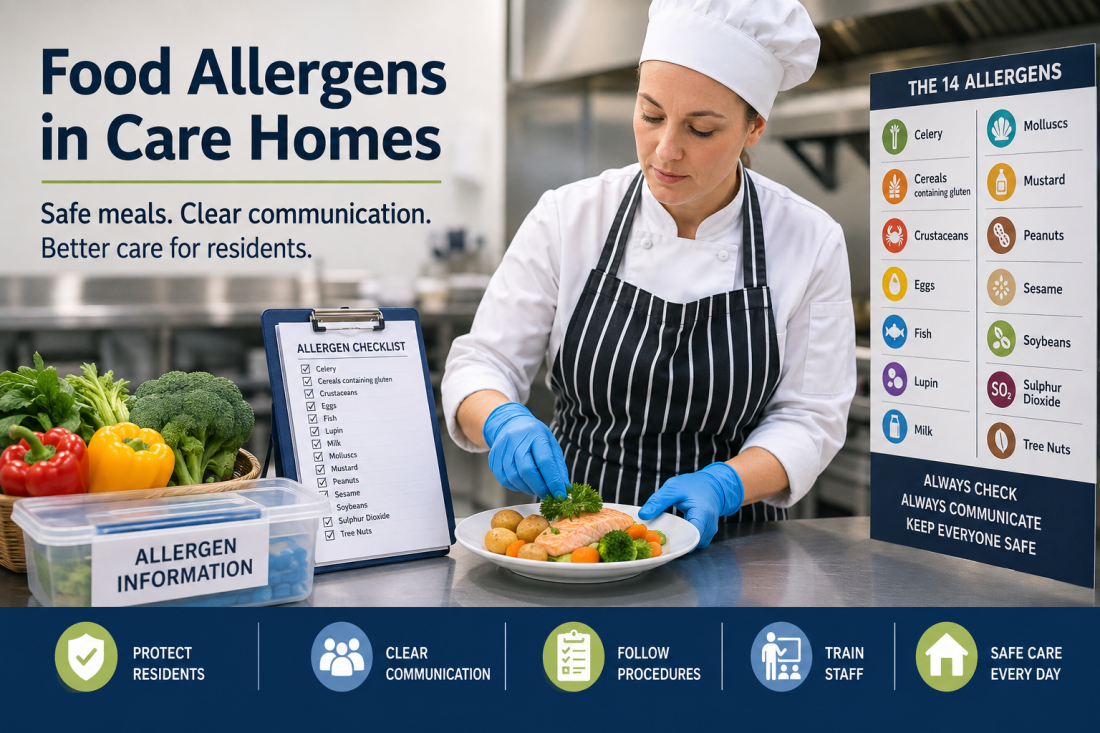
Managing food allergens safely is an essential responsibility in every care home kitchen.
Residents may have diagnosed food allergies, intolerances or other dietary requirements that must be understood and communicated accurately between care staff, kitchen teams and management. For some people, exposure to an allergen can cause a serious or potentially life-threatening reaction.
For chefs working within residential and nursing care environments, allergen management therefore involves far more than simply checking a menu.
Ingredients can change. Products may be substituted. Deliveries can arrive from different suppliers. Temporary or relief chefs may join the kitchen. Residents’ dietary requirements may also change.
A robust allergen management system helps ensure everyone involved in preparing and serving food has accurate, current information and understands their responsibilities.
This practical guide examines some of the key areas care home managers, chefs and kitchen teams should consider when managing food allergens safely.
Key Takeaways
✔ Care home kitchens need accurate and up-to-date information about residents’ food allergies and dietary requirements.
✔ UK food law identifies 14 allergens that food businesses must declare when they are used as ingredients in applicable foods.
✔ Ingredient changes and substitutions should never be assumed to be allergen-equivalent.
✔ Effective communication between care teams and catering staff is essential.
✔ Procedures should address cross-contact during storage, preparation, cooking and service.
✔ New, temporary and relief chefs need an effective kitchen and dietary handover.
✔ Regular allergen training helps staff understand the risks and follow procedures consistently.
Why Allergen Management Is Particularly Important in Care Homes
Care home catering involves preparing food for people who may have complex and changing needs.
CQC guidance requires providers to assess people’s nutritional and hydration needs and specifically identifies dietary intolerances and allergies among the matters that should be considered. Where somebody has been assessed as needing a specific diet, it must be provided in accordance with that assessment.
This makes communication between the kitchen and wider care team particularly important.
A chef may prepare hundreds of meals safely, but one incorrect ingredient, uncommunicated menu change or misunderstanding about a resident’s dietary requirements can create significant risk.
Allergen safety therefore needs to form part of the everyday culture of the kitchen rather than being treated as a paperwork exercise.
What Are the 14 Regulated Food Allergens?
UK food businesses are required to provide information when food contains any of the 14 regulated allergens as ingredients.
These are:
- Celery
- Cereals containing gluten, including wheat, rye, barley and oats
- Crustaceans
- Eggs
- Fish
- Lupin
- Milk
- Molluscs
- Mustard
- Peanuts
- Sesame
- Soybeans
- Sulphur dioxide and sulphites above the specified concentration
- Tree nuts
The Food Standards Agency also makes an important distinction: people can be allergic or intolerant to ingredients outside these 14. The list defines the allergens subject to specific statutory declaration requirements; it does not mean other ingredients cannot cause reactions.
Food Standards Agency – Allergen Guidance for Food Businesses
External link setting: Open in a new tab.
Food Allergy and Food Intolerance Are Not the Same
Kitchen teams should understand that a food allergy and a food intolerance are different.
A food allergy involves the body’s immune system and reactions can sometimes be severe. Food intolerance does not involve the immune system in the same way, although it can still cause significant symptoms and discomfort.
From the kitchen’s perspective, the important point is straightforward:
Never make assumptions about a resident’s dietary requirements.
Follow the resident’s documented care and dietary information and the care home’s agreed procedures.
Maintaining Accurate Resident Allergen Information
Information is only useful when it is accurate and current.
Care homes should have clear procedures for communicating relevant dietary information to catering teams.
Depending on the home’s systems, this may include:
- Resident dietary records
- Allergen matrices
- Kitchen dietary lists
- Care plans
- Meal-ordering systems
- Dietary handover information
- Updates following clinical assessment
Kitchen staff should know where the definitive information is held and what to do if information appears inconsistent.
If a chef is unsure whether a resident can safely receive a particular meal, the answer should never be guessed.
The issue should be checked with the appropriate member of the care team before the meal is served.
Ingredient Changes Can Create Hidden Risks
One of the easiest mistakes to make in a busy kitchen is assuming that a replacement product contains the same ingredients as the product normally used.
It may not.
A supplier might send a different:
- Gravy
- Stock
- Sauce
- Bread
- Dessert
- Sausage
- Margarine
- Seasoning
- Ready-prepared component
Even products that appear almost identical can have different formulations.
Check Every Substitution
When products change, kitchen teams should check the current label and allergen information rather than relying on memory or previous packaging.
Recipes and allergen records should also be updated where necessary.
This becomes especially important when shortages result in last-minute substitutions.
Preventing Allergen Cross-Contact
Cross-contact occurs when an allergen is unintentionally transferred to food that was not intended to contain it.
This can happen through:
- Hands
- Knives
- Chopping boards
- Utensils
- Work surfaces
- Fryers
- Grills
- Containers
- Cloths
- Serving equipment
- Storage practices
Good allergen management therefore requires more than simply removing an allergenic ingredient from a finished dish.
Preparation Procedures
Where required by the care home’s procedures and risk assessment, kitchen teams may need to consider:
- Thoroughly cleaned preparation areas
- Clean equipment and utensils
- Appropriate hand washing
- Safe ingredient storage
- Clearly identified containers
- Suitable preparation sequencing
- Preventing accidental ingredient substitution
- Appropriate service procedures
The objective is to minimise the risk of unintended allergen transfer throughout the food-production process.
Communication Between Care Staff and the Kitchen
Some of the strongest allergen controls happen before cooking begins.
Care staff often know residents closely and may become aware of changes to dietary requirements before kitchen teams do.
There should therefore be a reliable method for communicating relevant changes.
For example:
Resident dietary requirement changes → care team records information → kitchen is informed → catering records/menu information updated → staff preparing and serving food are made aware.
The precise system will differ between providers, but everyone should understand who is responsible for communicating changes and how those changes are recorded.
This is particularly important at weekends, during shift changes and when temporary staff are working.
Serving the Correct Meal to the Correct Resident
Preparing an allergen-safe meal correctly is only part of the process.
It must also reach the correct resident.
Care homes should have suitable procedures for identifying specialist meals during service.
Depending on the setting, this could involve:
- Clearly identified plates or trays
- Documented meal lists
- Appropriate labelling
- Communication with care staff
- Final checking before service
Care and catering teams should avoid informal systems that depend entirely on somebody remembering who receives which meal.
A reliable process reduces the risk of human error.
What About Natasha’s Law?
You may hear the term Natasha’s Law when discussing food allergens.
The rules introduced in October 2021 concern prepacked for direct sale (PPDS) food. Where PPDS requirements apply, the food must carry the name of the food and a full ingredients list, with relevant allergens emphasised within that list.
Whether a particular item prepared within a care setting falls within PPDS requirements depends on how it is produced, packaged and supplied, so providers should use the Food Standards Agency’s current guidance rather than assuming the rules do or do not apply.
GOV.UK – Introduction to PPDS Allergen Labelling (Natasha’s Law)
External link setting: Open in a new tab.
Relief and Agency Chefs Need a Proper Handover
This is an area particularly relevant to ASL Catering Agency.
When a relief chef enters an unfamiliar care home kitchen, they may be professionally experienced but they cannot automatically know the individual dietary requirements of that home’s residents.
A proper catering handover should therefore include information such as:
- Current menus
- Residents’ dietary requirements
- Known allergies and intolerances
- Texture-modified diets
- IDDSI requirements
- Fortified diets
- Kitchen procedures
- Allergen records
- Relevant food safety documentation
- Who to speak to if clarification is required
This is one reason why previous care-sector experience is so valuable when recruiting relief chefs.
Experienced care home chefs understand that specialist diets and allergen controls are fundamental parts of the role.
For information about specialist chef support:
ASL Catering Agency – Care Home Chef Recruitment
ASL Catering Agency – Request a Chef
Staff Training and Allergen Awareness
Procedures work best when staff understand why they exist.
Allergen awareness training can help catering teams understand:
- The 14 regulated allergens
- Food labelling
- Ingredient checking
- Cross-contact
- Safe food preparation
- Communication
- The importance of following established procedures
The Food Standards Agency states that food businesses must make sure staff receive training on allergens.
For care-home catering teams looking to strengthen their knowledge, FlexiLearnHub provides online training relevant to professional care catering.
Recommended Training
Allergen Awareness Training – FlexiLearnHub
Food Safety & Hygiene Level 2 – FlexiLearnHub
I’ve deliberately limited this to the three courses directly relevant to this article rather than inserting the entire FlexiLearnHub catalogue.
A Practical Allergen Checklist for Care Home Kitchens
Care home managers and catering teams can regularly ask:
Resident information
☐ Are residents’ allergy and intolerance records current?
☐ Are changes communicated promptly to the kitchen?
☐ Do kitchen staff know where authoritative dietary information is held?
Ingredients
☐ Are product labels checked?
☐ Are replacement products checked before use?
☐ Are recipe or allergen records updated following ingredient changes?
Kitchen controls
☐ Are appropriate procedures in place to minimise cross-contact?
☐ Are storage arrangements suitable?
☐ Are equipment and preparation areas managed appropriately?
☐ Do staff know what to do when they are uncertain?
Meal service
☐ Are specialist meals clearly identifiable?
☐ Is there a reliable system for getting the correct meal to the correct resident?
☐ Do care and catering teams communicate effectively?
Staff
☐ Have relevant staff received allergen awareness training?
☐ Are new and temporary staff given an appropriate dietary and kitchen handover?
☐ Is refresher training provided where appropriate?
Frequently Asked Questions
How many allergens must UK food businesses declare?
UK food law identifies 14 allergens that must be declared when they are used as ingredients in applicable foods. However, people can have allergies or intolerances to foods outside the statutory 14.
Should care home chefs check product labels every time?
Ingredient formulations and replacement products can change. Kitchen procedures should ensure current ingredient and allergen information is checked appropriately rather than relying solely on memory or assumptions.
Are food allergies and intolerances the same?
No. Food allergy involves an immune response, whereas food intolerance is different and generally does not involve the immune system in the same way. Both may nevertheless be important parts of an individual’s assessed dietary requirements.
Do relief chefs need allergen information?
Yes. Any chef preparing food needs access to the relevant dietary and allergen information required to prepare meals safely. Relief chefs should receive an appropriate handover before taking responsibility for the kitchen.
Does Natasha’s Law apply to care homes?
Natasha’s Law concerns food classed as prepacked for direct sale. Whether particular food prepared or supplied by a care home falls within those requirements depends on the circumstances. Providers should consult current FSA guidance for their specific operation.
Further Reading – Official Guidance
For further information, care providers and catering teams can consult:
Food Standards Agency – Allergen Guidance for Food Businesses
Care Quality Commission – Regulation 14: Meeting Nutritional and Hydration Needs
GOV.UK – Food Allergies and Allergen Information
Set all external links above to open in a new tab.
Visit FlexiLearnHub’s CPD & CQC Aligned certificated OnLine training courses
Our growing course library includes:
- Food Safety & Hygiene
- HACCP Level 2
- Allergen Awareness
- Nutrition & Hydration
- Dysphagia & IDDSI Awareness
- Advanced IDDSI Level 4 Professional Purée Presentation
- Infection Prevention & Control
- Dementia Awareness
- Mental Capacity Act & DoLS Awareness (CQC-Aligned)
- End of Life Care Awareness (CQC-Aligned)
- Modern Slavery Awareness (CQC-Aligned)
- Health & Safety Awareness in Care Settings (CQC-Aligned)
- Moving and Handling of People in Care
Thank you for visiting FlexiLearnHub
Supporting High Standards in Care Home Catering
Safe allergen management depends on good systems, effective communication, knowledgeable staff and consistent kitchen practices.
Care home chefs play a significant role in that process.
From checking ingredients and preventing cross-contact to understanding individual dietary requirements and communicating with care teams, attention to detail can make a major difference to resident safety.
At ASL Catering Agency Ltd, we specialise in supporting care homes, nursing homes and residential care providers with experienced catering professionals who understand the specialist demands of care-sector kitchens.
Whether you require temporary cover, relief support or help recruiting an experienced care home chef:
Request a Chef – ASL Catering Agency
For experienced chefs interested in working with ASL: