


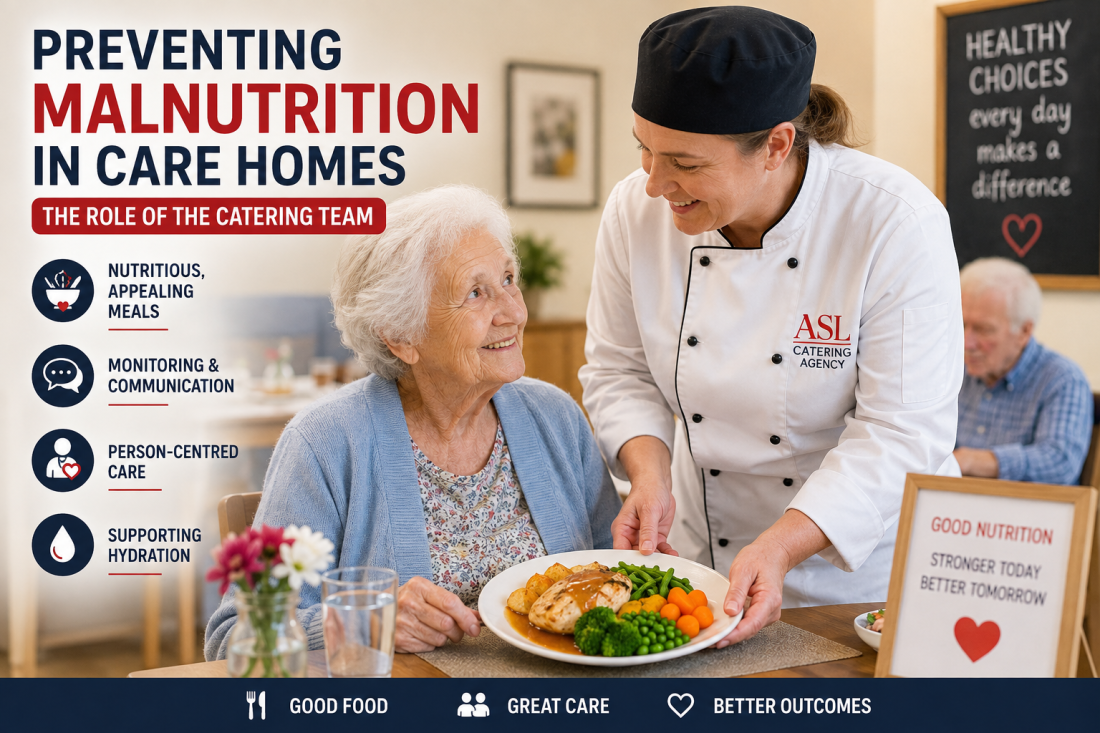
Food is one of life’s everyday pleasures, but within a care home it also plays a fundamental role in maintaining residents’ health, strength, independence and quality of life.
For some residents, eating enough can become difficult.
Illness, reduced appetite, dementia, swallowing difficulties, medication, changing tastes and other factors can all affect food intake. Malnutrition can develop gradually and may not always be immediately obvious.
The NHS defines malnutrition as a serious condition caused when a person’s diet does not contain the right amount of nutrients. Unintentional weight loss, reduced appetite, weakness and lack of interest in food and drink can be among its signs. Importantly, someone can be a normal weight—or even overweight—and still be malnourished.
Identifying and managing malnutrition is a multidisciplinary responsibility.
But the catering team has a particularly valuable perspective.
Chefs see which meals return to the kitchen untouched. They notice changing preferences. They know whether somebody who previously enjoyed Sunday lunch is suddenly eating very little.
Those observations can be important.
The role of the care-home chef is not to diagnose malnutrition. It is to provide safe, appealing food that meets assessed needs, communicate concerns and work alongside the wider care team to support residents at nutritional risk.
Key Takeaways
✔ Malnutrition is not simply about being underweight.
✔ Residents in care homes should be appropriately screened for malnutrition risk by trained professionals using a validated screening tool.
✔ Catering staff can provide valuable observations about changing appetite, preferences and uneaten meals.
✔ Residents’ individual nutritional assessments and care plans should guide catering provision.
✔ Smaller portions, snacks and a “little and often” approach may be appropriate for some residents.
✔ Fortification should follow the resident’s agreed nutritional plan rather than being introduced indiscriminately.
✔ Sudden or persistent changes in eating or swallowing should be communicated to the appropriate care or healthcare professional.
✔ Enjoyment, dignity, choice and presentation remain important when supporting nutritional intake.
What is Malnutrition ?
Malnutrition is sometimes misunderstood as simply meaning somebody is very thin.
The reality is more complex.
The NHS explains that malnutrition means poor nutrition and includes undernutrition—where someone is not receiving enough nutrients—as well as overnutrition.
For care-home catering teams, undernutrition is particularly relevant.
Possible indicators can include:
- Unintentional weight loss
- Reduced appetite
- Lack of interest in eating and drinking
- Weakness
- Tiredness
- Loose-fitting clothing
- Poor wound healing
- Difficulty swallowing
NICE specifically identifies issues including unintentional weight loss, poor appetite, impaired swallowing, poor wound healing and loose-fitting clothes as reasons for clinical concern in relation to malnutrition screening.
None of these observations should be used by a chef to diagnose a resident.
But they demonstrate why good communication matters.
Nutritional Screening Is a Professional Responsibility
Care-home kitchens should work within the home’s established nutritional assessment and care-planning system.
NICE states that people in care homes should be screened for malnutrition on admission and when there is clinical concern, using an appropriate validated approach. Its quality standard also says screening should be carried out by health and social care professionals who have undertaken training to use the validated tool.
One widely used system is the Malnutrition Universal Screening Tool (MUST) developed by BAPEN.
BAPEN describes MUST as the most commonly used nutritional screening tool across UK care settings.
The chef’s role is generally different.
Catering teams need to know what the resident’s assessed nutritional requirements mean for the food they prepare and serve.
CQC Requirements for Nutrition and Hydration
Nutrition and hydration are not optional extras in regulated care.
Under Regulation 14, providers must ensure people’s nutritional and hydration needs are met.
CQC guidance says nutritional needs should be assessed and regularly reviewed, and providers should respond to changes promptly. It also states that nutritious, appetising food should be available and that where somebody requires a specific diet, it should be provided in line with their assessment.
CQC also expects providers to consider:
- Dietary intolerances and allergies
- Support needed to eat and drink
- Appropriate meal timing
- Suitable quantities
- Individual preferences
- Religious and cultural requirements
- Specialist nutritional advice where necessary
This demonstrates why the kitchen is such an important part of the wider care service.
The Catering Team Can Be an Important Early Warning System
A chef may not conduct the nutritional assessment, but catering staff are in an excellent position to notice changes around food.
Imagine a resident who normally eats most of their lunch.
Over several days, their plates begin returning almost untouched.
That information matters.
There could be many possible explanations, including:
- Reduced appetite
- Illness
- Pain or discomfort
- Dental problems
- Changed preferences
- Difficulty using cutlery
- Difficulty recognising food
- Swallowing difficulties
- Medication-related effects
- Portions appearing overwhelming
The kitchen should not try to determine the clinical cause.
Instead, the observation should be communicated through the home’s agreed process so the appropriate person can investigate.
10 Observations Catering Teams Should Feed Back
These are observations rather than diagnostic signs.
Kitchen or dining staff should consider reporting through the home’s established procedures when a resident:
- Repeatedly leaves most of their meals.
- Suddenly stops eating a previously favourite dish.
- Consistently requests much smaller amounts than usual.
- Regularly refuses meals.
- Appears to struggle with a particular food texture.
- Frequently leaves drinks untouched.
- Begins having difficulty using cutlery.
- Appears to take considerably longer to eat than previously.
- Repeatedly returns texture-modified meals uneaten.
- Shows a noticeable change in eating habits or preferences.
The important point is not that any one observation proves malnutrition.
It is that changes should not disappear unnoticed with the plate waste.
Resident Choice Is Part of Good Nutritional Care
A nutritionally perfect meal has limited value if the resident consistently refuses to eat it.
Understanding personal preferences therefore matters.
Care-home catering teams should consider residents’:
- Favourite meals
- Foods they dislike
- Cultural background
- Religious requirements
- Ethical choices
- Preferred meal times
- Portion preferences
- Familiar foods
- Preferred drinks
CQC explicitly states that people’s reasonable food and hydration requirements arising from their preferences, religious or cultural background should be met.
Food is deeply personal.
For many older residents, familiar dishes may also carry decades of memories and associations.
Small Appetites May Need a Different Approach
Some residents simply cannot manage a large plate of food.
Putting more food on the plate does not necessarily result in somebody eating more.
For residents whose assessed plan supports it, a more effective approach might involve:
- Smaller portions
- Additional snacks
- Nourishing drinks
- Desserts
- Favourite foods
- Extra opportunities to eat throughout the day
CQC guidance specifically says snacks or other food should be available between meals for people who prefer to eat little and often.
The precise approach should always reflect the resident’s assessed needs.
Food Fortification Can Support Some Residents
Food fortification means increasing the energy or nutritional content of food without necessarily making the portion substantially larger.
Depending on an individual’s nutritional plan, this might involve enriching suitable dishes with ingredients such as:
- Full-fat dairy products
- Cheese
- Cream
- Butter
- Milk powder
- Oils
- Other energy- or protein-rich ingredients
However, fortification should not become a blanket kitchen policy.
Residents may have allergies, medical conditions, therapeutic diets or other nutritional requirements.
Where fortification forms part of someone’s nutritional support, the catering team should follow the agreed care plan and any dietetic or healthcare advice.
Presentation Still Matters
When somebody has a reduced appetite, the appearance of the meal can become even more important.
An enormous plate of beige food is unlikely to encourage enthusiasm.
Chefs can consider:
- Attractive colour combinations
- Clear separation of foods
- Appropriate portion sizes
- Garnishing where suitable
- Serving food at an appropriate temperature
- Maintaining recognisable presentation
CQC specifically expects food to be nutritious and appetising.
The objective should be to encourage eating while preserving dignity and enjoyment.
Don’t Forget the Dining Experience
Nutrition does not begin and end with what is on the plate.
The environment in which somebody eats can influence their experience.
Depending on residents’ needs and preferences, useful considerations can include:
- A calm atmosphere
- Comfortable seating
- Appropriate assistance
- Enough time to eat
- Social interaction where wanted
- Independence wherever possible
- Accessible drinks
- Suitable crockery and cutlery
Some residents may enjoy a sociable dining room.
Others may prefer somewhere quieter.
Person-centred care means recognising the difference.
Dementia Can Affect Nutritional Intake
Dementia may affect food recognition, appetite, concentration, communication and the ability to use cutlery.
This can make nutrition more challenging for some residents.
Our recent guide to Dementia-Friendly Mealtimes in Care Homes explores this subject in more detail.
The important principle for chefs is not to assume that a resident is “being difficult” when they refuse food.
There may be a reason the person cannot easily communicate.
Working with the care team can help identify practical adaptations while preserving the resident’s choice and dignity.
Dysphagia Requires Particular Care
Difficulty swallowing can significantly affect a person’s ability to eat and drink safely and adequately.
If a catering team notices apparent changes in somebody’s ability to manage food, the concern should be passed to the appropriate care or healthcare professional.
Chefs should not independently decide to change a resident onto a texture-modified diet.
Where a resident has been professionally assessed as requiring texture-modified food or drink, the kitchen must receive clear instructions and follow the prescribed requirements.
For residents using the IDDSI Framework, chefs need sufficient knowledge to prepare the required texture safely and consistently.
Texture Modification Should Not Mean Losing Nutritional Quality
Preparing a texture-modified meal can present additional challenges.
The kitchen still needs to consider:
- Nutritional content
- Appropriate portion size
- Flavour
- Colour
- Presentation
- Resident preferences
- Prescribed texture
- Fortification where required
A safe texture is essential, but so is producing something the resident actually wants to eat.
Experienced care-home chefs understand how important it is to balance these requirements.
Hydration and Nutrition Go Together
A resident’s food intake should not be considered in isolation from hydration.
CQC requires providers to meet both nutritional and hydration needs and says water should be available and accessible, with other drinks offered throughout the day and night as appropriate.
Catering teams can support this by providing a suitable range of drinks and working with care staff to understand residents’ preferences.
A person who repeatedly refuses plain water may readily drink something else that is appropriate for their assessed needs.
Again, knowing the individual matters.
Communication Is the Link Between the Kitchen and Care Plan
A care home’s nutritional system is strongest when information moves effectively between teams.
A useful principle is:
Assessment → Care Plan → Care Team → Kitchen → Meal Service → Observation → Feedback → Review
The kitchen needs accurate information about what to provide.
The care team needs useful information about what residents are actually eating.
Neither side should work in isolation.
What Information Does the Chef Need?
Where relevant to the individual, catering teams may need clear, current information about:
- Allergies and intolerances
- Dietary requirements
- Resident preferences
- Texture requirements
- IDDSI level
- Fortification requirements
- Portion requirements
- Cultural and religious requirements
- Suitable alternatives
- Relevant changes to the nutritional plan
Temporary and relief chefs also need an appropriate handover before taking responsibility for meal preparation.
Why Experienced Care Home Chefs Matter
Care-home catering is considerably more specialised than simply producing three meals per day.
A chef may need to balance:
- Food safety
- Nutrition
- Hydration
- Allergens
- Dementia-related needs
- Dysphagia
- IDDSI
- Fortification
- Resident preferences
- Cultural requirements
- Menu planning
- Food presentation
- Kitchen budgets
- Stock management
That breadth of responsibility is one reason care-sector experience can be so valuable.
At ASL Catering Agency Ltd, our specialist focus is supplying catering professionals who understand the demands of care-home, residential and nursing-home kitchens.
Care Home Chef Recruitment – ASL Catering Agency
Request a Chef – ASL Catering Agency
Relevant Training for Care Home Catering Teams
For this article, I would again keep the training recommendations focused rather than listing the whole FlexiLearnHub catalogue.
The most relevant subjects are:
- Nutrition & Hydration
- Dysphagia & IDDSI Awareness
- Dementia Awareness
- Food Safety & Hygiene
FlexiLearnHub – Care, Catering & Compliance Training
These topics help catering professionals understand the wider care environment in which their food is being prepared and served.
Care Home Nutrition & Mealtime Checklist
Resident Needs
☐ Does the kitchen have current dietary information?
☐ Are resident preferences recorded and communicated?
☐ Are cultural and religious requirements understood?
☐ Are allergies and intolerances clearly identified?
Eating Patterns
☐ Are repeated uneaten meals reported?
☐ Are significant appetite changes communicated?
☐ Is persistent plate waste investigated?
☐ Are residents offered suitable alternatives where appropriate?
Meal Provision
☐ Are meals attractive and appetising?
☐ Are portions appropriate to assessed needs?
☐ Are suitable snacks available for residents who eat little and often?
☐ Are fortified meals prepared correctly where required?
Specialist Diets
☐ Are texture requirements clearly communicated?
☐ Do relevant chefs understand IDDSI?
☐ Are texture-modified meals nutritionally appropriate and attractively presented?
☐ Are changes in swallowing ability escalated rather than independently managed by kitchen staff?
Communication
☐ Do care and catering teams communicate effectively?
☐ Does the kitchen receive changes promptly?
☐ Can chefs report concerns easily?
☐ Do temporary or relief chefs receive an appropriate handover?
Frequently Asked Questions
What is malnutrition?
Malnutrition means poor nutrition caused by receiving an inappropriate amount or balance of nutrients. In the context of this article, we are primarily discussing undernutrition. A person does not necessarily need to appear underweight to be malnourished.
Who should screen care-home residents for malnutrition?
NICE says malnutrition screening should use a validated tool and be carried out by health and social care professionals who have undertaken appropriate training. People in care homes should be screened on admission and where there is clinical concern.
What is MUST?
MUST stands for Malnutrition Universal Screening Tool. It was developed by BAPEN and is widely used across UK health and care settings to identify adults at risk of malnutrition.
Can a care-home chef diagnose malnutrition?
No. Diagnosis and nutritional assessment belong with appropriately trained health and care professionals. However, chefs can play an important role by noticing changes in eating patterns and reporting them through the home’s agreed procedures.
Should every resident at risk of malnutrition receive fortified food?
Not automatically. Nutritional interventions should reflect the individual’s assessment and care plan. Catering teams should follow the instructions provided by the appropriate healthcare or care professionals.
What should a chef do if a resident suddenly stops eating?
The chef should communicate the change promptly through the home’s established procedure. There may be numerous possible causes, and persistent or significant changes require appropriate assessment rather than assumptions being made in the kitchen.
Further Reading – Trusted UK Resources
These are the external resources I’d place at the bottom and set to Open in New Tab in WordPress:
Care Quality Commission – Regulation 14: Meeting Nutritional and Hydration Needs
NICE – Screening for the Risk of Malnutrition
BAPEN – Nutritional Screening and MUST
Good Nutrition Starts With Knowing the Resident
Preventing malnutrition in a care home cannot be achieved by the kitchen alone.
It requires assessment, care planning, communication, monitoring and cooperation between residents, care staff, healthcare professionals and catering teams.
But chefs have an important part to play.
They can prepare attractive food that reflects individual needs. They can understand residents’ preferences. They can adapt meals according to agreed nutritional plans. And importantly, they can notice when eating patterns change and make sure those observations reach the right people.
An excellent care-home chef therefore does much more than cook.
They contribute to a wider system designed to protect residents’ nutrition, dignity, independence, enjoyment and wellbeing.
For care providers requiring experienced catering support:
Request a Chef – ASL Catering Agency
For chefs interested in working within specialist care catering:
Join Our Chef Network – ASL Catering Agency
Visit FlexiLearnHub’s CPD & CQC Aligned certificated OnLine training courses
Our growing course library includes:
- Food Safety & Hygiene
- HACCP Level 2
- Allergen Awareness
- Nutrition & Hydration
- Dysphagia & IDDSI Awareness
- Advanced IDDSI Level 4 Professional Purée Presentation
- Infection Prevention & Control
- Dementia Awareness
- Mental Capacity Act & DoLS Awareness (CQC-Aligned)
- End of Life Care Awareness (CQC-Aligned)
- Modern Slavery Awareness (CQC-Aligned)
- Health & Safety Awareness in Care Settings (CQC-Aligned)
- Moving and Handling of People in Care
Thank you for visiting FlexiLearnHub