Care Home Catering, Training & Chef Recruitment Insights

Care Home Catering, Training & Chef Recruitment Insights

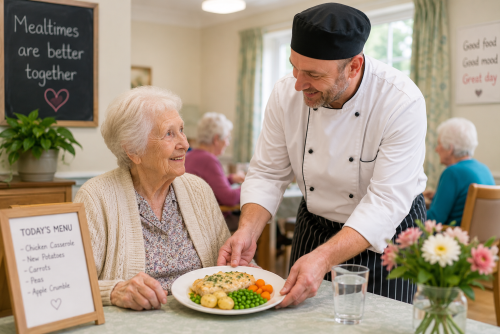
Care home chef serving a nutritious meal to an older resident in a welcoming dining room, supporting a positive dementia-friendly mealtime experience.

Dementia-Friendly Mealtimes in Care Homes: How Catering Teams Can Make a Difference

Mealtimes are an important part of everyday life in a care home. They provide nutrition and hydration, but they can also offer familiarity, enjoyment, independence, social interaction and a sense of routine.

For a person living with dementia, however, eating and drinking can sometimes become more difficult.

A resident may struggle to recognise food, forget that a meal has been served, find cutlery difficult to use, become distracted during meals or experience changes in appetite and food preferences. Some people may also develop chewing or swallowing difficulties.

The NHS notes that people living with dementia may not recognise foods, may refuse food, experience changing preferences or develop swallowing problems. Dementia can also affect drinking because a person may not recognise that they are thirsty.

This means the care home catering team has an important role that extends well beyond preparing food.

By working closely with carers, nurses and managers, chefs can help create meals and dining experiences that support residents’ individual needs, preferences, dignity and quality of life.


Key Takeaways

✔ Dementia can affect appetite, food recognition, coordination, communication and the ability to eat independently.

✔ Familiar foods and personal preferences can help make meals more meaningful.

✔ Calm, uncluttered dining environments may help reduce distraction and confusion.

✔ Smaller portions and finger foods can sometimes help residents maintain independence.

✔ Food presentation and visual contrast can make meals easier to recognise for some people.

✔ Hydration deserves as much attention as food.

✔ Dysphagia should be assessed appropriately rather than assuming every person with dementia needs texture-modified food.

✔ Good communication between catering and care teams is essential.


Why Dementia Can Affect Eating and Drinking

Dementia affects people differently, and there should never be a one-size-fits-all approach to catering.

Depending on the individual, dementia may affect:

  • Memory
  • Concentration
  • Coordination
  • Communication
  • Recognition of food
  • Appetite
  • Taste preferences
  • Ability to use cutlery
  • Awareness of hunger or thirst
  • Chewing and swallowing

Some residents may forget they have not eaten. Others may forget they have already eaten.

Someone who previously enjoyed a particular dish may suddenly refuse it, while another resident may develop a preference for stronger or sweeter flavours.

Alzheimer’s Society advises that changes in thinking and memory can make it difficult for someone to recognise food or understand how to begin eating.

For the catering team, flexibility and good communication become extremely important.


Start With the Person, Not the Diagnosis

A diagnosis of dementia does not tell a chef what somebody enjoys eating.

The individual still has their own:

  • Favourite foods
  • Dislikes
  • Family traditions
  • Cultural background
  • Religious requirements
  • Mealtime routines
  • Preferred drinks
  • Portion preferences
  • Memories associated with food

This is where person-centred catering becomes particularly important.

A resident who has eaten a cooked breakfast every morning for 60 years may find that meal reassuring and familiar. Someone else may strongly associate Sunday lunch with family life.

Food can carry memories and emotional meaning.

Alzheimer’s Society recommends considering the person’s likes, dislikes, past routines, culture, religion and dietary beliefs when supporting eating and drinking.

Care-home menus should therefore provide meaningful choice rather than expecting every resident to fit the same pattern.


Create a Calm and Familiar Mealtime Environment

The catering team does not control every aspect of the dining room, but chefs and care staff can work together to improve the overall mealtime experience.

Too much noise, movement or visual clutter can make it harder for some people living with dementia to concentrate.

Helpful approaches may include:

  • Reducing unnecessary background noise
  • Keeping tables relatively uncluttered
  • Allowing sufficient time to eat
  • Creating a relaxed atmosphere
  • Ensuring food is clearly visible
  • Maintaining familiar routines where possible

Alzheimer’s Society recommends a calm, relaxing environment and reducing distracting background noise and clutter.

The aim should not be to create a clinical dining room.

It should feel like somewhere people can enjoy eating.


Food Presentation Can Make a Difference

Presentation matters in every catering environment, but it can have additional importance in dementia care.

A resident may find it difficult to distinguish food from the plate or the plate from the table.

Consider Visual Contrast

Some NHS dementia guidance suggests that contrasting colours can help make food and tableware easier to distinguish—for example, contrasting a plain plate with the table or placemat.

This does not mean every person with dementia requires brightly coloured crockery.

Individual needs should guide the approach.

The broader principle is useful: make the food easy to see and recognise.

Avoid unnecessarily cluttered presentation and consider whether the individual components of the meal are visually clear.


Avoid Overwhelming the Plate

Large portions can sometimes appear intimidating, particularly for somebody experiencing a reduced appetite.

A smaller, attractive portion may be more approachable, with additional food available if wanted.

Alzheimer’s Society recommends avoiding overloaded plates and notes that smaller, regular portions can work well for some people with dementia.

This should not be confused with simply reducing residents’ food intake.

Where a resident has identified nutritional needs or is at risk of malnutrition, those needs must remain central to their care.

CQC requires providers to assess and meet people’s nutritional and hydration requirements and keep those needs under review.


Finger Foods Can Help Maintain Independence

Using a knife and fork can become difficult for some people living with dementia.

Finger foods can sometimes provide an alternative that allows the resident to continue eating independently.

Depending on dietary requirements, examples might include:

  • Small sandwiches
  • Soft fruit pieces
  • Vegetable pieces of an appropriate texture
  • Potato wedges
  • Small savoury items
  • Bite-sized cakes or desserts
  • Suitable snacks

NHS clinical guidance includes finger foods among strategies that can help when somebody has difficulty using cutlery.

The important principle is supporting independence wherever safely possible.

A meal does not become less dignified simply because someone chooses to eat it with their hands.


Familiar Food Can Be Powerful

Care-home chefs often have considerable freedom to make menus interesting, but innovation should not come at the expense of familiarity.

For many residents, traditional dishes may be comforting and recognisable.

Depending on the individual, that might include:

  • Cottage pie
  • Fish and chips
  • Roast dinners
  • Stews and casseroles
  • Soup and sandwiches
  • Rice pudding
  • Apple crumble
  • Familiar regional dishes

The resident’s own history matters far more than a generic list of “food for older people”.

Someone raised in another country or cultural tradition may have completely different familiar foods.

That is why getting to know residents is such an important part of excellent care-home catering.


H2: Food Preferences May Change

Chefs should also be prepared for tastes to change.

A resident who has always preferred savoury food may begin enjoying sweeter flavours. Another may reject foods they previously loved.

The NHS advises carers to be prepared for changing tastes and to offer foods the person enjoys.

Rather than automatically labelling someone as a “poor eater”, it can be worth exploring whether their preferences have changed.

Care staff can provide invaluable feedback to the kitchen about what residents are actually eating.


Hydration Is Just as Important as Food

Hydration can be particularly challenging for some people living with dementia.

They may:

  • Forget to drink
  • Not recognise thirst
  • Struggle to communicate that they want a drink
  • Forget where their drink is
  • Have difficulty handling cups or glasses

The NHS warns that inadequate fluid intake can contribute to problems including constipation, headaches and urinary tract infections, which may in turn increase confusion.

Catering and care teams can work together to provide appropriate drinks regularly and identify what residents actually enjoy.

High-moisture foods may also contribute to fluid intake where suitable, but individual dietary and clinical requirements should always be followed.


Dementia Does Not Automatically Mean Dysphagia

This distinction is very important.

Some people living with dementia develop difficulties with chewing or swallowing, particularly as dementia progresses. But a dementia diagnosis alone does not mean somebody should automatically receive a texture-modified diet.

If swallowing difficulties are suspected, the resident should receive appropriate assessment and professional advice.

A Speech and Language Therapist (SLT) may assess swallowing and recommend suitable food and drink consistencies or strategies.

Where texture modification has been prescribed or recommended, catering teams need clear information about the resident’s requirements.

This is where knowledge of the International Dysphagia Diet Standardisation Initiative (IDDSI) Framework becomes particularly relevant.


Texture-Modified Meals Should Still Look Like Meals

Where a resident requires texture-modified food, safety is paramount—but presentation and enjoyment still matter.

A puréed meal should not automatically become an anonymous collection of food on a plate.

Experienced chefs can consider:

  • Separating individual meal components
  • Maintaining appropriate colours
  • Creating recognisable presentation
  • Using suitable moulding or piping techniques where appropriate
  • Maintaining flavour
  • Following the required IDDSI texture
  • Ensuring nutritional requirements are met

The objective is to combine safety with dignity and enjoyment.


Communication Between Care Staff and Chefs Is Essential

The chef may notice that Mrs Smith has stopped eating a dish she previously enjoyed.

A carer may notice that Mr Jones is eating breakfast well but struggling at dinner.

A nurse may be aware that a resident’s swallowing needs have changed.

Individually, these are pieces of information.

Together, they can help create a much clearer picture.

Strong communication should allow relevant information to move between:

Resident → Care Team → Kitchen → Catering Response → Ongoing Review

This can help the kitchen respond appropriately to changing preferences, appetite, dietary requirements and assessed needs.


Monitor What Residents Actually Eat

Menus tell you what the kitchen serves.

Plate waste tells you what people eat.

If a resident repeatedly leaves most of a particular meal, that deserves attention.

Possible reasons could include:

  • Portion size
  • Taste
  • Temperature
  • Presentation
  • Difficulty recognising the food
  • Difficulty using cutlery
  • Dental discomfort
  • Reduced appetite
  • Swallowing problems
  • Simply disliking the meal

Not all of these are catering problems, but catering teams can help identify patterns and communicate them to the wider care team.

This also connects naturally with our guide to reducing food waste in care homes—because monitoring waste can improve both kitchen efficiency and the resident experience.


Experienced Care Home Chefs Make a Difference

Excellent dementia-friendly catering requires more than following a menu.

Care-home chefs may need to understand:

  • Nutrition and hydration
  • Individual dietary requirements
  • Food allergies
  • Fortified meals
  • Texture modification
  • IDDSI
  • Resident preferences
  • Food presentation
  • Food safety
  • Communication with care teams

That is one reason specialist care-sector experience is so valuable when recruiting chefs.

At ASL Catering Agency Ltd, we specialise in supplying experienced catering professionals to care homes, nursing homes and residential care settings.

For care providers requiring catering support:

ASL Catering Agency – Care Home Chef Recruitment

Request a Chef – ASL Catering Agency


Relevant Training for Care Home Teams

Professional training can help chefs and care staff better understand the needs of residents living with dementia.

For this article, I would keep the FlexiLearnHub links tightly focused on the subject:

FlexiLearnHub – Online Care and Catering Training

I would link specifically from this section to your Dementia Awareness, Nutrition & Hydration, and Dysphagia & IDDSI Awareness courses. If you paste me the exact live URLs for those three course pages, I can give you the final anchor links without risking sending visitors to an outdated course URL.


Dementia-Friendly Mealtime Checklist

Care-home managers and catering teams can use these questions when reviewing their approach:

Resident Choice & Preferences

☐ Does the kitchen know residents’ likes and dislikes?

☐ Are cultural and religious preferences understood?

☐ Are changing food preferences communicated?

☐ Are familiar foods incorporated into menus?

Environment & Presentation

☐ Is the dining environment calm and welcoming?

☐ Is unnecessary clutter reduced?

☐ Is food easy to recognise?

☐ Could better colour contrast help individual residents?

☐ Are portions appropriate and visually appealing?

Independence

☐ Are residents supported to eat independently where possible?

☐ Could suitable finger foods help?

☐ Is enough time allowed for meals?

Nutrition & Hydration

☐ Are residents at nutritional risk identified and appropriately supported?

☐ Are drinks offered regularly?

☐ Are significant changes in appetite communicated?

☐ Is repeated plate waste investigated?

Specialist Requirements

☐ Are swallowing difficulties appropriately assessed?

☐ Does the kitchen have clear information about prescribed texture requirements?

☐ Do relevant staff understand IDDSI?

☐ Are texture-modified meals presented attractively as well as safely?

Teamwork

☐ Do care and catering staff communicate effectively?

☐ Are changes in resident needs passed to the kitchen promptly?

☐ Are temporary and relief chefs given an appropriate dietary handover?


Frequently Asked Questions

What makes a mealtime dementia-friendly?

There is no single formula. A dementia-friendly approach is person-centred and may include familiar foods, a calm environment, suitable portions, clear presentation, sufficient time, support for independence and good communication between care and catering teams.

Are finger foods suitable for people with dementia?

They can be useful for some people who have difficulty using cutlery or remaining seated for a conventional meal, provided the foods are appropriate for that person’s dietary and swallowing needs.

Should people with dementia receive smaller portions?

Not automatically. Some people with reduced appetite may find smaller, more frequent portions easier, but nutritional requirements are individual and must be met.

Does everyone with dementia need an IDDSI diet?

No. Dementia does not automatically mean a person requires texture-modified food. Where swallowing difficulties exist, appropriate professional assessment should guide the person’s food and drink requirements.

Why might someone with dementia suddenly stop eating?

There can be many possible causes, including changing preferences, difficulty recognising food, reduced appetite, dental problems, illness, medication effects or swallowing difficulties. Significant or unexplained changes should be raised with the appropriate healthcare professional rather than simply assumed to be caused by dementia.


Further Reading – Trusted Resources

These are the external links I recommend adding and setting to Open in New Tab:

Care Quality Commission – Regulation 14: Meeting Nutritional and Hydration Needs

NHS – Looking After Someone With Dementia: Eating and Drinking

Alzheimer’s Society – Supporting Someone With Dementia to Eat and Drink

These provide excellent authoritative supporting information for managers and care teams.


Making Every Mealtime Matter

Good dementia-friendly catering is not about creating a completely separate menu for everyone living with dementia.

It is about recognising the individual behind the diagnosis.

Their favourite meal still matters. Their culture matters. Their independence matters. Their dignity matters. And enjoying food still matters.

An experienced care-home chef can contribute enormously by working alongside care teams, listening to resident feedback, adapting presentation and portions where appropriate, understanding specialist dietary requirements and ensuring meals remain safe, nutritious and enjoyable.

When catering and care teams work together, mealtimes can become much more than a nutritional requirement.

They can remain a familiar, enjoyable and meaningful part of everyday life.

For experienced care-home catering support:

Request a Chef from ASL Catering Agency

And for chefs interested in joining ASL:

Join Our Chef Network


Visit FlexiLearnHub’s CPD & CQC Aligned certificated OnLine training courses

Our growing course library includes:

Thank you for visiting FlexiLearnHub

Professional care home chef preparing a nutritious meal in a commercial kitchen while managing fresh ingredients and food waste.

Reducing Food Waste in Care Homes: Practical Strategies for Better Catering

Food waste is an important issue for every professional kitchen, but in a care home it deserves particular attention.

Care-home catering teams must balance several priorities at once: providing nutritious meals, accommodating individual dietary requirements, offering residents meaningful choice, maintaining food-safety standards and controlling kitchen costs.

Reducing waste should therefore never mean simply providing less food.

Instead, it is about understanding why food is being wasted and making intelligent improvements to purchasing, menu planning, preparation, portioning and communication.

A well-managed care-home kitchen can reduce unnecessary waste while continuing to provide residents with safe, nutritious and enjoyable meals.

In this guide, we look at practical ways care-home managers, chefs and catering teams can reduce food waste without compromising resident choice, dignity or wellbeing.


Key Takeaways

✔ Measure food waste before deciding how to reduce it.

✔ Use resident feedback to identify unpopular meals and inappropriate portion sizes.

✔ Improve stock rotation and purchasing to prevent ingredients expiring unnecessarily.

✔ Communication between care and catering teams can prevent meals being prepared unnecessarily.

✔ Texture-modified, fortified and specialist diets require particularly careful planning.

✔ Food-safety requirements must never be compromised simply to reduce waste.

✔ Experienced care-home chefs can play an important role in controlling food costs while maintaining catering standards.


Why Reducing Food Waste Matters

Food that is purchased, stored, prepared and ultimately discarded represents more than the cost of the ingredients.

There may also be costs associated with:

  • Staff time
  • Preparation
  • Cooking
  • Energy
  • Refrigeration
  • Storage
  • Cleaning
  • Waste collection and disposal

There is also an environmental impact.

UK government guidance on food and drink waste places preventing surplus and waste as the first priority, ahead of redistribution, recycling, energy recovery and disposal.

For a care home, however, there is another important consideration.

Plate waste can tell us something.

If residents repeatedly leave particular dishes, vegetables, portion sizes or desserts, that information may help the catering team understand what residents actually enjoy eating.

Reducing food waste can therefore become part of improving the overall dining experience.


Start by Understanding Where Food Is Being Wasted

Before changing menus or reducing ordering, managers need to understand where waste is occurring.

Care-home food waste can broadly occur at several stages.

Storage Waste

Food may be discarded because it has:

  • Passed its use-by date
  • Deteriorated during storage
  • Been over-ordered
  • Been incorrectly stored
  • Been forgotten at the back of a refrigerator, freezer or storeroom

Good stock management can reduce much of this waste.

Preparation Waste

Some waste occurs during preparation.

This might include excessive trimming of vegetables, ingredients prepared but never required, or unnecessarily large batches.

Some preparation waste is unavoidable, but good kitchen practices can minimise unnecessary losses.

Overproduction

A kitchen may prepare significantly more portions than are actually required.

This can happen when the kitchen does not receive accurate information about:

  • Residents who are absent
  • Hospital appointments
  • Residents eating elsewhere
  • Changes in appetite
  • Dietary changes
  • Alternative meal requests

Better communication can make a significant difference.

Plate Waste

Plate waste is food that has been served but not eaten.

Rather than viewing this simply as rubbish, kitchens can use it as useful feedback.

Are portions consistently too large?

Is one menu choice repeatedly unpopular?

Is a particular vegetable always left?

Do some residents prefer smaller portions with the option of seconds?

Patterns can help catering teams make better decisions.


Measure Before You Manage

One of the most useful steps a care home can take is to begin measuring food waste.

Government guidance describes measuring and recording food and drink surplus and waste as good practice and points organisations towards resources for consistent measurement.

This does not necessarily require a complicated computer system.

A simple food-waste record could identify:

Date | Meal | Type of Waste | Approximate Quantity | Possible Reason

For example:

Monday | Lunch | Plate waste | High | Vegetable side largely uneaten

Over several weeks, patterns may become apparent.

This allows the chef or catering manager to make decisions based on evidence rather than guesswork.


Menu Planning Should Start With the Residents

A nutritionally balanced menu is important, but a meal provides little nutritional benefit if the resident does not want to eat it.

Good menu planning should consider both nutritional requirements and resident preferences.

Care-home catering teams can gather feedback through:

  • Resident meetings
  • Menu discussions
  • Informal conversations
  • Meal satisfaction surveys
  • Discussions with relatives where appropriate
  • Feedback from care staff
  • Monitoring plate waste

Seasonal menus can also help kitchens use ingredients effectively while providing variety throughout the year.

The objective is not simply to create a menu that looks good on paper.

It is to create food that residents want to eat.


Portion Control Does Not Mean Smaller Meals for Everyone

Reducing portion size across the board would be the wrong approach to tackling food waste.

Residents have individual nutritional requirements and appetites.

Some may require larger portions, while others may find a standard portion overwhelming.

An alternative approach can be offering an appropriate smaller portion where suitable, with additional food available if the resident wants more.

This can be particularly helpful for residents with smaller appetites.

However, nutritional requirements must always come first.

Where somebody is at risk of malnutrition or has an assessed nutritional requirement, their individual care and dietary plan should guide the approach.


Improve Communication Between the Care Team and Kitchen

This is one of the simplest areas in which waste can potentially be reduced.

Imagine that three residents are away from the home for lunch, another has gone to hospital and two have requested an alternative meal.

If the kitchen doesn’t receive that information, six unnecessary meals could potentially be prepared.

Multiply that across weeks and months and the waste becomes significant.

A simple communication process can help.

Care team → updated resident/meal information → kitchen → accurate production numbers

The system does not need to be complicated.

It needs to be reliable.

Kitchen teams should know how many residents they are catering for and whether there have been significant dietary or meal changes before production begins.


Better Stock Management Can Prevent Avoidable Waste

A well-organised storeroom, refrigerator and freezer can significantly reduce unnecessary waste.

Good practices include:

  • Regular stock checks
  • Sensible ordering levels
  • Clear date labelling
  • Appropriate rotation
  • Monitoring use-by dates
  • Reviewing slow-moving ingredients
  • Checking stock before placing new orders
  • Avoiding unnecessary duplication

FIFO – First In, First Out

Using older suitable stock before newer stock can help prevent ingredients becoming forgotten and eventually discarded.

However, date marking and food-safety requirements must always take priority.

Food must never be used simply because management wants to avoid waste if it is no longer safe.

Government guidance is explicit that food must not be used, sold or donated after its use-by date.


Be Careful With Bulk Purchasing

Buying larger quantities can sometimes reduce the unit cost of ingredients.

But cheaper does not always mean better value.

If a care home purchases ten cases because the price is attractive but eventually throws three away, the apparent saving may disappear.

Purchasing decisions should therefore consider:

  • Available storage
  • Shelf life
  • Menu cycle
  • Number of residents
  • Historical usage
  • Supplier delivery frequency

Good procurement is about purchasing the right quantity, not simply obtaining the lowest price per unit.


Texture-Modified Meals Require Particular Attention

Residents with dysphagia may require texture-modified meals prepared in accordance with their assessed needs.

These meals can require additional preparation, specialist knowledge and careful portioning.

Producing substantially more than required can therefore create both waste and unnecessary workload.

Kitchen teams should have accurate information about:

  • How many residents require texture modification
  • The appropriate IDDSI level for each resident
  • Portion requirements
  • Fortification requirements where applicable
  • Menu choices

Importantly, reducing waste must never result in unsafe improvisation or inappropriate reuse of food.

Resident safety always takes priority.

For catering professionals who prepare texture-modified meals, appropriate dysphagia and IDDSI knowledge is an important part of care catering.


Presentation Can Influence Waste Too

People eat with their eyes as well as their appetite.

An unappealing meal may be rejected before a resident has really started eating it.

Presentation is especially important when preparing texture-modified food.

Where safe and appropriate, chefs can consider:

  • Colour contrast
  • Separate presentation of meal components
  • Recognisable food appearance
  • Suitable portioning
  • Attractive plating
  • Variety across the menu

The objective should be to provide meals that are not only nutritionally appropriate but also enjoyable and dignified.


Fortified Meals Need Thoughtful Planning

Some residents may require additional calories or protein as part of an assessed nutritional plan.

Fortification can increase the nutritional density of meals without necessarily increasing their physical size significantly.

This can be valuable for people with smaller appetites.

However, kitchen teams need clear instructions and accurate resident information.

Reducing food waste must never become an excuse to alter a resident’s prescribed or assessed nutritional provision.


Food Safety Must Always Come First

There is an important boundary when discussing food waste:

Not everything should be saved or reused.

Reducing waste must operate within robust food-safety procedures.

Food businesses are responsible for ensuring food is safe, training staff, operating a food-safety management system and managing allergen and other food hazards.

Kitchen teams should follow their food-safety management procedures regarding:

  • Cooking
  • Cooling
  • Reheating
  • Storage
  • Temperature control
  • Cross-contamination
  • Allergens
  • Date marking

Trying to reduce waste must never encourage unsafe practices.


What Happens to Food That Cannot Be Prevented From Becoming Waste?

Prevention should be the priority, but some food waste is inevitable.

Government guidance establishes a hierarchy for dealing with surplus and waste food. After prevention, options can include redistribution where appropriate, followed by other routes including recycling. Sending food waste to sewer or landfill sits at the bottom of the hierarchy.

Care providers should ensure their waste arrangements comply with the rules applicable to their operation and location.

There are also specific restrictions around catering waste and animal products. For example, catering waste must not be supplied as farm-animal feed.


Experienced Care Home Chefs Can Make a Difference

Effective kitchen management requires more than cooking ability.

An experienced care-home chef may be responsible for balancing:

  • Resident preferences
  • Nutrition
  • Specialist diets
  • Allergens
  • Menu planning
  • Purchasing
  • Stock control
  • Food safety
  • Staffing
  • Budget management
  • Waste reduction

This is one reason specialist care-sector experience can be so valuable.

A chef who understands the environment can make informed decisions about production quantities and stock while keeping resident needs at the centre of the catering service.

For care providers requiring experienced catering professionals:

ASL Catering Agency – Care Home Chef Recruitment

Request a Chef – ASL Catering Agency


Training Supports Better Kitchen Management

Professional development can help catering staff understand the wider responsibilities involved in running a care-home kitchen.

For this article, I would link only to the training most directly relevant to the subject:

Nutrition & Hydration Training – FlexiLearnHub

Food Safety & Hygiene Level 2 – FlexiLearnHub

HACCP Level 2 – FlexiLearnHub

Dysphagia & IDDSI Awareness – FlexiLearnHub


Practical Care Home Food Waste Checklist

Use this simple checklist as a starting point for reviewing kitchen waste.

Menu & Residents

☐ Are residents regularly asked for menu feedback?

☐ Are unpopular dishes being identified?

☐ Are individual portion requirements considered?

☐ Are changes in resident numbers communicated to the kitchen?

Stock

☐ Are stock levels reviewed regularly?

☐ Is stock rotated effectively?

☐ Are use-by dates monitored?

☐ Is existing stock checked before new orders are placed?

☐ Are frequently wasted ingredients identified?

Production

☐ Does the kitchen know how many meals are actually required?

☐ Are batch quantities appropriate?

☐ Is overproduction being measured?

☐ Are specialist meals produced in appropriate quantities?

Plate Waste

☐ Is significant plate waste monitored?

☐ Are patterns discussed with care staff?

☐ Are portion sizes reviewed where appropriate?

☐ Are residents’ preferences being reflected in future menus?

Management

☐ Is food waste measured periodically?

☐ Are findings discussed with the catering team?

☐ Are realistic waste-reduction objectives set?

☐ Are food-safety standards maintained at all times?


Frequently Asked Questions

H3: How can care homes reduce food waste?

Start by measuring where waste occurs. Common opportunities include improving stock control, reviewing portion sizes, communicating resident numbers accurately, monitoring plate waste and involving residents in menu planning.

H3: Should portion sizes be reduced to prevent waste?

Not automatically. Residents have different nutritional requirements and appetites. Portion decisions should remain person-centred and consistent with assessed nutritional needs.

H3: Can leftover food simply be reused?

Not necessarily. Any reuse must comply with the home’s food-safety management procedures, including controls around temperature, cooling, storage, reheating, allergens and contamination. Food safety takes priority over waste reduction.

H3: Why should care homes measure plate waste?

Plate waste can reveal patterns. If particular dishes or portions are repeatedly left, the kitchen can investigate whether menu choice, portion size, presentation or another factor may be contributing.

H3: Can good menu planning reduce food waste?

Yes. Planning menus around resident preferences, seasonal ingredients, actual occupancy and realistic production quantities can help reduce avoidable waste while maintaining choice and nutritional standards.


Further Reading – Official Resources

For additional guidance:

GOV.UK – Food and Drink Waste Hierarchy

GOV.UK – Running a Food Business: Responsibilities

GOV.UK – How Food Businesses Must Dispose of Food and Former Foodstuffs

Set these external links to open in a new tab when you add them to WordPress.


Better Catering, Less Waste

Reducing food waste in a care home is not about cutting portions, limiting resident choice or finding ways to reuse food that should be discarded.

It is about running the kitchen intelligently.

Better communication can prevent unnecessary meals from being prepared. Better stock management can prevent ingredients expiring. Better menu planning can increase resident satisfaction. Measuring plate waste can reveal what residents actually enjoy.

When these practices work together, care homes can potentially reduce unnecessary costs and environmental impact while maintaining the nutrition, choice, dignity and enjoyment residents deserve.

At ASL Catering Agency Ltd, we understand that experienced care-home chefs contribute far more than cooking skills. Strong catering professionals can help maintain food safety, manage specialist diets, organise kitchens effectively and provide consistent meal services for residents.

Request a Chef – ASL Catering Agency

For chefs interested in care-home opportunities:

Join Our Chef Network – ASL Catering Agency

Visit FlexiLearnHub’s CPD & CQC Aligned certificated OnLine training courses

Our growing course library includes:

Thank you for visiting FlexiLearnHub

Professional care home chef preparing a safe meal in a commercial kitchen with allergen information and a checklist for the 14 regulated food allergens.

Food Allergens in Care Homes: A Practical Guide for Kitchen Teams

Managing food allergens safely is an essential responsibility in every care home kitchen.

Residents may have diagnosed food allergies, intolerances or other dietary requirements that must be understood and communicated accurately between care staff, kitchen teams and management. For some people, exposure to an allergen can cause a serious or potentially life-threatening reaction.

For chefs working within residential and nursing care environments, allergen management therefore involves far more than simply checking a menu.

Ingredients can change. Products may be substituted. Deliveries can arrive from different suppliers. Temporary or relief chefs may join the kitchen. Residents’ dietary requirements may also change.

A robust allergen management system helps ensure everyone involved in preparing and serving food has accurate, current information and understands their responsibilities.

This practical guide examines some of the key areas care home managers, chefs and kitchen teams should consider when managing food allergens safely.


Key Takeaways

✔ Care home kitchens need accurate and up-to-date information about residents’ food allergies and dietary requirements.

✔ UK food law identifies 14 allergens that food businesses must declare when they are used as ingredients in applicable foods.

✔ Ingredient changes and substitutions should never be assumed to be allergen-equivalent.

✔ Effective communication between care teams and catering staff is essential.

✔ Procedures should address cross-contact during storage, preparation, cooking and service.

✔ New, temporary and relief chefs need an effective kitchen and dietary handover.

✔ Regular allergen training helps staff understand the risks and follow procedures consistently.


Why Allergen Management Is Particularly Important in Care Homes

Care home catering involves preparing food for people who may have complex and changing needs.

CQC guidance requires providers to assess people’s nutritional and hydration needs and specifically identifies dietary intolerances and allergies among the matters that should be considered. Where somebody has been assessed as needing a specific diet, it must be provided in accordance with that assessment.

This makes communication between the kitchen and wider care team particularly important.

A chef may prepare hundreds of meals safely, but one incorrect ingredient, uncommunicated menu change or misunderstanding about a resident’s dietary requirements can create significant risk.

Allergen safety therefore needs to form part of the everyday culture of the kitchen rather than being treated as a paperwork exercise.


What Are the 14 Regulated Food Allergens?

UK food businesses are required to provide information when food contains any of the 14 regulated allergens as ingredients.

These are:

  1. Celery
  2. Cereals containing gluten, including wheat, rye, barley and oats
  3. Crustaceans
  4. Eggs
  5. Fish
  6. Lupin
  7. Milk
  8. Molluscs
  9. Mustard
  10. Peanuts
  11. Sesame
  12. Soybeans
  13. Sulphur dioxide and sulphites above the specified concentration
  14. Tree nuts

The Food Standards Agency also makes an important distinction: people can be allergic or intolerant to ingredients outside these 14. The list defines the allergens subject to specific statutory declaration requirements; it does not mean other ingredients cannot cause reactions.

Food Standards Agency – Allergen Guidance for Food Businesses

External link setting: Open in a new tab.


Food Allergy and Food Intolerance Are Not the Same

Kitchen teams should understand that a food allergy and a food intolerance are different.

A food allergy involves the body’s immune system and reactions can sometimes be severe. Food intolerance does not involve the immune system in the same way, although it can still cause significant symptoms and discomfort.

From the kitchen’s perspective, the important point is straightforward:

Never make assumptions about a resident’s dietary requirements.

Follow the resident’s documented care and dietary information and the care home’s agreed procedures.


Maintaining Accurate Resident Allergen Information

Information is only useful when it is accurate and current.

Care homes should have clear procedures for communicating relevant dietary information to catering teams.

Depending on the home’s systems, this may include:

  • Resident dietary records
  • Allergen matrices
  • Kitchen dietary lists
  • Care plans
  • Meal-ordering systems
  • Dietary handover information
  • Updates following clinical assessment

Kitchen staff should know where the definitive information is held and what to do if information appears inconsistent.

If a chef is unsure whether a resident can safely receive a particular meal, the answer should never be guessed.

The issue should be checked with the appropriate member of the care team before the meal is served.


Ingredient Changes Can Create Hidden Risks

One of the easiest mistakes to make in a busy kitchen is assuming that a replacement product contains the same ingredients as the product normally used.

It may not.

A supplier might send a different:

  • Gravy
  • Stock
  • Sauce
  • Bread
  • Dessert
  • Sausage
  • Margarine
  • Seasoning
  • Ready-prepared component

Even products that appear almost identical can have different formulations.

Check Every Substitution

When products change, kitchen teams should check the current label and allergen information rather than relying on memory or previous packaging.

Recipes and allergen records should also be updated where necessary.

This becomes especially important when shortages result in last-minute substitutions.


Preventing Allergen Cross-Contact

Cross-contact occurs when an allergen is unintentionally transferred to food that was not intended to contain it.

This can happen through:

  • Hands
  • Knives
  • Chopping boards
  • Utensils
  • Work surfaces
  • Fryers
  • Grills
  • Containers
  • Cloths
  • Serving equipment
  • Storage practices

Good allergen management therefore requires more than simply removing an allergenic ingredient from a finished dish.

Preparation Procedures

Where required by the care home’s procedures and risk assessment, kitchen teams may need to consider:

  • Thoroughly cleaned preparation areas
  • Clean equipment and utensils
  • Appropriate hand washing
  • Safe ingredient storage
  • Clearly identified containers
  • Suitable preparation sequencing
  • Preventing accidental ingredient substitution
  • Appropriate service procedures

The objective is to minimise the risk of unintended allergen transfer throughout the food-production process.


Communication Between Care Staff and the Kitchen

Some of the strongest allergen controls happen before cooking begins.

Care staff often know residents closely and may become aware of changes to dietary requirements before kitchen teams do.

There should therefore be a reliable method for communicating relevant changes.

For example:

Resident dietary requirement changes → care team records information → kitchen is informed → catering records/menu information updated → staff preparing and serving food are made aware.

The precise system will differ between providers, but everyone should understand who is responsible for communicating changes and how those changes are recorded.

This is particularly important at weekends, during shift changes and when temporary staff are working.


Serving the Correct Meal to the Correct Resident

Preparing an allergen-safe meal correctly is only part of the process.

It must also reach the correct resident.

Care homes should have suitable procedures for identifying specialist meals during service.

Depending on the setting, this could involve:

  • Clearly identified plates or trays
  • Documented meal lists
  • Appropriate labelling
  • Communication with care staff
  • Final checking before service

Care and catering teams should avoid informal systems that depend entirely on somebody remembering who receives which meal.

A reliable process reduces the risk of human error.


What About Natasha’s Law?

You may hear the term Natasha’s Law when discussing food allergens.

The rules introduced in October 2021 concern prepacked for direct sale (PPDS) food. Where PPDS requirements apply, the food must carry the name of the food and a full ingredients list, with relevant allergens emphasised within that list.

Whether a particular item prepared within a care setting falls within PPDS requirements depends on how it is produced, packaged and supplied, so providers should use the Food Standards Agency’s current guidance rather than assuming the rules do or do not apply.

GOV.UK – Introduction to PPDS Allergen Labelling (Natasha’s Law)

External link setting: Open in a new tab.


Relief and Agency Chefs Need a Proper Handover

This is an area particularly relevant to ASL Catering Agency.

When a relief chef enters an unfamiliar care home kitchen, they may be professionally experienced but they cannot automatically know the individual dietary requirements of that home’s residents.

A proper catering handover should therefore include information such as:

  • Current menus
  • Residents’ dietary requirements
  • Known allergies and intolerances
  • Texture-modified diets
  • IDDSI requirements
  • Fortified diets
  • Kitchen procedures
  • Allergen records
  • Relevant food safety documentation
  • Who to speak to if clarification is required

This is one reason why previous care-sector experience is so valuable when recruiting relief chefs.

Experienced care home chefs understand that specialist diets and allergen controls are fundamental parts of the role.

For information about specialist chef support:

ASL Catering Agency – Care Home Chef Recruitment

ASL Catering Agency – Request a Chef


Staff Training and Allergen Awareness

Procedures work best when staff understand why they exist.

Allergen awareness training can help catering teams understand:

  • The 14 regulated allergens
  • Food labelling
  • Ingredient checking
  • Cross-contact
  • Safe food preparation
  • Communication
  • The importance of following established procedures

The Food Standards Agency states that food businesses must make sure staff receive training on allergens.

For care-home catering teams looking to strengthen their knowledge, FlexiLearnHub provides online training relevant to professional care catering.

Recommended Training

Allergen Awareness Training – FlexiLearnHub

Food Safety & Hygiene Level 2 – FlexiLearnHub

HACCP Level 2 – FlexiLearnHub

I’ve deliberately limited this to the three courses directly relevant to this article rather than inserting the entire FlexiLearnHub catalogue.


A Practical Allergen Checklist for Care Home Kitchens

Care home managers and catering teams can regularly ask:

Resident information

☐ Are residents’ allergy and intolerance records current?

☐ Are changes communicated promptly to the kitchen?

☐ Do kitchen staff know where authoritative dietary information is held?

Ingredients

☐ Are product labels checked?

☐ Are replacement products checked before use?

☐ Are recipe or allergen records updated following ingredient changes?

Kitchen controls

☐ Are appropriate procedures in place to minimise cross-contact?

☐ Are storage arrangements suitable?

☐ Are equipment and preparation areas managed appropriately?

☐ Do staff know what to do when they are uncertain?

Meal service

☐ Are specialist meals clearly identifiable?

☐ Is there a reliable system for getting the correct meal to the correct resident?

☐ Do care and catering teams communicate effectively?

Staff

☐ Have relevant staff received allergen awareness training?

☐ Are new and temporary staff given an appropriate dietary and kitchen handover?

☐ Is refresher training provided where appropriate?


Frequently Asked Questions

How many allergens must UK food businesses declare?

UK food law identifies 14 allergens that must be declared when they are used as ingredients in applicable foods. However, people can have allergies or intolerances to foods outside the statutory 14.

Should care home chefs check product labels every time?

Ingredient formulations and replacement products can change. Kitchen procedures should ensure current ingredient and allergen information is checked appropriately rather than relying solely on memory or assumptions.

Are food allergies and intolerances the same?

No. Food allergy involves an immune response, whereas food intolerance is different and generally does not involve the immune system in the same way. Both may nevertheless be important parts of an individual’s assessed dietary requirements.

Do relief chefs need allergen information?

Yes. Any chef preparing food needs access to the relevant dietary and allergen information required to prepare meals safely. Relief chefs should receive an appropriate handover before taking responsibility for the kitchen.

Does Natasha’s Law apply to care homes?

Natasha’s Law concerns food classed as prepacked for direct sale. Whether particular food prepared or supplied by a care home falls within those requirements depends on the circumstances. Providers should consult current FSA guidance for their specific operation.


Further Reading – Official Guidance

For further information, care providers and catering teams can consult:

Food Standards Agency – Allergen Guidance for Food Businesses

Care Quality Commission – Regulation 14: Meeting Nutritional and Hydration Needs

GOV.UK – Food Allergies and Allergen Information

NHS – Food Allergy Guidance

Set all external links above to open in a new tab.


Visit FlexiLearnHub’s CPD & CQC Aligned certificated OnLine training courses

Our growing course library includes:

Thank you for visiting FlexiLearnHub

Supporting High Standards in Care Home Catering

Safe allergen management depends on good systems, effective communication, knowledgeable staff and consistent kitchen practices.

Care home chefs play a significant role in that process.

From checking ingredients and preventing cross-contact to understanding individual dietary requirements and communicating with care teams, attention to detail can make a major difference to resident safety.

At ASL Catering Agency Ltd, we specialise in supporting care homes, nursing homes and residential care providers with experienced catering professionals who understand the specialist demands of care-sector kitchens.

Whether you require temporary cover, relief support or help recruiting an experienced care home chef:

Request a Chef – ASL Catering Agency

For experienced chefs interested in working with ASL:

Join Our Chef Network

Experienced care home chefs preparing nutritious meals in a professional care home kitchen, demonstrating the skills, teamwork and high standards needed to support resident wellbeing.

What Makes an Outstanding Care Home Chef? Skills, Qualities and Experience Explained

When people think about chefs, they often imagine busy restaurant kitchens, fine dining or hotel catering. However, working as a chef in a care home requires a very different combination of skills, knowledge and personal qualities.

An outstanding care home chef does far more than prepare breakfast, lunch and dinner. They play a vital role in supporting residents’ health, wellbeing and quality of life by providing safe, nutritious and enjoyable meals every day. Their work contributes directly to dignity, independence and person-centred care.

For care home managers, recruiting the right chef is one of the most important staffing decisions they can make. For chefs considering a career in the care sector, understanding what employers expect can help them develop the skills needed to succeed.

In this guide, we’ll explore the qualities, experience and professional standards that define an outstanding care home chef and explain why specialist recruitment makes all the difference.


Key Takeaways

✔ Outstanding care home chefs combine culinary expertise with compassion and professionalism.

✔ Food safety, nutrition and allergen management are essential everyday responsibilities.

✔ Strong communication and teamwork help ensure residents receive person-centred care.

✔ Continuous professional training supports compliance with CQC expectations and evolving best practice.

✔ Recruiting experienced chefs helps care homes maintain consistent catering standards and resident wellbeing.


Why Care Home Catering Is Different

Preparing meals in a care home is unlike working in most other catering environments. Every meal served has the potential to influence a resident’s health, comfort and overall wellbeing.

Residents may require:

  • Nutritionally balanced meals.
  • Texture-modified diets.
  • Fortified meals.
  • Food allergy management.
  • Diabetic or therapeutic diets.
  • Cultural and religious dietary preferences.
  • Individually tailored meal plans.

Care home chefs must also work closely with carers, nurses and managers to ensure meals meet each resident’s assessed needs while remaining enjoyable and appealing.

Unlike many commercial kitchens, success is measured not only by the quality of the food but also by the positive impact it has on residents’ daily lives.


The Essential Skills Every Outstanding Care Home Chef Needs

Technical cooking ability is only one part of the role. Exceptional care home chefs combine catering expertise with specialist knowledge developed through experience and ongoing training.


Food Safety and Hygiene

Food safety is the foundation of every professional kitchen.

Outstanding chefs understand:

  • Safe food storage.
  • Temperature control.
  • Cross-contamination prevention.
  • Personal hygiene.
  • Cleaning schedules.
  • Safe food handling procedures.

Maintaining these standards helps protect vulnerable residents and demonstrates compliance with food safety legislation and Care Quality Commission (CQC) expectations.


Nutrition and Hydration

Good nutrition plays an essential role in supporting older adults.

Experienced care home chefs understand how meals contribute to:

  • Maintaining healthy body weight.
  • Supporting recovery from illness.
  • Promoting hydration.
  • Improving energy levels.
  • Encouraging independence.
  • Enhancing quality of life.

They also recognise that mealtimes provide important social opportunities that contribute to residents’ emotional wellbeing.


Allergen Awareness

Food allergies and intolerances must always be taken seriously.

Outstanding chefs follow strict allergen procedures by:

  • Preventing cross-contamination.
  • Maintaining accurate allergen information.
  • Clearly identifying ingredients.
  • Communicating effectively with care staff.
  • Following documented kitchen procedures.

Attention to detail protects residents and helps maintain confidence in the catering service.


Dysphagia and IDDSI Knowledge

Many residents require texture-modified meals due to swallowing difficulties.

Experienced chefs understand:

  • The IDDSI Framework.
  • Safe texture preparation.
  • Food presentation.
  • Consistency testing.
  • Portion control.
  • Maintaining nutritional value while adapting meals.

Preparing modified texture meals correctly helps protect residents from avoidable risks while preserving dignity and enjoyment at mealtimes.

Visit FlexiLearnHub’s CPD & CQC Aligned certificated OnLine training courses

Our growing course library includes:

Thank you for visiting FlexiLearnHub

Professional care home chefs preparing nutritious meals in a clean commercial kitchen before a Care Quality Commission (CQC) inspection.

Preparing Your Care Home Kitchen for a CQC Inspection: A Practical Checklist

Every care home strives to provide residents with safe, nutritious and enjoyable meals, but maintaining high catering standards involves far more than simply serving good food. During a Care Quality Commission (CQC) inspection, the kitchen plays an important role in demonstrating that residents are receiving safe, effective and person-centred care.

Inspectors don’t just look at cleanliness. They assess how food is stored, prepared and served, whether staff understand food safety procedures, how allergens are managed, and whether the kitchen supports residents’ nutritional needs. They may also review documentation, training records and the overall organisation of the catering operation.

Whether your inspection is due next week or next year, being inspection-ready every day is the best approach. This practical checklist will help you prepare your care home kitchen while maintaining the high standards expected by residents, families and regulators.


Key Takeaways

✔ Maintain excellent kitchen hygiene every day—not just before inspections.

✔ Keep food safety, HACCP and temperature records accurate and up to date.

✔ Ensure all kitchen staff receive regular food safety and compliance training.

✔ Monitor nutrition, hydration and specialist dietary requirements carefully.

✔ Have experienced chefs available to maintain catering standards during sickness or staff shortages.

✔ Review your kitchen regularly using your own internal inspection checklist.


Why Kitchen Standards Matter During a CQC Inspection

A well-managed kitchen demonstrates much more than good catering. It reflects the overall quality, organisation and culture of a care home.

Inspectors recognise that nutrition, hydration and safe food preparation contribute directly to resident wellbeing. Poor kitchen management can increase risks relating to foodborne illness, malnutrition, dehydration and allergen exposure, all of which can affect the quality of care delivered.

Strong catering standards also demonstrate effective leadership, good governance and a commitment to continuous improvement.

If your care home requires experienced catering professionals to maintain these standards, ASL Catering Agency provides experienced relief and permanent chefs for care homes across the UK.

Internal Link

Care Home Chef Recruitment

https://www.aslcateringagency.co.uk/care-home-residential-nursing-home-chef-recruitment-agency-uk/


Kitchen Hygiene and Cleaning Standards

Kitchen cleanliness is one of the first things inspectors notice. A clean, organised kitchen immediately creates confidence that food safety procedures are being followed consistently.

Rather than carrying out a last-minute deep clean before an inspection, aim to maintain high standards every day. Daily routines are far easier to demonstrate than temporary improvements.


Daily Cleaning Schedules

Every care home kitchen should operate with documented cleaning schedules covering:

  • Food preparation surfaces
  • Cooking equipment
  • Refrigerators and freezers
  • Storage areas
  • Floors and walls
  • Hand washing facilities
  • Waste disposal areas

Cleaning records should be completed consistently and signed where appropriate.


Deep Cleaning Programme

Regular deep cleaning helps prevent the build-up of grease, bacteria and contamination in areas that are not cleaned during daily routines.

Your deep cleaning schedule should include:

  • Extraction canopies
  • Ventilation systems
  • Ovens
  • Refrigeration units
  • Shelving
  • Dry stores
  • Walk-in fridges
  • Freezers

Maintaining records of completed deep cleans provides useful evidence during inspections.


Equipment Maintenance

Kitchen equipment should always be clean, safe and fully operational.

Regularly inspect:

  • Temperature probes
  • Refrigerators
  • Freezers
  • Ovens
  • Dishwashers
  • Food processors
  • Slicers
  • Trolleys

Faulty equipment should be reported immediately and repaired without delay.


Food Safety Documentation

Good documentation demonstrates that your kitchen operates consistently rather than relying on memory.

Inspectors often ask to see written evidence that procedures are being followed correctly.

Important records include:

  • HACCP monitoring
  • Fridge and freezer temperatures
  • Hot holding temperatures
  • Cooling records
  • Cleaning schedules
  • Pest control reports
  • Delivery temperature checks
  • Food traceability information
  • Allergen information
  • Staff training records

Keeping documentation accurate and up to date helps demonstrate effective management and provides confidence that food safety systems are working as intended.

Professional food safety training helps kitchen teams understand not only what records need to be completed, but why they are essential for protecting residents.

Visit FlexiLearnHub’s CPD & CQC Aligned certificated OnLine training courses

Our growing course library includes:

Thank you for visiting FlexiLearnHub

Experienced relief care home chef helping maintain food safety and resident wellbeing during chef shortages.

The Hidden Cost of Being Short of a Care Home Chef

When a care home is unexpectedly left without a chef, the immediate concern is often simply finding someone to cover the shift. However, the true cost of being short of an experienced care home chef extends far beyond filling a rota.

From resident wellbeing and food quality to staff morale and CQC compliance, the impact of a kitchen vacancy can quickly affect the entire home.

At ASL Catering Agency, we understand how important it is to provide experienced relief chefs who can step into a busy kitchen with confidence and maintain the high standards your residents deserve.

Nutrition Isn’t Just About Food

For many elderly residents, mealtimes are the highlight of the day.

A well-prepared meal provides far more than nutrition. It supports dignity, independence, comfort and overall wellbeing.

When an experienced chef is unavailable, care homes may face challenges such as:

  • Reduced menu choices
  • Delays in meal service
  • Increased pressure on kitchen teams
  • Greater reliance on convenience foods
  • Difficulty meeting specialist dietary requirements

Maintaining consistency is essential, particularly for residents who depend on modified texture diets, fortified meals or carefully managed allergen controls.

Increased Pressure on Existing Staff

Chef shortages rarely affect only the kitchen.

Existing chefs often work additional hours, increasing fatigue and the risk of mistakes. Catering assistants may find themselves undertaking duties outside their normal responsibilities, while care staff can experience increased pressure if meal services are delayed.

Over time this can affect:

  • Staff wellbeing
  • Team morale
  • Productivity
  • Retention of experienced employees

Providing temporary professional cover helps reduce this pressure and allows permanent staff to continue working safely and effectively.

Protecting Food Safety Standards

Experienced care home chefs understand that every meal served must meet strict food safety requirements.

During periods of staff shortages there is an increased risk of:

  • HACCP procedures being overlooked
  • Allergen controls being compromised
  • Poor stock rotation
  • Inconsistent food temperatures
  • Incomplete kitchen records

Professional relief chefs are familiar with working in different environments and understand the importance of maintaining food safety systems from the moment they arrive.

Supporting CQC Expectations

The Care Quality Commission expects providers to ensure residents receive safe, nutritious and appropriate food.

Kitchen staffing shortages should never result in reduced standards of care.

Having access to experienced temporary chefs helps homes continue providing:

  • Safe meal preparation
  • Nutritionally balanced menus
  • Consistent meal service
  • Good kitchen hygiene
  • Professional catering standards

Why Experience Matters

Care home catering is very different from restaurant catering.

Experienced care home chefs understand:

  • Nutritional needs of older adults
  • Texture modified meals
  • Allergen management
  • Food fortification
  • Therapeutic diets
  • Working alongside care teams
  • Maintaining detailed kitchen documentation

This specialist knowledge allows them to become productive quickly with minimal disruption.

The Value of a Specialist Recruitment Agency

Recruiting temporary catering staff through a specialist agency provides confidence that candidates have experience working in professional catering environments.

At ASL Catering Agency, we understand the demands placed on care home kitchens and work hard to provide dependable chefs who can integrate quickly into your team and maintain the standards your residents expect.

Whether you require emergency same-day cover, planned holiday relief or longer-term temporary support, our aim is to help keep your kitchen operating smoothly.

Need an Experienced Relief Chef?

If your care home requires experienced temporary catering staff, ASL Catering Agency is here to help.

We supply professional relief chefs who understand the importance of food safety, nutrition and delivering high-quality meals within care environments.

Contact our team today to discuss your staffing requirements and let us help keep your kitchen running smoothly.

Need Training?

view our CPD and CQC Aligned certificated OnLine training courses at FlexiLearnHub

Care home chef preparing nutritious meals to support nutrition and hydration for older residents

Why Good Nutrition and Hydration Start in the Care Home Kitchen

Providing nutritious meals and encouraging good hydration are essential parts of delivering outstanding care. While carers play an important role in supporting residents during mealtimes, it all begins much earlier—in the care home kitchen.

Experienced care home chefs understand that every meal they prepare has the potential to support health, wellbeing and quality of life. From menu planning to food presentation, the kitchen team plays a vital role in creating positive dining experiences for residents.

The Care Home Kitchen Is About More Than Cooking

Today’s care home chefs do much more than prepare breakfast, lunch and dinner.

They are responsible for creating meals that are nutritious, enjoyable and appropriate for a wide range of dietary needs.

This may include:

  • Modified texture meals where required.
  • Special dietary requirements.
  • Food allergies and intolerances.
  • Cultural and religious preferences.
  • Hydration support through suitable drinks and desserts.

An experienced chef understands that every resident has individual needs and deserves meals that are both safe and enjoyable.

Nutrition Supports Wellbeing

Good nutrition contributes to many aspects of health and wellbeing.

Balanced meals can help support:

  • Energy levels.
  • Overall health.
  • Muscle strength.
  • Recovery following illness.
  • Enjoyment of food and mealtimes.

Working alongside care staff and managers, catering teams help ensure residents receive meals that meet both nutritional needs and personal preferences.

Hydration Is Everyone’s Responsibility

The kitchen also plays an important role in promoting hydration.

Providing a variety of appealing drinks, soups, fruit-based desserts and other suitable refreshments helps encourage regular fluid intake throughout the day.

Good communication between catering teams and care staff helps ensure residents receive the support they need in accordance with their individual care plans.

Recruiting the Right Care Home Chef Matters

Providing excellent catering within a care home requires more than strong cooking skills.

The best care home chefs understand:

  • Food safety.
  • Allergen awareness.
  • Nutrition and hydration.
  • Special diets.
  • Texture-modified meals where appropriate.
  • Working closely with care teams.
  • Delivering meals with dignity and respect.

These are specialist skills developed through experience and professional training.

Supporting Care Homes Across the UK

At ASL Catering Agency, we understand the importance of placing experienced chefs into care home environments.

Whether you require emergency chef cover, temporary support or permanent recruitment, we help care providers find catering professionals who understand the unique demands of residential and nursing care.

Reliable catering teams help create positive mealtime experiences that support both residents and the wider care team.

Investing in Training

Alongside recruiting experienced chefs, ongoing professional development is equally important.

Training in areas such as:

helps catering professionals maintain high standards and continue developing their knowledge.

You can also visit our:

Knowledge Hub – Free Professional Resources for Care, Catering & Hospitality

Conclusion

Great care starts with great teamwork.

Care staff, managers and catering professionals all contribute to creating safe, enjoyable and person-centred mealtime experiences.

By investing in experienced chefs and ongoing training, care homes can continue delivering the high standards that residents deserve.

Looking for experienced care home chefs?

ASL Catering Agency supplies professional chefs for residential care homes, nursing homes and specialist care settings throughout the UK.

We also support ongoing professional development through our sister company, FlexiLearnHub, offering CPD-accredited online training for the care, catering and hospitality sectors.

Experienced care home chef recruitment in Wolverhampton by ASL Catering Agency providing reliable relief, temporary and permanent chefs for residential and nursing homes across the West Midlands.

Care Home Chef Recruitment Wolverhampton | Reliable Relief & Permanent Care Home Chefs

Recruiting experienced chefs for care homes requires more than simply filling a vacancy. Care home catering professionals play a vital role in supporting residents’ health, wellbeing and quality of life by preparing nutritious, safe and enjoyable meals every day.

At ASL Catering Agency, we specialise in Care Home Chef Recruitment throughout Wolverhampton, supplying experienced relief, temporary and permanent chefs to residential care homes, nursing homes and assisted living providers across the West Midlands.

Whether you need emergency chef cover or are recruiting for a long-term position, we can help you find experienced catering professionals who understand the unique demands of working within care environments.

Specialist Care Home Chef Recruitment

Unlike traditional hospitality kitchens, care home catering requires chefs who appreciate the importance of nutrition, food safety and resident wellbeing.

Our chefs understand the need to prepare meals that meet a wide range of dietary requirements while maintaining the highest professional standards.

Experience within care settings often includes knowledge of:

Training helps kitchen teams remain compliant while continually developing their professional knowledge.

Browse our course at FlexiLearnHub

Relief Care Home Chefs in Wolverhampton

Unexpected staff shortages can happen at any time.

Whether your kitchen requires support because of:

  • Annual Leave
  • Staff Sickness
  • Emergency Absence
  • Increased Occupancy
  • Recruitment Delays
  • Long-Term Leave

ASL Catering Agency can supply experienced relief chefs who are ready to step into your kitchen and maintain continuity of service.

Our chefs are accustomed to adapting quickly to different care home environments while maintaining high standards of food quality and professionalism.

Permanent Care Home Chef Recruitment

Finding the right permanent chef is essential for maintaining consistency within any care home kitchen.

We recruit experienced:

  • Head Chefs
  • Care Home Chefs
  • Second Chefs
  • Sous Chefs
  • Kitchen Managers
  • Catering Managers

Our recruitment process focuses on matching experienced chefs with organisations that value professionalism, quality catering and resident wellbeing.

Supporting Care Homes Throughout Wolverhampton

We proudly support care providers across Wolverhampton, including:

  • Bilston
  • Wednesfield
  • Tettenhall
  • Penn
  • Bushbury
  • Finchfield
  • Oxley
  • Whitmore Reans
  • Fallings Park
  • Ettingshall

We also provide care home chef recruitment throughout the wider West Midlands region.

Professional Training for Care Home Catering Teams

Recruitment and training work together to help maintain excellent catering standards.

Through our sister company FlexiLearnHub, care providers can also access online professional training including:

  • Food Safety & Hygiene Level 2
  • HACCP Level 2
  • Allergen Awareness
  • Nutrition & Hydration
  • Dysphagia & IDDSI Awareness
  • Advanced IDDSI Level 4 Professional Purée Presentation
  • Infection Prevention & Control
  • Dementia Awareness
  • Mental Capacity Act & DoLS Awareness

Browse our course at FlexiLearnHub

Supporting staff development helps organisations strengthen knowledge, compliance and confidence across their catering teams.

Why Choose ASL Catering Agency?

Care homes choose ASL Catering Agency because we understand the specialist requirements of care home catering.

We provide:

  • Experienced Care Home Chefs
  • Relief Chef Cover
  • Emergency Chef Cover
  • Permanent Recruitment
  • Temporary Chef Placements
  • West Midlands Coverage
  • Professional Recruitment Support
  • Responsive, Friendly Service

Whether you require a chef tomorrow or are planning future recruitment, our experienced team is here to help.

Contact ASL Catering Agency

If you’re searching for Care Home Chef Recruitment in Wolverhampton, contact ASL Catering Agency today.

We proudly supply experienced care home chefs throughout Wolverhampton and across the West Midlands, helping care providers maintain exceptional catering standards and continuity of service.

Care Home Chef Recruitment Wolverhampton 

Care Home Chef Recruitment Coventry 

Care Home Chef Recruitment Birmingham

Experienced care home chef preparing nutritious meals in a Coventry care home kitchen for ASL Catering Agency chef recruitment services.

Care Home Chef Recruitment Coventry | Finding Reliable Relief & Permanent Care Home Chefs

Finding experienced chefs for care homes isn’t always easy. Whether you need emergency chef cover, temporary holiday relief or a permanent Head Chef, having access to reliable catering professionals is essential to maintaining high standards of resident care.

At ASL Catering Agency, we specialise in supplying experienced care home chefs throughout Coventry and the wider West Midlands, helping residential care homes, nursing homes and assisted living providers maintain safe, compliant and high-quality catering services.

Why Care Home Catering Matters

A care home kitchen is very different from a traditional restaurant environment.

Chefs working within care settings need to understand the importance of:

  • Nutritionally balanced menus
  • Food safety and hygiene
  • Allergen awareness
  • Modified texture diets
  • IDDSI Framework awareness
  • Special dietary requirements
  • Dignity and resident wellbeing

To see our courses visit: FlexiLearnHub

Good nutrition contributes directly to residents’ health, wellbeing and quality of life, making experienced care home chefs an essential part of every care team.

Relief Care Home Chefs Across Coventry

Unexpected staff shortages can place enormous pressure on care home catering departments.

Whether caused by:

  • Annual leave
  • Sickness
  • Emergency absence
  • Increased occupancy
  • Recruitment gaps

ASL Catering Agency can help source experienced relief chefs to keep your kitchen operating safely and efficiently.

Our relief chefs are accustomed to working in busy care environments and can quickly integrate into existing kitchen teams.

Permanent Care Home Chef Recruitment

Recruiting the right permanent chef is one of the most important staffing decisions any care provider makes.

We help care homes throughout Coventry recruit experienced professionals including:

  • Head Chefs
  • Care Home Chefs
  • Second Chefs
  • Sous Chefs
  • Kitchen Managers
  • Catering Managers

Our recruitment process focuses on matching chefs with the right skills, experience and understanding of care home catering.

Supporting Care Homes Throughout Coventry

We proudly support care providers across Coventry, including surrounding areas such as:

  • Binley
  • Earlsdon
  • Tile Hill
  • Allesley
  • Walsgrave
  • Canley
  • Coundon
  • Bell Green
  • Holbrooks
  • Stoke
  • Eastern Green

We also provide chef recruitment services across the wider West Midlands region.

Training Supports Better Care

Professional development is equally important within care home catering.

Through our sister company FlexiLearnHub, we also provide online training covering:

Training helps kitchen teams remain compliant while continually developing their professional knowledge.

Why Choose ASL Catering Agency?

We understand the unique challenges of care home catering because we specialise in this sector.

Our service offers:

  • Experienced care home chefs
  • Emergency chef cover
  • Relief and temporary chefs
  • Permanent recruitment
  • UK-wide support
  • West Midlands coverage
  • Friendly, professional service
  • Ongoing recruitment support

Whether you need cover at short notice or are recruiting for a permanent position, we’re here to help.

Contact ASL Catering Agency

If you’re looking for reliable Care Home Chef Recruitment in Coventry.

Contact ASL Catering Agency today.

We supply experienced care home chefs across Coventry and throughout the West Midlands, helping care providers maintain exceptional catering standards and continuity of service.

Care Home Chef Recruitment Wolverhampton 

Care Home Chef Recruitment Coventry 

Care Home Chef Recruitment Birmingham

Experienced care home chef preparing nutritious meals in a Birmingham care home kitchen supplied by ASL Catering Agency.

Care Home Chef Recruitment Birmingham

Introduction

Finding experienced chefs for care homes can be challenging, particularly when maintaining high standards of nutrition, food safety and resident satisfaction is essential. At ASL Catering Agency, we specialise in supplying experienced care home chefs to residential homes, nursing homes and supported living services throughout Birmingham and the surrounding West Midlands.

Whether you require emergency chef cover, temporary support during staff shortages or a permanent chef to strengthen your kitchen team, we provide reliable catering professionals with experience working in care environments.

Why Choose ASL Catering Agency?

Our chefs understand the unique demands of catering within care settings, including preparing nutritious meals for elderly residents while working within strict food safety and dietary requirements.

We provide:

  • Emergency chef cover
  • Temporary relief chefs
  • Permanent chef recruitment
  • Holiday and sickness cover
  • Experienced care home chefs
  • Support for residential and nursing homes
  • Flexible recruitment solutions

Supporting Quality Care Through Catering

Food plays an important role in the wellbeing of residents. We recruit chefs who understand the importance of providing balanced, nutritious meals while maintaining consistency, hygiene and excellent kitchen management.

Many of our chefs have experience preparing meals for residents with specialist dietary requirements and work confidently within professional care home kitchens.

Recruitment Across Birmingham & The West Midlands

We recruit and supply chefs throughout the west midlands:

  • Birmingham City Centre
  • Sutton Coldfield
  • Edgbaston
  • Harborne
  • Solihull
  • West Bromwich
  • Smethwick
  • Walsall
  • Dudley
  • Wolverhampton
  • Coventry
  • surrounding West Midlands locations

More Than Just Chef Recruitment

ASL Catering Agency also supports the care sector through FlexiLearnHub, providing online CPD Accredited and CQC-aligned training for care and catering professionals.

Training includes:

Training helps kitchen teams remain compliant while continually developing their professional knowledge.

Visit: FlexiLearnHub

This allows employers to access both experienced chefs and professional online training from organisations working closely with the care sector.

Why Birmingham Care Homes Choose ASL

We understand that staffing shortages can affect meal quality, resident satisfaction and operational efficiency. Our responsive recruitment service helps care providers maintain continuity by supplying experienced chefs who can integrate quickly into existing kitchen teams.

Whether you require immediate emergency cover or wish to recruit a permanent care home chef, our experienced team is here to help.

Call To Action

Need a Care Home Chef in Birmingham?

If your care home requires an experienced relief, temporary or permanent chef in Birmingham or the West Midlands, contact ASL Catering Agency today to discuss your requirements.

We provide dependable chef recruitment solutions that help care homes continue delivering high-quality catering services to their residents.

Internal Links


ASL Catering Agency Our Blog


Care Home Chef Recruitment Wolverhampton 

Care Home Chef Recruitment Coventry 

Care Home Chef Recruitment Birmingham