


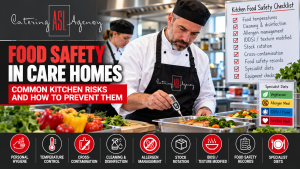
Common Kitchen Risks and How to Prevent Them. Food safety matters in every commercial kitchen, but within a care home it carries particular importance. Residents may include older people and people with complex health or dietary needs. Care-home catering teams therefore need reliable food-safety systems, good communication and consistent kitchen procedures every day. The Food Standards Agency’s food hygiene guidance for businesses identifies key areas including cleaning, cooking, chilling, personal hygiene and preventing cross-contamination. Within a care-home kitchen, these basic principles operate alongside additional responsibilities such as managing food allergies, specialist diets, texture-modified meals, resident preferences and the safe delivery of meals around the home. Good food safety is therefore about much more than keeping a kitchen visibly clean. It means creating a system in which safe practices are understood and followed on every shift.
Why Food Safety Is Particularly Important in Care Homes
A busy care-home kitchen may prepare breakfast, lunch, evening meals, desserts, snacks and drinks alongside individual alternatives and specialist meals. At a single service, the kitchen may be producing standard meals, allergen-managed meals, fortified dishes and texture-modified foods for different residents. Every additional requirement makes accurate systems and communication increasingly important. Care-home catering also contributes directly to resident wellbeing. Meals need to be nutritious and enjoyable, but they must also be stored, prepared and served safely. The Food Standards Agency’s food hygiene guidance provides practical information for food businesses on managing these responsibilities.
The Four Fundamental Areas of Food Hygiene
Four particularly important principles underpin safe food preparation.
Cleaning
Hands, equipment, utensils and food-contact surfaces need to be kept appropriately clean to reduce the risk of harmful microorganisms and other contamination spreading around the kitchen.
Cooking
Foods that require cooking need to be cooked sufficiently to make them safe. Kitchen staff should follow the cooking procedures and checks contained within the care home’s food-safety management system.
Chilling
Foods requiring refrigeration need appropriate temperature control throughout storage and handling. Kitchen teams should know what checks are required, how they are recorded and what action should be taken if temperatures fall outside the home’s accepted limits.
Preventing Cross-Contamination
Raw foods, ready-to-eat foods, equipment, surfaces, cloths and hands can all provide routes for contamination. Good kitchen organisation and safe working practices are therefore essential.
12 Common Food-Safety Risks in Care Home Kitchens
Understanding where problems can occur helps kitchen teams prevent them.
1. Poor Hand Hygiene
Hands can transfer contamination between food, equipment and surfaces. Effective handwashing is therefore one of the simplest but most important food-safety controls. Staff should understand when handwashing is required, including after handling raw food, visiting the toilet, handling waste or undertaking another activity that could contaminate their hands. Disposable gloves do not replace good hand hygiene. Used incorrectly, gloves can simply transfer contamination from one surface or food to another.
2. Cross-Contamination Between Raw and Ready-to-Eat Foods
Cross-contamination can occur through chopping boards, knives, work surfaces, cloths, containers, equipment and hands. Raw and ready-to-eat foods therefore need to be managed in accordance with the home’s food-safety procedures. The FSA includes avoiding cross-contamination as one of its central food-hygiene principles. Further information is available from the Food Standards Agency’s official food hygiene resource.
3. Incorrect Chilled Storage
Refrigeration is an important control because low temperatures slow the growth of many harmful bacteria. But temperature monitoring is only useful when action follows an unacceptable reading. Care-home kitchens should have clear procedures covering temperature checks, recording, reporting faulty equipment and protecting food when refrigeration equipment is not operating correctly. Repeatedly recording an abnormal temperature without investigating or taking appropriate action defeats the purpose of monitoring.
4. Inadequate Cooking
Food that requires cooking must be cooked safely. Care-home chefs should follow the cooking methods and monitoring procedures established within the home’s food-safety management system. Where temperature probes are used, staff should also know how to use and clean them correctly so the probe itself does not become a route for cross-contamination.
5. Unsafe Reheating
Reheating needs the same disciplined approach as initial cooking. Food should be reheated according to the home’s documented safe methods, and kitchen staff should understand which foods can be reheated and how they should be handled. The important principle is consistency: staff should not improvise different food-safety procedures from one shift to another.
6. Poor Cleaning and Disinfection
A surface can look clean without necessarily being hygienically safe. An effective cleaning system should cover relevant areas and equipment throughout the kitchen, including food-contact surfaces, chopping boards, refrigerators, handles, sinks, equipment, floors and storage areas. Staff also need to understand which cleaning products are used, where they should be used and the correct method of application. The official Safer Food, Better Business guidance includes cleaning as one of the principal areas of its food-safety management system.
7. Poor Date Control and Stock Rotation
Busy kitchens can accumulate significant quantities of food. Without effective organisation, older products can disappear behind newer deliveries. Good stock management should therefore include checking deliveries, following date information, correct storage, appropriate labelling and effective stock rotation. FIFO — First In, First Out — can be a useful stock-management principle, but it does not replace checking use-by dates and individual storage instructions. Effective stock management can also help reduce unnecessary food waste.
8. Out-of-Date Allergen Information
Allergen management requires particular attention because ingredients can change. Suppliers change. Brands change. Recipes change. Products may be substituted. The kitchen should therefore never assume that allergen information remains unchanged indefinitely. Where residents have identified food allergies, catering staff need access to accurate information about both the resident’s requirements and the ingredients being used. Communication between care staff and catering staff is particularly important when a resident’s dietary requirements change.
9. Confusing Specialist Meals
A single lunch service might involve standard meals, vegetarian meals, fortified meals, allergen-managed dishes, texture-modified meals and individual alternatives. The kitchen’s responsibility does not end when the correct meal has been prepared. The correct meal must reach the correct resident. Clear identification, communication and service procedures are therefore important throughout the complete journey from preparation to the resident.
10. Staff Working While Unwell
Food handlers can present a food-safety risk if they work while suffering from certain illnesses. Kitchen employees should understand the organisation’s sickness-reporting procedures and know when symptoms must be reported. This also needs to be communicated to temporary and relief chefs. A chef entering an unfamiliar care home should know who to contact if an illness or other issue may affect their fitness to handle food safely.
11. Incomplete Food-Safety Records
Paperwork alone does not make food safe. However, appropriate records can help demonstrate that important controls are being monitored and that problems are acted upon. Depending on the home’s food-safety management system, records may cover areas including refrigeration, cooking, cleaning, deliveries and corrective actions. The official Safer Food, Better Business guidance advises businesses using the system to retain completed diary pages because local-authority food-safety officers may wish to examine them. Records should reflect what actually happened in the kitchen. Completing checks retrospectively simply to make paperwork appear complete undermines the purpose of the system.
12. Poor Handover to Relief or Temporary Chefs
An experienced relief chef can walk into a kitchen with excellent professional knowledge, but they cannot automatically know how that particular care home operates. They may need information about resident allergies, specialist diets, IDDSI requirements, food-safety records, equipment, menus, cleaning procedures and changes affecting the current shift. A proper kitchen handover therefore matters. For care homes requiring experienced temporary support, ASL Catering Agency’s Care Home Chef Recruitment service provides specialist chef recruitment for care homes, residential homes and nursing homes. Experienced care-home chefs interested in working with ASL can also visit Join Our Chef Network.
Safer Food, Better Business for Residential Care Homes
An important current resource for the sector is the Food Standards Agency’s Safer Food, Better Business supplement for residential care homes. Published on 25 June 2026, it is a food-safety management resource for small residential care homes that prepare and cook food for residents. Care-home managers and catering teams can access it free through the official government website: Safer Food, Better Business Supplement for Residential Care Homes – GOV.UK This is a particularly useful external resource to retain alongside the home’s own food-safety arrangements.
Food Safety Starts When a Delivery Arrives
Safe catering begins before ingredients reach the kitchen shelves. When deliveries arrive, relevant checks may include the condition of packaging, date information, chilled or frozen condition where appropriate and whether the correct products have been supplied. Substituted products deserve particular attention. A supplier substitution may not simply affect the recipe or cost. Different ingredients may contain different allergens, so the replacement product needs to be checked before it is used.
Safe Storage Requires Organisation
Good storage supports several food-safety controls simultaneously. Food should be stored according to its requirements, protected from contamination, appropriately labelled and easy for kitchen staff to identify. Raw and ready-to-eat foods should be separated as required by the home’s food-safety system. An overcrowded and disorganised refrigerator also makes effective cleaning, stock rotation and identification of food considerably harder. Kitchen organisation is therefore part of food safety, not merely tidiness.
Cleaning Schedules Must Work in Practice
A professionally presented cleaning schedule achieves very little if nobody follows it. Responsibilities need to be clear. Kitchen staff should understand what needs cleaning, how often it needs cleaning, which method and products should be used and how required checks are recorded. Cleaning systems should also evolve with the kitchen. If equipment is replaced or new equipment is introduced, managers should consider whether cleaning arrangements need updating.
Pest Awareness
Food premises can attract pests when food, waste and access points are not effectively controlled. Kitchen staff should remain alert for potential signs of pest activity, including damaged packaging, droppings, insect activity or unusual evidence around storage and waste areas. Suspected pest activity should be reported through the home’s established procedure rather than ignored.
Training Must Match the Job
Food handlers need appropriate supervision, instruction and/or training for the work they carry out. A particular training certificate should not be confused with the underlying legal requirement for food handlers to have appropriate food-hygiene knowledge for their responsibilities. Training can nevertheless provide a structured way for chefs and catering staff to develop and refresh that knowledge. For teams wishing to develop their care and catering knowledge, FlexiLearnHub provides online training covering areas including Food Safety & Hygiene, HACCP, Allergen Awareness, Nutrition & Hydration and Dysphagia & IDDSI Awareness.
Care Home Kitchen Food-Safety Checklist
Personal Hygiene
☐ Staff understand handwashing requirements ☐ Appropriate protective clothing is used ☐ Sickness-reporting procedures are understood ☐ Temporary and relief staff receive appropriate information
Storage
☐ Required refrigeration checks are completed ☐ Frozen storage is appropriately managed ☐ Food is protected from contamination ☐ Date controls are followed ☐ Stock is rotated effectively ☐ Raw and ready-to-eat foods are appropriately separated
Preparation
☐ Cross-contamination controls are followed ☐ Equipment and surfaces are appropriately cleaned ☐ Allergen information is current ☐ Specialist meals are clearly identified
Cooking and Service
☐ Cooking procedures are followed ☐ Reheating procedures are followed ☐ Hot and cold holding controls are understood ☐ Specialist meals reach the correct resident ☐ Food is protected during transfer and service
Cleaning
☐ The cleaning schedule is current ☐ Appropriate cleaning products are available ☐ Staff understand the required cleaning methods ☐ Food-contact equipment receives appropriate attention
Management
☐ Food-safety records are completed accurately ☐ Corrective actions are recorded where required ☐ Equipment faults are reported ☐ Pest concerns are reported ☐ Relief chefs receive an appropriate kitchen handover
Why Experienced Care Home Chefs Matter
Care-home catering requires considerably more than culinary ability. A chef may simultaneously be responsible for food hygiene, allergens, specialist diets, IDDSI requirements, resident preferences, stock control, cleaning, documentation, temperature controls and meal service. Experienced care-home chefs understand that producing attractive food is only one part of the job. Meals also need to be safe, appropriate and suitable for the resident receiving them. ASL Catering Agency Ltd specialises in supplying experienced chefs to care homes, residential homes and nursing homes. Care providers looking for specialist recruitment support can find further information through our Care Home, Residential & Nursing Home Chef Recruitment service. Our growing Care Home Catering Blog also contains practical guidance covering catering, recruitment, training and professional standards within care environments.
Frequently Asked Questions
What are the main food-safety risks in a care-home kitchen?
Common risks include cross-contamination, inadequate cooking or chilling, poor cleaning, incorrect storage, ineffective allergen controls, poor personal hygiene and failures in communication surrounding specialist meals. The Food Standards Agency’s Food Hygiene for Businesses guidance provides further official information on cleaning, cooking, chilling, personal hygiene and cross-contamination.
What is Safer Food, Better Business?
Safer Food, Better Business — often abbreviated to SFBB — is a Food Standards Agency food-safety management system designed to help relevant food businesses manage food safely and demonstrate their procedures. There is now a specific SFBB supplement for residential care homes.
Are food-safety records important?
Yes. Appropriate records can help demonstrate that food-safety controls are being monitored and that action is taken when problems occur. Businesses using SFBB are advised to retain completed diary pages because local-authority food-safety officers may wish to review them. Further information is available in the official SFBB guidance.
Should a relief chef use their own food-safety procedures?
A relief chef should work within the food business’s established food-safety management system and procedures. An experienced chef should raise concerns if something appears unsafe, but temporary responsibility for the kitchen does not mean replacing the home’s established system with a chef’s preferred paperwork or methods.
Why is a kitchen handover important for a relief chef?
Every care home operates slightly differently. A handover can provide important information about resident diets, allergens, texture-modified meals, menus, food-safety records, equipment, cleaning arrangements and changes affecting the shift. This allows an experienced relief chef to understand the kitchen much more quickly while maintaining continuity.
Official Food-Safety Resources
Care-home managers and catering professionals may also find the following official resources useful: Food Standards Agency – Food Hygiene for Businesses GOV.UK – Safer Food, Better Business for Residential Care Homes GOV.UK – Safer Food, Better Business Full Guidance External authority resources should be set to open in a new tab when adding the article to WordPress.
Food Safety Depends on Consistency
A care-home kitchen can have excellent policies, modern equipment and comprehensive paperwork. None of those replaces consistent everyday practice. Food safety depends on chefs and catering staff applying appropriate controls during every delivery, preparation task and meal service. That means washing hands when required. Separating foods appropriately. Monitoring temperatures. Managing allergens carefully. Cleaning effectively. Completing records accurately. Reporting problems. And making sure everyone working in the kitchen — including temporary and relief chefs — understands how the kitchen operates. When those practices become part of the everyday culture of a care-home kitchen, food safety stops being something staff think about only when an inspection is approaching. It becomes simply how the kitchen works. For specialist care-home chef recruitment and catering support, visit ASL Catering Agency Ltd or learn more about our Care Home Chef Recruitment service.
Visit FlexiLearnHub’s CPD & CQC Aligned certificated OnLine training courses
Our growing course library includes:
- Food Safety & Hygiene
- HACCP Level 2
- Allergen Awareness
- Nutrition & Hydration
- Dysphagia & IDDSI Awareness
- Advanced IDDSI Level 4 Professional Purée Presentation
- Infection Prevention & Control
- Dementia Awareness
- Mental Capacity Act & DoLS Awareness (CQC-Aligned)
- End of Life Care Awareness (CQC-Aligned)
- Modern Slavery Awareness (CQC-Aligned)
- Health & Safety Awareness in Care Settings (CQC-Aligned)
- Moving and Handling of People in Care
Thank you for visiting ASL Catering Agency


