


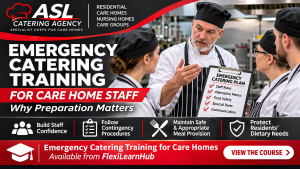
Emergency Catering Training is an important part of helping residential care homes and nursing homes prepare for unexpected kitchen disruptions, staffing shortages and interruptions to essential meal services.
Every care home has a responsibility to provide residents with safe, nutritious and appropriate meals, including those with specialist dietary requirements, food allergies and swallowing difficulties.
But what happens when the usual chef is unavailable, essential kitchen equipment breaks down or a power failure interrupts normal food preparation?
Having an emergency catering plan is important. However, staff must also understand how to respond when that plan needs to be put into practice.
At ASL Catering Agency Ltd, our specialist work in care-home chef recruitment gives us an understanding of the challenges that unexpected catering disruptions can create.
Through our associated online training provider, FlexiLearnHub, we are also developing a dedicated Emergency Catering Training for Care Homes course to support greater awareness of catering preparedness and food continuity.
Explore the Emergency Catering Training course:
https://flexilearnhub.com/courses/emergency-catering-training-care-homes/
In this article, we explain why staff preparation matters, which employees should understand emergency procedures and how training and specialist chef recruitment can work together to support care-home catering services.
Why Emergency Catering Training Matters in Care Homes
Care-home catering is an essential daily service.
Unlike restaurants or hotels, residential and nursing homes must maintain appropriate food and drink provision for residents even when normal kitchen operations are disrupted.
Potential emergencies include:
- Unexpected chef absence or staff shortages
- Electrical power failures
- Refrigeration or freezer breakdowns
- Cooking equipment failures
- Water supply interruptions
- Delayed or cancelled food deliveries
- Severe weather
- Temporary kitchen closures
- Food contamination incidents
- Other unexpected operational disruptions
Each situation may require different actions.
Staff must understand when to report concerns, who is responsible for coordinating the response and how residents’ individual needs will continue to be met.
Emergency catering training can support staff awareness of these responsibilities and help organisations identify weaknesses in their existing arrangements.
A Written Emergency Catering Plan Is Only the Beginning
Most care homes have business continuity procedures covering various operational risks.
However, a written plan is of limited practical value if employees do not know where it is kept or what actions they are expected to take.
Imagine a care-home kitchen losing electricity shortly before lunchtime.
The manager may know that an emergency plan exists, but several questions immediately arise.
- Who assesses the food-safety risks?
- Can the planned meals still be prepared?
- What happens to chilled and frozen food?
- Are alternative meals available?
- Who checks residents’ specialist dietary requirements?
- Who communicates changes to care staff?
- When should external catering assistance be requested?
These are the types of operational questions that care homes should consider before an incident occurs.
Training, staff briefings and practical exercises can help employees understand the procedures relevant to their responsibilities.
Which Staff Need Emergency Catering Training?
Emergency catering preparedness should involve more than the head chef.
Different members of the care-home team may have responsibilities during a catering disruption.
Care Home Managers and Registered Managers
Managers may need to coordinate the response, assess risks, authorise alternative arrangements and ensure that appropriate communication takes place.
They should understand how catering emergencies fit within the organisation’s wider business continuity arrangements.
Head Chefs and Catering Managers
Chefs and catering managers may be responsible for assessing kitchen operations, available ingredients, equipment failures and alternative meal arrangements.
They must also consider food safety, resident dietary requirements and the practical limitations of available staff.
Kitchen Assistants and Catering Support Staff
Kitchen assistants should understand how to report incidents, locate relevant procedures and carry out the duties for which they are trained and competent.
They should also know when to stop an activity and seek management guidance.
Care Assistants and Senior Care Staff
Care staff may need to communicate residents’ individual dietary requirements and support changes to established meal routines.
They should understand how to report concerns about food provision, hydration or residents’ wellbeing.
Effective emergency catering arrangements depend on communication between management, catering and care teams.
Protecting Residents With Specialist Dietary Requirements
One of the greatest challenges during a catering emergency is ensuring that alternative meal arrangements remain suitable for every resident.
Food Allergies and Intolerances
Emergency menu changes must not introduce avoidable allergen risks.
Staff should follow documented dietary information and check replacement ingredients carefully.
The Food Standards Agency provides guidance on allergen management:
https://www.food.gov.uk/business-guidance/allergen-guidance-for-food-businesses
Dysphagia and IDDSI Requirements
Some residents require texture-modified meals or thickened drinks following professional assessment.
These requirements must continue to be followed during emergencies.
Staff should not independently change professionally recommended food textures or drink thicknesses.
Where appropriate provision cannot be maintained, the issue should be escalated promptly through the home’s management and clinical arrangements.
The International Dysphagia Diet Standardisation Initiative provides information about the IDDSI Framework:
Nutrition and Hydration
Care homes must also consider residents requiring fortified meals, nutritional supplements or other individual dietary arrangements.
Emergency food supplies and alternative menus should be planned with these needs in mind.
Emergency Catering Training and Food Safety
Food-safety responsibilities do not disappear during an emergency.
Unexpected staffing shortages or equipment failures can create additional risks that require careful management.
Staff should understand the importance of:
- Safe food storage
- Appropriate temperature monitoring
- Preventing cross-contamination
- Safe cooking and reheating
- Personal hygiene
- Cleaning and disinfection
- Allergen management
- Maintaining food-safety records
- Reporting unsafe conditions
For example, a refrigeration failure may require staff to assess whether affected food can still be used safely.
Food must not be assumed safe simply because it appears normal.
Decisions should follow appropriate food-safety procedures and relevant guidance.
Further information is available from the Food Standards Agency:
Practical Emergency Catering Scenarios for Staff
One useful approach to emergency preparedness is discussing realistic situations with employees.
Scenario 1 – The Head Chef Calls in Sick
Your head chef telephones early in the morning and cannot attend work.
No other qualified chef is available.
What should happen next?
Managers should consider whether existing staff can safely maintain meal provision, what alternative arrangements are available and whether specialist relief chef support is required.
Scenario 2 – A Power Failure Before Lunch
The kitchen loses electricity shortly before the main meal service.
Staff need to assess the immediate impact on equipment, food storage and meal preparation.
Alternative arrangements must account for residents’ individual dietary needs.
Scenario 3 – An Essential Food Delivery Does Not Arrive
A supplier fails to deliver ingredients required for the day’s planned meals.
The catering team must establish which suitable alternatives are available and ensure that any substitutions remain safe and appropriate.
Scenario 4 – A Refrigeration Breakdown
A refrigerator fails overnight, potentially affecting stored ingredients.
Staff must follow food-safety procedures, assess the affected stock and determine how safe meal provision will continue.
Discussing scenarios like these can help care homes identify weaknesses before a genuine emergency occurs.
Coming Soon – Emergency Catering Training for Care Homes from FlexiLearnHub
To support greater awareness of emergency catering preparedness, FlexiLearnHub is developing a dedicated online Emergency Catering Training course for care-home environments.
The course is intended to complement workplace contingency arrangements and encourage consideration of how catering services can be maintained during unexpected disruptions.
The final syllabus, learning outcomes, duration and any accreditation details will be confirmed when course development is complete.
Discover the Emergency Catering Training Course
Emergency Catering Training for Care Homes – FlexiLearnHub
https://flexilearnhub.com/courses/emergency-catering-training-care-homes/
This dedicated course page provides a central location for information about the forthcoming training.
Care-home managers, catering managers and relevant employees can use the link to find the course as further details become available.
FlexiLearnHub also provides existing online courses across food safety, care, catering and professional development.
Explore all FlexiLearnHub courses:
https://flexilearnhub.com/our-courses/
Why This Training Topic Is Important
Emergency catering preparedness is not simply about knowing how to produce a different menu.
It involves understanding responsibilities, recognising potential risks, protecting residents and knowing when alternative arrangements are required.
A well-prepared team may be better placed to identify concerns early, communicate effectively and follow the organisation’s established procedures.
However, training must be supported by appropriate workplace policies, competent staffing, equipment, resources and management oversight.
How ASL Catering Agency Supports Care Homes During Staffing Emergencies
Training and contingency planning are important, but there may still be occasions when a care home urgently requires an experienced chef.
At ASL Catering Agency Ltd, we specialise in recruiting chefs for residential care homes and nursing homes.
We understand that care-home catering requires more than general hospitality experience.
Chefs may need to work with specialist dietary requirements, food allergens, nutritional care plans and established meal-service procedures.
Our recruitment approach prioritises substantial previous care-home catering experience and professional suitability.
Depending on candidate availability, ASL can discuss requirements for:
- Emergency chef cover
- Temporary care-home chefs
- Relief chef assignments
- Sickness cover
- Annual leave cover
- Longer-term temporary staffing support
ASL recruits chefs through PAYE arrangements rather than supplying freelance or self-employed chefs.
Learn more about our specialist care-home chef recruitment services:
https://www.aslcateringagency.co.uk/care-home-residential-nursing-home-chef-recruitment-agency-uk/
Why Recruitment and Training Work Together
Emergency catering training can help existing employees understand their responsibilities during disruptions.
Specialist relief chef recruitment can provide additional catering expertise when appropriately experienced staff are unavailable.
These services address different operational needs.
For care providers, having suitable contingency arrangements and knowing where to seek experienced chef support can form part of a wider approach to maintaining catering continuity.
Emergency Catering Preparedness and Regulatory Responsibilities
Care providers must maintain appropriate arrangements to meet residents’ needs and manage risks.
In England, the Care Quality Commission (CQC) regulates relevant health and adult social care services.
Its fundamental standards include requirements relating to safe care and treatment and meeting nutritional and hydration needs.
In Wales, Care Inspectorate Wales (CIW) regulates relevant care services under the applicable Welsh framework.
https://www.careinspectorate.wales/
Care-home kitchens must also comply with applicable food-safety legislation.
Appropriate training, staff competence, contingency planning and management oversight can contribute to meeting these responsibilities.
However, completion of an online training course does not, by itself, demonstrate regulatory compliance.
Five Questions Every Care Home Manager Should Ask
Before the next catering emergency, consider the following questions.
1. Do our employees understand the emergency catering procedures?
Relevant staff should know where to find the procedures and what responsibilities apply to their roles.
2. Could we maintain safe meal services if our usual chef was unavailable?
Managers should understand the competence of available employees and know how to arrange additional support.
3. Could we maintain specialist diets during a disruption?
Alternative arrangements should account for food allergies, dysphagia, IDDSI requirements and other documented dietary needs.
4. Do staff know what to do if essential kitchen equipment fails?
Reporting, escalation and alternative arrangements should be clear.
5. Have we reviewed our emergency catering preparedness recently?
Staff discussions and practical exercises can help identify areas for improvement.
If these questions reveal uncertainty, it may be time to review the home’s catering contingency arrangements and relevant staff training.
Read Our Related Guide – Emergency Catering in Care Homes
We have also published a separate ASL Catering Agency article covering the practical challenges of maintaining care-home catering during emergencies.
Emergency Catering in Care Homes – Relief Chefs and Contingency Planning
https://www.aslcateringagency.co.uk/emergency-catering-care-homes-relief-chefs/
That article focuses on operational disruption and relief chef support.
This article focuses on Emergency Catering Training, staff preparedness and the importance of understanding workplace procedures.
Together, they provide complementary guidance for care-home managers and catering teams.
Prepare Your Team – Explore FlexiLearnHub Emergency Catering Training
If your organisation is reviewing its emergency catering arrangements, the forthcoming FlexiLearnHub course may be a useful training resource to consider once available.
Emergency Catering Training for Care Homes
https://flexilearnhub.com/courses/emergency-catering-training-care-homes/
Visit the course page for further information as development progresses.
Need an Experienced Care Home Chef?
If your care home is experiencing an unexpected staffing shortage or planning temporary chef cover, ASL Catering Agency would welcome your enquiry.
Contact Karen Richards
General Enquiries & Client Support
ASL Catering Agency Ltd
Email: karen@aslcateringagency.co.uk
Please include your care home’s location, required dates, shift times and any specialist catering requirements.
We will review your enquiry and discuss whether suitable chef support may be available.
ASL Catering Agency Ltd – Specialist Chefs for Care Homes.
All chef assignments are subject to candidate availability, suitability, recruitment checks and agreed commercial terms. Emergency cover cannot be guaranteed.
FlexiLearnHub’s Emergency Catering Training course is described as forthcoming. Final course details and availability should be confirmed on the course page.